The ESP32 Beat Skips the LLM Today: A Desk Companion, Drumsticks, and a JavaScript OS
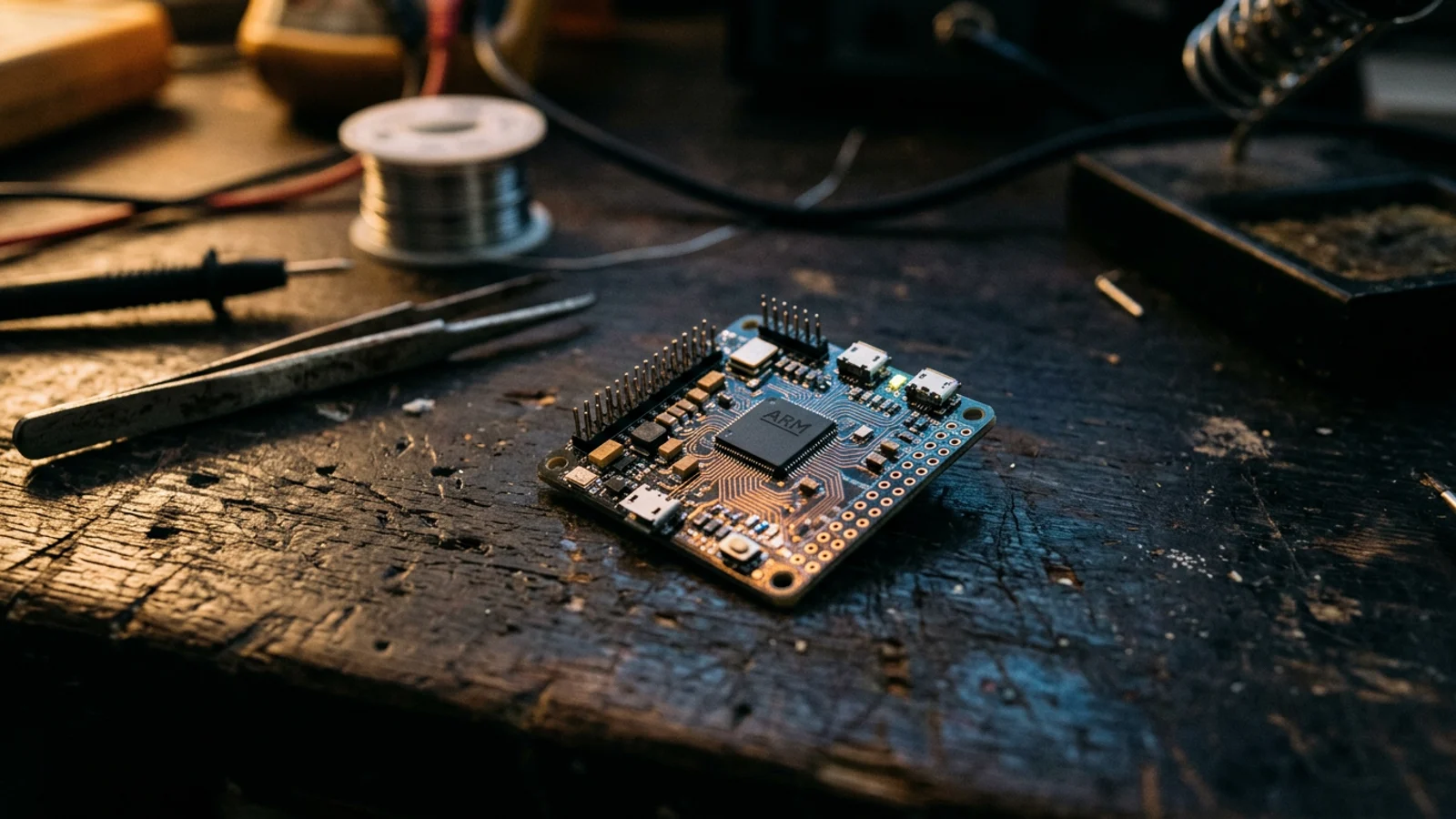
Three ESP32 builds this week show the chip's range — a reactive desk companion, motion-sensing drumsticks, and a scripting OS — none of them running a language model.
Nuvi: A Desk Companion That Reacts, Not Reasons
Arduino's blog published a write-up on September 22, 2026, about Nuvi, a tiny desk companion built by Luca Di Lorenzo (@LucaDilo) in collaboration with Arduino. It started, in Arduino's own words, as "what was meant to be a simple robot assistant" and grew into something more expressive, running its behavior entirely on an ESP32-class Arduino board with no network connection required.
The honest caveat: Arduino's post does not describe a trained language or vision model running on the chip. Nuvi's charm comes from tuned reactive logic and servo-driven expressions responding to its surroundings — not generative AI. That distinction is worth stating plainly on a beat full of "AI companion" branding: plenty of genuinely on-device projects are lightweight behavior code, not inference.
Why it still belongs here: it is a clean example of ESP32-class hardware doing all of its own decision-making locally, with zero cloud round-trip, which is the baseline this beat cares about even before a model enters the picture.
Space Drums 2.0 Puts Motion Tracking in Your Wrists
Adafruit's blog highlighted Space Drums 2.0 on September 22, 2026, a build from Instructables user Makestreme. Version 2.0 rebuilds the original drumsticks around an ESP32-S3, adding self-contained motion tracking and haptic feedback so a strike gesture is sensed and confirmed with a buzz — no external camera rig, no drum pads, no kit.
This is gesture-sensing logic on a microcontroller, not a deep model doing pose estimation; call it TinyML-adjacent rather than TinyML proper, since the write-up describes onboard motion tracking rather than a trained classifier. It matters for the beat anyway because it is exactly the kind of self-contained sensor loop — IMU plus haptic driver plus BLE, running entirely on the ESP32-S3 — that keeps showing up as the default architecture for wearable maker builds.
KryonOS Turns the ESP32 Into a Scriptable Computer
Hackaday published a piece on September 23, 2026, on KryonOS, a JavaScript-based operating system layer for the ESP32. Hackaday frames it as the latest entry in a long-running line of attempts — following projects like Kaluma and Moddable — to let a $2-class microcontroller run scripted logic instead of compiled C firmware for every change.
The caveat is the usual one for this genre: it is an early-stage hobby OS, not production firmware, and Hackaday's own framing treats it as a demonstration of what's possible rather than a finished toolchain. Still, this is squarely a developer-tooling story for the beat: it lowers the barrier for iterating on ESP32 logic without a full recompile cycle, which is the kind of workflow change that quietly speeds up every other ESP32 build on this list.
No language model in this dispatch — just three reminders that the ESP32's real strength is doing small, complete jobs entirely on the chip, from a desk companion's reactions to a drumstick's haptic buzz to the firmware layer underneath both.
References & Citations
- Arduino blog — Meet Nuvi, September 22, 2026 — https://blog.arduino.cc/2026/09/22/meet-nuvi-the-ai-desk-companion-that-goes-from-q-to-cute/
- Adafruit blog — Space Drums 2.0, September 22, 2026 — https://blog.adafruit.com/2026/09/22/play-drums-without-a-kit-with-space-drums-2-0/
- Hackaday — A JavaScript OS for the ESP32, September 23, 2026 — https://hackaday.com/2026/09/23/a-javascript-os-for-the-esp32/
Subscribe to new posts from theaivibe.org
Related Posts
Tiny Audio AI Models Learn to Whisper Without Ever Calling Home
Two new speech stacks and a tool-calling model push voice AI fully on-device, while Nordic and Zephyr quietly harden the hardware underneath.
llama.cpp's Nightly Grind Teaches Phone Chips New AI Tricks While NVIDIA Ships a Rival Edge Runtime
Small llama.cpp builds keep adding Hexagon DSP ops, NVIDIA's TensorRT-Edge-LLM adds Day-0 model support, and a new leaderboard measures tokens per joule.
A 27B AI Model Shrinks to 5.9GB as Ternary Quantization Keeps Pushing the Floor Down
PrismML compresses a 27B model to 5.9GB, Intel's BITCOS beats the 1.585-bit ternary limit, and a 44M-parameter model claims exact arithmetic on a laptop CPU.