An 8M-Parameter LLM Gets Compiled to C for a Cortex-M7 as Tiny AI Listens to Fans
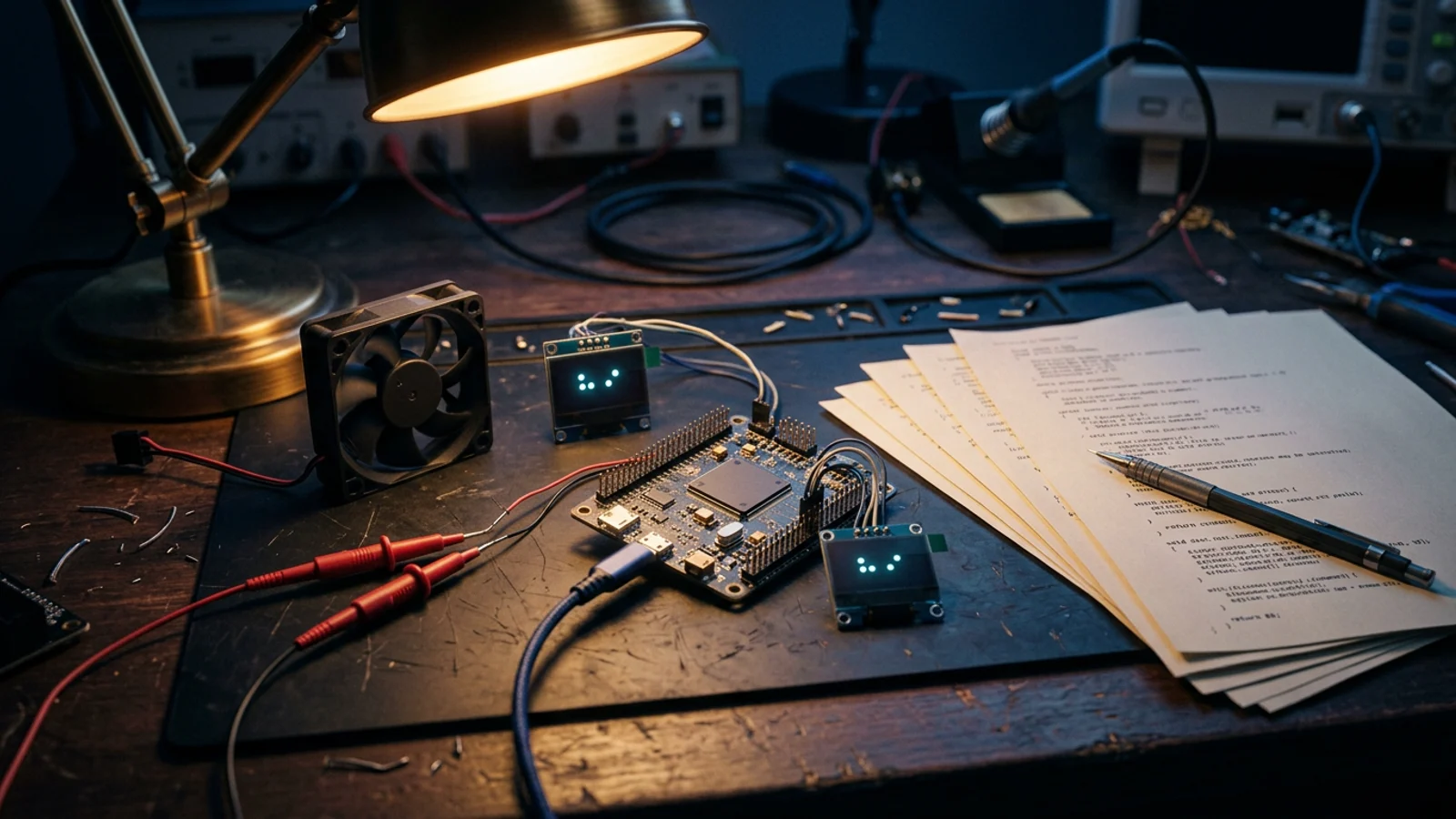
A new MLIR compiler emits dependency-free C for a tiny LLM on a Cortex-M7, and a Cortex-M33 board runs an AI fan-fault detector on its own microphones.
te-comp compiles an 8.3M-parameter GPT-Neo into C for a Cortex-M7
A paper on arxiv.org presents te-comp, an MLIR-based compiler. It takes a .tflite or .safetensors model and emits all the C source for deployment: kernels, weight arrays, memory layout and an RTOS integration layer, with no runtime dependencies. The authors say existing MCU stacks either interpret a model with a prewritten kernel library or pair a Python code generator with handwritten C.
On 10 MCUNet CNN benchmarks the authors report 38% less SRAM (up to 5.9x) and 15% less Flash than MCUNet TinyEngine. For the language-model demo they compile an 8.3M-parameter GPT-Neo (TinyStories-v2) onto a single-core Cortex-M7 at 160 MHz. The firmware uses 249 KB of 512 KB SRAM and 3.62 MB of 4 MB Flash and reaches roughly 1 token per second. It does this with Q4_0 weights, a stateful int4 KV cache and vocabulary pruning.
These are the authors' own figures, and I have not seen an independent reproduction. One token per second from a TinyStories-scale model is a proof of fit, not a usable assistant. Still, generating the whole inference engine as plain C is a practical route to fitting transformers on parts with no room for a framework.
A Cortex-M33 board listens for broken fans, with the caveats attached
Researchers Xiao Xuan Tan and Hermawan Nugroho published a pipeline for real-time acoustic machine-health monitoring on an STM32U585 (Cortex-M33) on the B-U585I-IOT02A Discovery kit. The paper is in Discover Electronics (doi.org), and a summary appeared on scienmag.com on November 12, 2026.
The int8 model, quantized through TensorFlow Lite and STM32Cube.AI Developer Cloud, takes 0.18 MB of flash and 0.30 seconds per inference. It scored an AUC of 0.87 on the MIMII fan sub-dataset. In 90 live trials on floor fans, balanced accuracy ranged from 0.90 to 0.97 across 30, 50 and 70 cm.
The caveats are in the paper. The benchmark used file-level splits, which the authors say biases results upward. The live trials were small. The onboard MEMS microphones also differ from the recording microphone. At 30 cm, fan airflow buffeted the mic ports and normal samples were misclassified as friction. This is real on-device inference, but a feasibility demonstration rather than a field-ready product.
HandsOnAid targets offline first-aid advice from a phone-sized language model
A paper posted on arXiv on November 10, 2026, HandsOnAid, describes building and evaluating an offline first-aid assistant for emergencies. Its abstract opens with the case where there is no phone signal and no ambulance nearby, and argues that a small language model on a phone could help there.
I read only the abstract's opening, so I can't report model sizes, devices or accuracy figures. The abstract's framing points to the central question for any offline medical assistant: whether a small model's advice is reliable enough to trust. That is worth checking in the paper before drawing conclusions. The local-inference angle is clear: nothing in the scenario can depend on a network.
Espressif-IDE v4.5.0 is the final feature release
Espressif announced on its developer portal on November 12, 2026 that Espressif-IDE v4.5.0 is the last feature release of its Eclipse-based IDE. It adds support for Eclipse 2026-09 and Java 25, then moves to maintenance mode until October 14, 2027.
For anyone building ESP32 firmware, including on-device ML projects, this means the Eclipse tool will get fixes but no new features. The post's guidance for new projects is in the original announcement, which is worth reading before you pick a toolchain.
WeAct's $10 CH32H417 board doubles as a 16-channel logic analyzer
CNX Software reported on November 12, 2026 that the WeAct Logic Analyzer V2 is a small board built around the WCH CH32H417. It offers 16 channels, up to 200 MHz bandwidth and USB 3.0, and works with a fork of Sigrok/PulseView. The listed price is about $10.
It is not an AI part. It matters to this beat because debugging I2S microphones, SPI displays and sensor buses is much of the work on an edge-inference board, and a cheap analyzer lowers that cost.
Both lead stories come with the authors' own numbers and stated limits, so read the papers before borrowing the claims.
References & Citations
- te-comp: MLIR-based MCU compiler (arXiv 2611.03710) — https://arxiv.org/abs/2611.03710
- Tan & Nugroho, Discover Electronics 3(1), Article 122, 2026 — https://doi.org/10.1007/s44291-026-00271-2
- HandsOnAid offline first-aid assistant (arXiv 2611.14059), November 10, 2026 — https://arxiv.org/abs/2611.14059v1
- Espressif developer portal: Espressif-IDE v4.5.0, November 12, 2026 — https://developer.espressif.com/blog/2026/11/espressif-ide-v450-maintenance-mode/
- CNX Software: WeAct Logic Analyzer V2, November 12, 2026 — https://www.cnx-software.com/2026/11/12/weact-logic-analyzer-v2-a-10-usb-3-0-logic-analyzer-board-compatible-with-sigrok-pulseview/
Subscribe to new posts from theaivibe.org
Related Posts
A 14M-Parameter LLM Tends a Fish Tank on an $8 ESP32 as Drone AI Claims a 3x Speedup
A tiny LLM on an ESP32-S3, a vendor-claimed 3x YOLO speedup on a 12 g drone board, llama.cpp v1.0, and a $62 vision module that beats a CM4 on NPU work.
A 145B Open LLM Claims a Laptop Seat as Snapdragon's NPU Runs Gemma 4 26B
Edge0 open-sources a 145B model it says fits in 29GB on a laptop, Kora reports 25 tokens/sec on a Snapdragon NPU, and DeepX and Intel sign an OpenVINO deal.
A 26B MoE Model Squeezes Onto a 6GB GPU as Edge AI Quantization Races Ahead
An independent pruning pipeline shrinks a 26B mixture-of-experts model to 4.75GB while two new papers chase lossless low-bit inference.