Split-Brain Robots: Jetson Handles the Vision, a $49 MCU Kit Handles the Milliseconds — Edge AI Keeps Dividing the Job
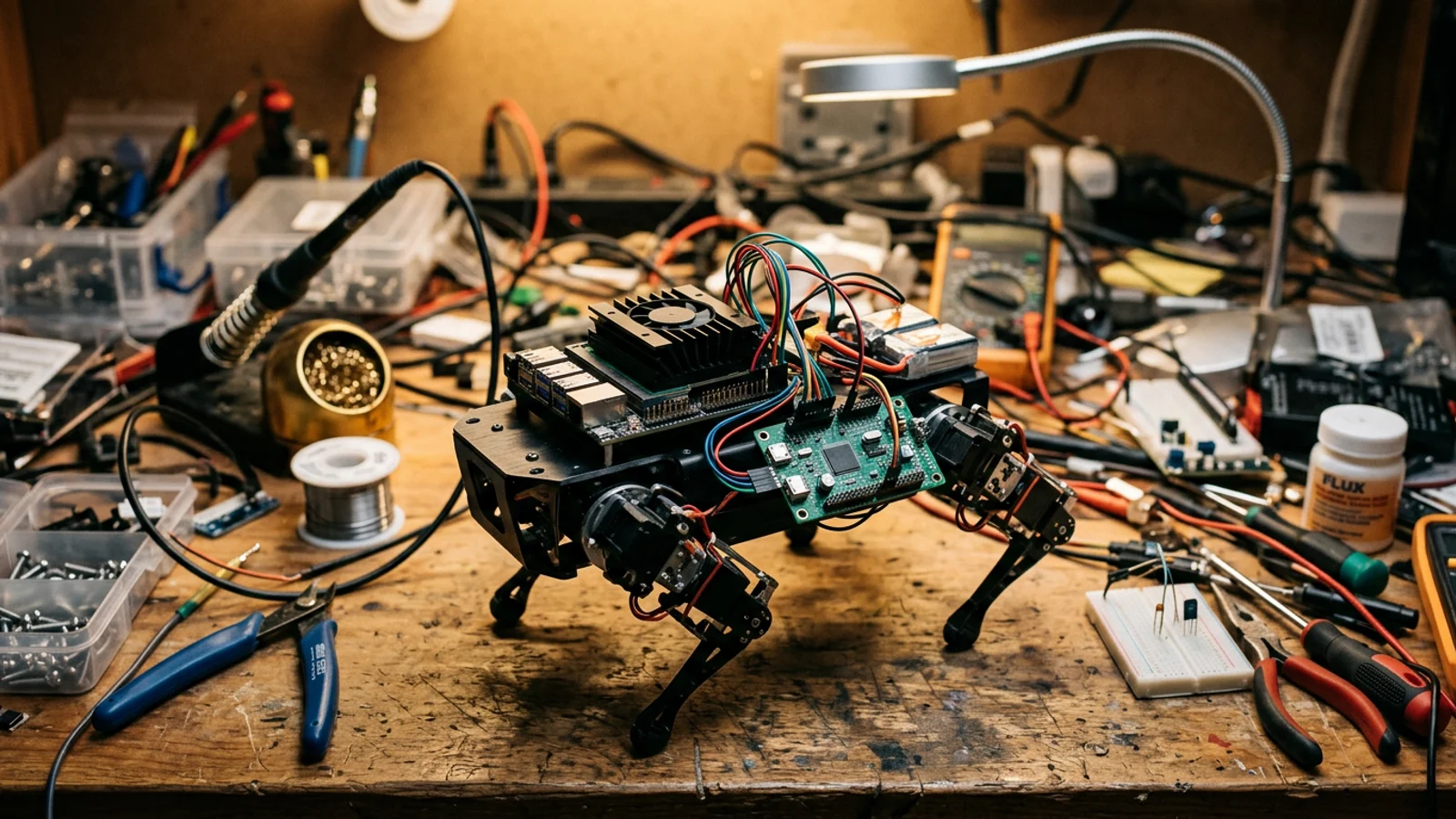
A student-built quadruped, a walking-robot policy on a Rockchip SBC, a tiny STM32N6 vision camera, and a $49 TinyML kit all landed this week.
A Student's Quadruped Splits Vision From Real-Time Control
Ashish Agrahari, a mechatronics engineering student at the University of Waterloo, spent eight months building Orion, a 12-DOF quadruped that runs ROS 2 Humble on an NVIDIA Jetson Orin Nano for stereo depth (SGBM, MiDaS), 2D LiDAR SLAM, Nav2 path planning, and reinforcement-learning locomotion policies, as detailed in a CircuitDigest write-up.
The perception stack hands off to custom STM32-based PCBs running FreeRTOS, which handle inverse kinematics, gait generation, and high-frequency servo loops directly — deterministic timing that a GPU-bound Jetson can't reliably guarantee. It's a solo/hobby build, not a benchmarked platform, and the RL locomotion policy's robustness outside the maker's test environment is unverified.
The interesting part isn't the robot dog itself but the architecture: putting AI inference and real-time control on separate chips is becoming the default recipe for on-device robots, echoing what professional humanoid stacks already do.
A Walking-Robot Policy Runs at 50 Hz on a Bare Rockchip SBC
OpenELAB published a write-up on how its Microduck bipedal robot learns to walk: a PPO policy trained in MuJoCo, transferred sim-to-real, and executed onboard a Rockchip RK3566 single-board computer as an ONNX network evaluated once every 20 milliseconds — a fixed 50 Hz control tick, not a display frame rate.
OpenELAB is explicit that this is a control cadence, not a claim that every sensor or motor process shares that rate, and the RK3566 is a modest quad-core Cortex-A55 chip with no dedicated NPU mentioned in the piece — the whole policy inference runs on general-purpose CPU.
That's the point worth noting for the tiny-hardware crowd: a full RL locomotion policy closing its own feedback loop fits inside a low-cost SBC's power and compute envelope, with no cloud round-trip in the loop.
A USB-Stick Camera Packs an NPU Into an STM32N6
CNX Software covered CamThink's NeoEyes NE302 on September 12, 2026: a USB-C powered, WiFi 6-connected vision camera built around an STM32N6 Arm Cortex-M55 microcontroller and its integrated Neural-ART NPU, small enough to sit on a USB stick.
CNX's coverage doesn't include independent latency or accuracy benchmarks for the onboard NPU, and the tiny form factor likely caps how much model can run at once — this is a niche industrial vision node, not a flagship inference board.
Still, it's another data point in the trend of shrinking real NPU-class vision inference into ever-cheaper, ever-smaller housings, alongside the STM32N6 boards that have been showing up across the CNX beat all year.
Alif Cuts TinyML Entry Price to $49
Hackster reported on September 11, 2026 that Alif Semiconductor has launched $49 StartKits for its Ensemble and Balletto microcontroller families — low-power Arm MCUs with integrated neural coprocessors — as ready-to-run development boards aimed at lowering the barrier to TinyML projects.
Performance figures for the neural coprocessors are Alif's own, and the Hackster piece doesn't include independent benchmarking of what those coprocessors can actually run at that price point; treat the specs as vendor claims until makers publish real workloads.
Cheaper hardware is still cheaper hardware: a sub-$50 dev kit with an onboard neural coprocessor puts serious TinyML experimentation within reach of anyone who'd otherwise be choosing between an ESP32 and hope.
The common thread today isn't a single model or chip — it's architecture: AI perception on one processor, deterministic real-time control on another, and NPU silicon getting cheaper and smaller enough to put a camera or a coprocessor almost anywhere.
References & Citations
- CircuitDigest — Orion quadruped, Jetson Orin Nano + STM32, September 2026 — https://circuitdigest.com/news/maker-builds-a-12-dof-ros-2-quadruped-using-jetson-orin-nano-for-vision-and-stm32-for-real-time-control
- OpenELAB — Microduck PPO sim-to-real on RK3566, September 2026 — https://openelab.com/blogs/learn/how-microduck-learns-to-walk-mujoco-ppo-sim-to-real
- CNX Software — NeoEyes NE302 STM32N6 camera, September 12, 2026 — https://www.cnx-software.com/2026/09/12/neoeyes-ne302-a-tiny-usb-c-powered-wifi-6-edge-ai-vision-camera-based-on-stm32n6-mcu/
- Hackster — Alif Semi $49 TinyML StartKits, September 11, 2026 — https://www.hackster.io/news/alif-semi-lowers-the-barrier-to-entry-for-ensemble-balletto-tinyml-projects-with-new-49-startkits-8e12aee648c6
Subscribe to new posts from theaivibe.org
Related Posts
Jetson Thor Sprints Past llama.cpp While a 15M-Parameter LLM Still Fits an $8 Chip
NVIDIA posts a 6.4x MLPerf edge win on Jetson AGX Thor, a dense TinyStories model skips the flash trick, and a paper splits VLA robots between cloud and a tiny local model.
ESP32 Special: An $8 Chip Runs a 29-Million-Parameter LLM, and Vendors Rethink the Board Around It
A one-chip LLM, a Wi-Fi upgrade to Seeed's tiny displays, and Tuya's push to make ESP32 an AI-agent target, not just a Wi-Fi one.
A Wristband Reads Muscles, a Ring Wants Your Ideas: Edge AI Moves Onto the Body
New wearable and phone releases push transcription, gesture control and silent speech fully on-device, while ESP32 and Jetson tooling keeps pace.