A Game Runs Entirely on a $6 Chip While AMD Tries to Skip ROCm for Local AI
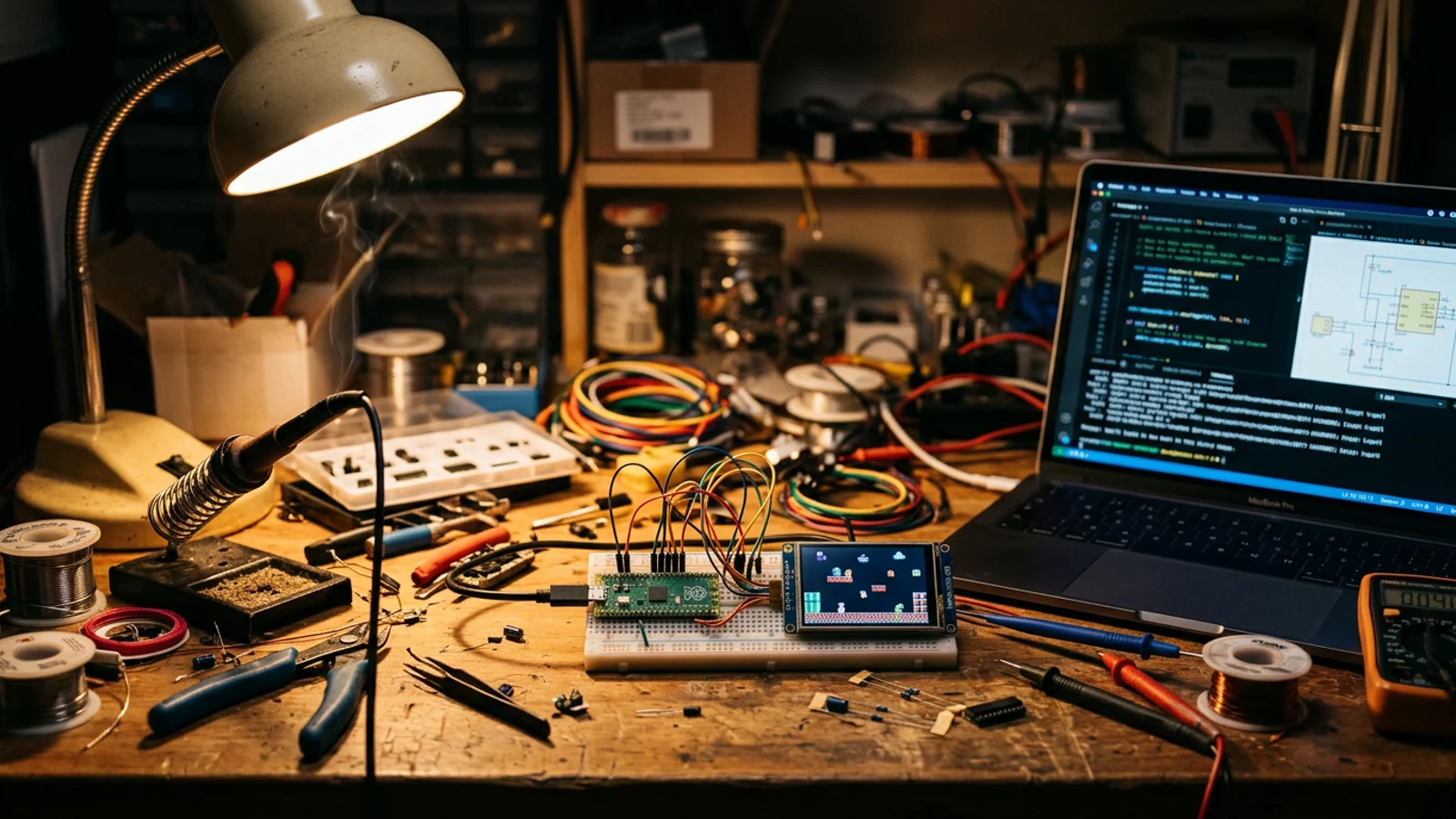
A tiny world model plays games on a Pico 2 W, AMD ships an early NPU/GPU SDK, and a measurement study checks edge-NPU VLM hype.
A Tiny World Model Plays Games Entirely on a $6 Microcontroller
A project called tinyworldformer, posted by GitHub user SheepSeb, runs a small neural "world model" directly on a Raspberry Pi Pico 2 W, the roughly $6 board built around RP2350's dual Cortex-M33 cores. According to the repository and the Hacker News discussion that reached 237 points on October 29, 2026, the model learns game dynamics from recorded play, then generates each next frame and game state from player input, with no host PC or cloud involved.
That is the same idea behind research world models like DIAMOND or Genie, shrunk to run on a microcontroller instead of a GPU. The caveat is real: this is a self-reported hobby build, not a peer-reviewed benchmark, and the games shown are necessarily simple and low-resolution — a neural net predicting frames at MCU speed cannot match a hand-coded game loop for fidelity.
Still, it is a concrete demonstration that generative, learned simulation can run on sub-$10 silicon with no NPU at all, using plain Cortex-M cycles. That lowers the floor for what counts as "inference on a microcontroller," which is usually classifiers, not generators.
AMD's New Loom SDK Tries to Skip ROCm for NPU and GPU Inference
AMD published hrx-loom 0.1.0 to PyPI on October 29, 2026, the first tagged release of Loom, a compiler-and-runtime package meant to compile and serve models on CPUs, AMD GPUs and AMD XDNA NPUs without installing the full ROCm SDK. As Voltgrid News reported, a developer picks a device flag — task for CPU, amdgpu for GPU, xdna for NPU — and execution on AMD silicon routes through a library called libamdf plus an OS driver, nothing else. Wheels target Windows 11 and Linux with glibc 2.39+, require Python 3.12 or newer, and are licensed Apache-2.0.
Loom sits inside AMD's broader ROCm HRX effort, which AMD's own developer blog frames as three pieces — FastFlow, IRON and HRX — aimed first at Ryzen AI's XDNA2 NPUs. AMD's own documentation calls the code early access and warns the APIs will change; no supported device list ships with 0.1.0, and no independent benchmark exists yet.
The honest read is that this is plumbing, not a performance claim. If it matures, a pip-installable path reaching both the GPU and NPU on one unified-memory laptop, without a ROCm install, would lower the bar for running small models locally on Ryzen AI hardware.
A New Measurement Study Asks How Ready Edge NPUs Really Are for Vision-Language Models
A paper posted to arXiv on October 29, 2026, titled "How Far Are We From On-Device VLM Inference? A Measurement Study on Edge NPUs," benchmarks the stack of optimizations — model architecture changes, inference runtimes, hardware-specific acceleration — that vendors have proposed for running vision-language models on phone- and laptop-class NPUs.
The authors' self-reported finding is that these optimizations do not compose as cleanly as advertised: gains measured in isolation shrink once a full VLM pipeline — vision encoder, projector, language decoder — runs end to end on real NPU hardware, with runtime overhead and memory-bandwidth limits eating into the headline numbers.
It is one paper, not a product, and its exact hardware list and methodology deserve a closer read before citing specific percentages. But it is a useful counterweight to vendor slide decks: "runs on the NPU" and "runs well on the NPU" are different claims, a gap this beat has already flagged with other vendors' own NPU stacks.
A 559,000-Parameter Japanese TTS Model Speaks Entirely Inside an ESP32-S3
Developer ayutaz released sanoTTS-jp, a Japanese text-to-speech model with 559,000 parameters that synthesizes speech in real time on an ESP32-S3, according to the project's page, updated October 30, 2026 and already at 70 GitHub stars. The pipeline — morphological analysis of mixed kanji-kana text, accent estimation, then waveform synthesis — runs entirely on the chip, with no cloud call, and the author reports it verified on a physical M5Stack CoreS3 board.
The project advertises zero external dependencies for its inference path, which is the harder part of these builds: Japanese TTS needs text normalization and pitch-accent prediction before synthesis even starts, steps many embedded demos skip by hard-coding phonemes. None of this is independently benchmarked for voice quality against commercial TTS, and "real-time" is the author's own claim.
It is a small project, but it extends what a few-dollar microcontroller can do for voice output without a server round-trip — the same territory as other ESP32 voice builds this beat has tracked this month.
Nothing here is a finished product you can buy off a shelf today — a hobby world model, an early-access SDK, one measurement paper and a bedroom TTS project — but together they sketch where the floor for local inference sits right now, somewhere between a $6 microcontroller and a Panther Lake mini PC.
References & Citations
- SheepSeb/tinyworldformer — GitHub, Oct 29, 2026 — https://github.com/SheepSeb/tinyworldformer
- Hacker News discussion thread, Oct 29, 2026 — https://news.ycombinator.com/item?id=50295450
- Voltgrid News — AMD Loom 0.1 report, Oct 30, 2026 — https://voltgridnews.com/story/amd-loom-0-1-sdk-targets-cpus-gpus-and-npus-without-a-rocm-install
- hrx-loom 0.1.0 — PyPI, Oct 29, 2026 — https://pypi.org/project/hrx-loom/
- AMD Developer Blog — Introducing FastFlow SDK, 2026 — https://www.amd.com/en/developer/resources/technical-articles/2026/introducing-fastflow-sdk.html
- arXiv — How Far Are We From On-Device VLM Inference?, Oct 29, 2026 — https://arxiv.org/abs/2610.40039v1
- ayutaz/sanoTTS-jp — GitHub, Oct 30, 2026 — https://github.com/ayutaz/sanoTTS-jp
Subscribe to new posts from theaivibe.org
Related Posts
A $25 ESP32 Trains Its Own Tiny LLM While an 8B MoE Model Squeezes Under 1GB of RAM
From a from-scratch LLM on a $25 microcontroller to an 8B MoE model living in under a gigabyte, the edge keeps shrinking its memory budget.
A Viral Android AI Agent Taps Its Own Phone While a Neuromorphic Chip Teaches a Raspberry Pi to Learn Live
An open-source Android AI agent tops 2,100 GitHub stars in two days as a neuromorphic kit teaches a Raspberry Pi 5 to learn sounds on the fly.
A $7 ESP32 Gives an AI Agent Hands on a Real iPhone While a 14M LLM Keeps a Fish Alive
A cheap ESP32 becomes an AI agent's eyes and hands on a real iPhone, while a tiny distilled LLM runs an $8 virtual fish tank offline.