A Viral Android AI Agent Taps Its Own Phone While a Neuromorphic Chip Teaches a Raspberry Pi to Learn Live
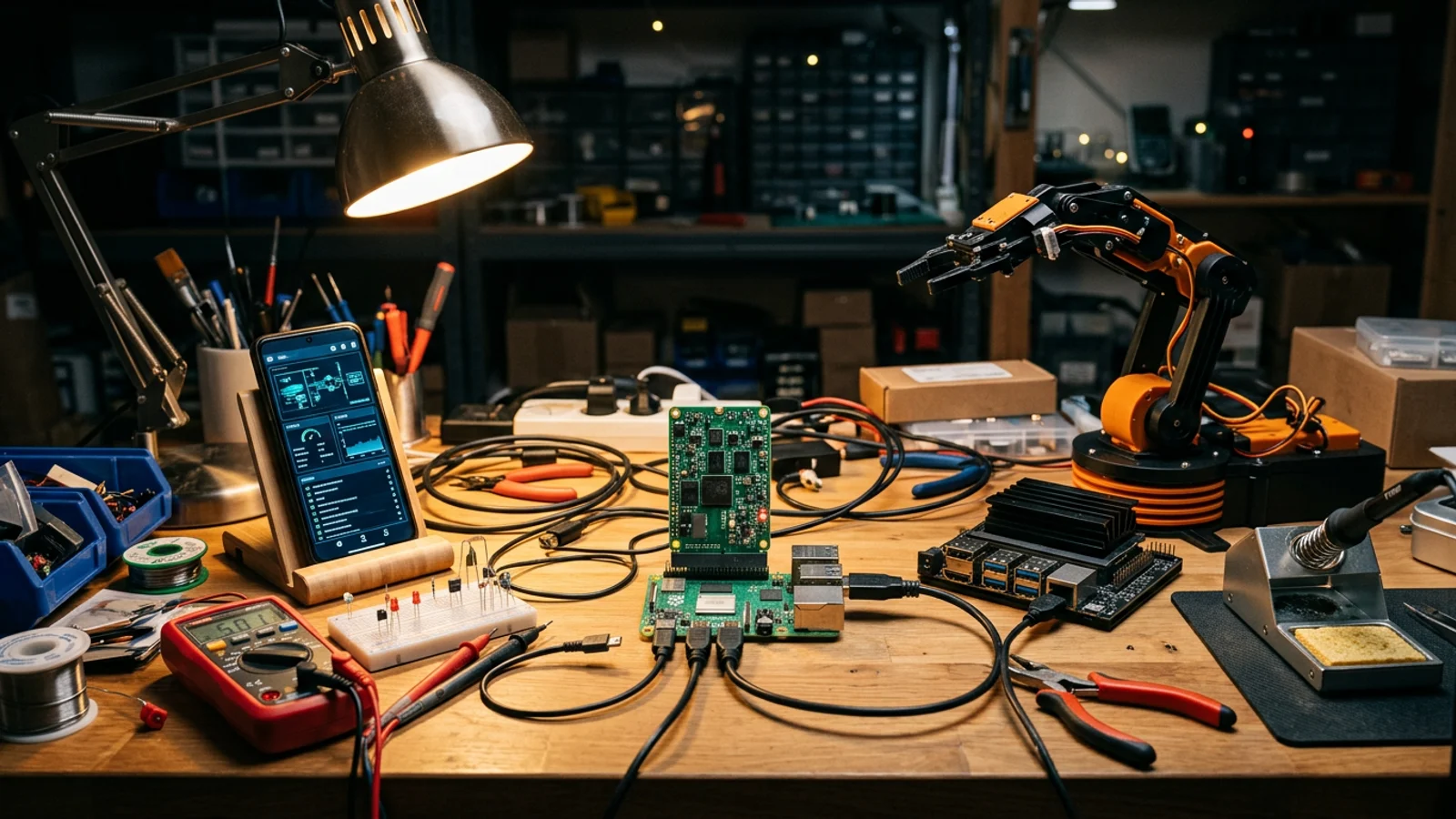
An open-source Android AI agent tops 2,100 GitHub stars in two days as a neuromorphic kit teaches a Raspberry Pi 5 to learn sounds on the fly.
An Android AI Agent Operates Apps, No Human Taps
Developer wangzan101 published Mika on GitHub on October 29, 2026. By October 31 the repo had passed 2,100 stars, according to its own page. The Chinese-language README describes it as a personal AI assistant that operates apps, browses the web and gets tasks done on your phone.
The honest caveat: nothing in the repo yet says which model does the reasoning or where it runs. Many Android "agent" projects wire an accessibility-service that taps the screen to a cloud LLM API, so only the hands are local while the thinking happens elsewhere. Mika's description does not rule that out.
Either way, the appetite for phone agents that act rather than chat is real, and projects like this are the test bed for how much of that loop — reading the screen, planning, and executing — eventually stays on the device.
A Benchmark Puts Three Robot Brains on Three Jetson Boards
ZETIC announced ixian-bench on October 28, 2026, publishing per-stage latency and power numbers for vision-language-action models on NVIDIA Jetson AGX Thor, AGX Orin and Orin Nano. On AGX Thor at BF16 and batch size one, compiling SmolVLA with torch.compile cut median latency from 197ms to 50ms, but pushed peak memory from 4.22GB to 6.76GB and raised average board power from 43.4W to 66.9W. π0.5 went from 254ms to 132ms under the same change.
These are ZETIC's own measurements; the company sells edge inference optimization services and discloses that its optimized paths are labeled separately. Success rates are not comparable across models since each used its own evaluation suite.
Still, the trade-off is concrete and useful: a battery-powered robot and a tethered workstation want different answers to the compile-or-not question, and this is one of the few public datasets that shows the cost on real Jetson silicon.
A World Model Hits Real Time on a Dedicated NPU
Chip company Quadric says it ported Meta's V-JEPA 2.1 world model onto its own GPNPU, the QC-Ultra, running a 16-frame clip in 43.5 milliseconds — 23 clips per second on a single core — according to the company's October blog post. Quadric says engineers ported the model in about 90 minutes using its agentic SDK tooling, then doubled throughput in a day and a half using its Kernel Arena optimizer.
This is a vendor benchmark on vendor silicon, with no independent confirmation yet. V-JEPA here is Meta's pretrained self-supervised perception model, not a game-playing agent.
It still matters: purpose-built edge NPUs running heavier self-supervised vision models — not just image classifiers — points at where robot and camera perception stacks are headed off the GPU.
NVIDIA Ships a Lightweight C++ Runtime for Embedded LLMs
NVIDIA's developer blog, posted October 30, 2026, introduced TensorRT Edge-LLM, a lightweight C++ inference runtime built for embedded workloads such as cabin monitors and small robots, alongside an updated Jetson developer kit now available in a 64GB memory configuration for prototyping and fine-tuning.
The caveat: this is NVIDIA's own how-to post, with its own framing that the pipeline takes "just a few commands." No independent third-party benchmarks of TensorRT Edge-LLM have surfaced yet.
What's notable is the target: a dedicated C++ runtime, not a Python-heavy stack, aimed squarely at the board-class hardware — not datacenter GPUs — that this beat covers.
A Neuromorphic Chip Teaches a Raspberry Pi 5 to Learn New Sounds Live
BrainChip launched the AKD1500 Raspberry Pi 5 Development Kit on October 29, 2026, pairing a Pi 5 with an M.2 board carrying its AKD1500 event-based neuromorphic chip, according to the company's press release. BrainChip says the chip processes only meaningful sensor events instead of every frame, and supports on-chip learning — a Pi 5 running it can be taught a new keyword, gesture or object in the field without cloud retraining, with the new data staying local.
Caveat: these are the company's own claims, with no independent power or latency figures published yet, and this is a development kit meant for prototyping rather than a finished consumer product, as a follow-up writeup notes.
Cheap always-on sensing that learns in place, without round-tripping to the cloud, is exactly the gap the Pi ecosystem has lacked.
Nothing here claims a finished product — a two-day-old agent repo, vendor benchmarks on vendor silicon, and two development kits — but together they sketch where the edge-robotics and SBC beat is actually moving this week: faster compile paths on Jetson, lighter runtimes from NVIDIA, and a neuromorphic chip betting the Raspberry Pi can learn in the field instead of just inferring.
References & Citations
- wangzan101/Mika — GitHub, Oct 29, 2026 — https://github.com/wangzan101/Mika
- ZETIC — ixian-bench on Jetson, Zeniteq, Oct 28, 2026 — https://www.zeniteq.com/ixian-bench-measures-vla-models-on-jetson-h0x1hg
- Quadric — V-JEPA 2.1 on GPNPU blog post, Oct 2026 — https://quadric.ai/blog/world-models-at-the-edge-real-time-vjepa-gpnpu
- NVIDIA Developer Blog — TensorRT Edge-LLM, Oct 30, 2026 — https://developer.nvidia.com/blog/run-ai-models-for-edge-application-development-with-just-a-few-commands/
- BrainChip — AKD1500 Raspberry Pi 5 Kit press release, Oct 29, 2026 — https://brainchip.com/press/brainchip-launches-akd1500-raspberry-pi-5-kit-giving-developers-a-direct-path-from-prototype-to-production/
- DeviceCritique — AKD1500 Pi 5 kit follow-up, Oct 29, 2026 — https://devicecritique.com/2026/10/brainchip-akd1500-raspberry-pi-5-kit-edge-ai-price/
Subscribe to new posts from theaivibe.org
Related Posts
A $25 ESP32 Trains Its Own Tiny LLM While an 8B MoE Model Squeezes Under 1GB of RAM
From a from-scratch LLM on a $25 microcontroller to an 8B MoE model living in under a gigabyte, the edge keeps shrinking its memory budget.
A Game Runs Entirely on a $6 Chip While AMD Tries to Skip ROCm for Local AI
A tiny world model plays games on a Pico 2 W, AMD ships an early NPU/GPU SDK, and a measurement study checks edge-NPU VLM hype.
A $7 ESP32 Gives an AI Agent Hands on a Real iPhone While a 14M LLM Keeps a Fish Alive
A cheap ESP32 becomes an AI agent's eyes and hands on a real iPhone, while a tiny distilled LLM runs an $8 virtual fish tank offline.