NPUs Learn to Fuse: AMD Opens Its XDNA Compiler, Qualcomm Previews Linux, and Two New On-Device AI Models Land
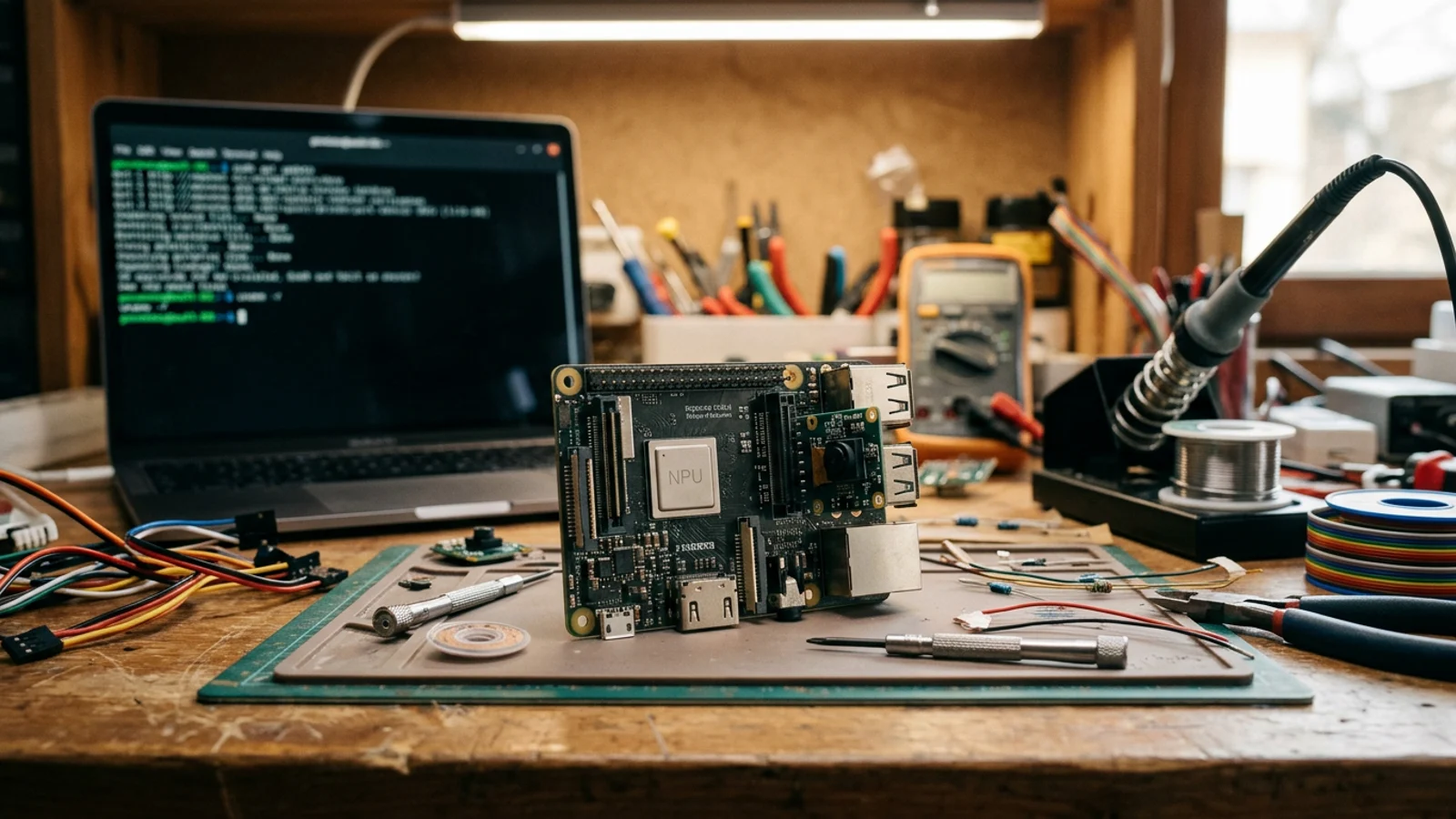
AMD open-sources fused FlashAttention kernels for XDNA NPUs, Qualcomm ships a Linux preview for Snapdragon X2, and fresh research pushes tiny and trillion-scale models toward
AMD Open-Sources Fused FlashAttention Kernels for XDNA NPUs
A new paper from AMD researchers walks through four ways to map FlashAttention onto XDNA spatial NPUs using the open-source IRON and MLIR-AIR compiler flows, then releases the reference designs. The fused version, which keeps attention scores in local compute-tile memory instead of shuttling them back to shared MemTile RAM, hits 3.62 TFLOP/s on XDNA 2 — twice the throughput of the un-fused IRON baseline and, the authors report, 5.3 to 7.2 times more energy-efficient than the integrated GPU on the same chip at 2K tokens and beyond.
This is a research paper with released code, not a shipped runtime feature — the gains are specific to FlashAttention and to the twelve LLM configurations tested, from BERT to DeepSeek up to 128K tokens.
The useful part for anyone building on Ryzen AI hardware is the roofline rule the paper distills: fuse operators on-chip until you clear the memory-level's ridge point, then stop, because on first-gen XDNA the same fusion trick is nearly wasted. That's a concrete recipe for squeezing more inference out of NPUs that are already sitting idle in millions of laptops.
Memories.ai Brings an Omni-Model to Snapdragon for On-Device Perception
Memories.ai announced on September 24, 2026 at Qualcomm's Snapdragon Summit that its "omni-model" — built for visual memory and perception tasks — now runs on Snapdragon silicon, positioning the company as part of what it calls the visual memory layer for physical intelligence.
The announcement is short on hard numbers: no parameter count, TOPS figure, or specific Snapdragon SKU is disclosed in the release, so treat this as a self-reported milestone rather than a benchmarked result.
Still, it's another data point in a week full of Snapdragon Summit on-device perception pitches — the direction matters more than the specifics right now: vendors are racing to keep camera and video understanding off the cloud entirely.
SSD-LLaMA Squeezes a Trillion-Parameter MoE Onto a Single Consumer GPU
A new preprint, SSD-LLaMA, describes a system for running trillion-parameter Mixture-of-Experts models on a single consumer PC by treating the SSD as a native tier of model memory, coordinating SSD, RAM, and VRAM instead of pruning experts. The authors report decode-rate improvements of 2.10x to 15.58x over their baselines, and say they cross 1 token per second on a trillion-parameter model using one RTX 5090 and no more than 32GB of system RAM.
The honest caveat: 1 token/s is still very slow for interactive use, and this is a paper with claimed results, not yet an independently reproduced release. It also assumes a fast NVMe SSD and a top-tier consumer GPU, so 'consumer' here means enthusiast, not budget.
What matters for the edge beat is the direction — treating storage as an active inference tier rather than dead weight is the same idea driving MoE work on phones and SBCs, just pushed to a much bigger model.
A Controlled Re-Examination Questions Ternary Microcontroller LLM Claims
A new arXiv paper re-examines ternary (1.58-bit) language models at the 60,000-parameter scale that microcontroller researchers use as a testbed, arguing that many prior comparisons in this sub-1M-parameter regime relied on isolated, single-seed runs. The authors run controlled experiments varying baseline shape and find that conclusions about which ternary architecture wins can flip depending on those choices.
This is a methodology paper, not a new model or product — it doesn't ship a better microcontroller LLM, it questions whether some published claims about which ones are better actually hold up.
For a beat that has run several ternary and sub-30MB model stories this month, that's a useful corrective: benchmark results at these tiny scales need multiple seeds and matched baselines before they mean much.
Qualcomm Opens a Linux Preview for Snapdragon X2 Laptops
Qualcomm released an Early Developer Preview of Linux for its Snapdragon X2 Series on September 23, 2026, built on Debian 13 'Trixie' with a custom kernel, giving kernel developers upstream patches, reference device trees, and driver work for the Adreno GPU, Hexagon NPU, USB, and PCIe.
This is explicitly not a consumer release — you build and flash the kernel yourself, and battery life, sleep, and Wi-Fi are still unresolved, according to the preview notes. But it exposes the Hexagon NPU via FastRPC without emulation, opening a path to native on-device AI compute on ARM Linux laptops that previously required Windows.
Vicharak's Axon-Lite Packs a 6 TOPS NPU Into a Swappable-Module SBC
Vicharak's new Axon-Lite single-board computer, covered by It's FOSS News on September 25, 2026, pairs a Rockchip RK3576 SoC and its 6 TOPS NPU with swappable interface modules for voice, vision, or sensing, letting the same tiny board be reconfigured for different edge-AI jobs.
Pricing and shipping date weren't confirmed in the initial coverage, so this is one to watch rather than buy yet. The modular-daughterboard approach is the interesting bit: it turns a single low-power NPU board into several different edge devices without redesigning the compute module each time.
Between AMD's open compiler recipes, Qualcomm's kernel-only Linux preview, and papers pushing both tiny ternary models and trillion-parameter MoEs toward consumer hardware, the NPU and edge-silicon layer keeps getting more legible — even where the wins are still measured in caveats.
References & Citations
- arXiv 2609.21264 — AMD XDNA FlashAttention paper, Sept 2026 — https://arxiv.org/abs/2609.21264
- Memories.ai press release via EIN Presswire, Sept 24, 2026 — https://www.einpresswire.com/article/944523317/memories-ai-brings-omni-model-to-snapdragon-for-on-device-perception
- arXiv 2609.18110 — SSD-LLaMA paper, Sept 2026 — https://arxiv.org/abs/2609.18110
- arXiv 2609.29397 — Ternary LM re-examination paper, Sept 2026 — https://arxiv.org/abs/2609.29397
- CNX Software — Qualcomm Linux developer preview, Sept 25, 2026 — https://www.cnx-software.com/2026/09/25/qualcomm-releases-linux-developer-preview-snapdragon-x2/
- Open Source For You — Snapdragon X2 Linux preview details — https://www.opensourceforu.com/2026/09/qualcomm-opens-linux-preview-for-snapdragon-x2/
- It's FOSS News — Vicharak Axon-Lite SBC, Sept 25, 2026 — https://itsfoss.com/news/vicharak-axon-lite/
Subscribe to new posts from theaivibe.org
Related Posts
Wearable AI Chips Land as an ESP32 Board Learns to Run a Full Offline Voice Loop
From a Qualcomm earbud chip to an ESP32-S3 that hears, thinks and speaks with no cloud, edge AI keeps shrinking into pockets and ears.
A $300 GPU Streams a 177B AI Model From an SSD While llama.cpp Learns to Skip Ahead
Community builders push token throughput further this week — via SSD-streamed MoE experts, prompt-lookup drafting, and a wrapper for Apple's built-in on-device LLM.
A Classifier That Only Picks, a Model That Skips Tokens, and an AI Firm Bets 2.6B Parameters Can Do Agent Work
Liquid AI ships a 2.6B agentic model for edge hardware, a 144M classifier skips text generation entirely, and a new paper shows byte-level LLMs can beat tokenized ones with sc