Jetson Thor Sprints Past llama.cpp While a 15M-Parameter LLM Still Fits an $8 Chip
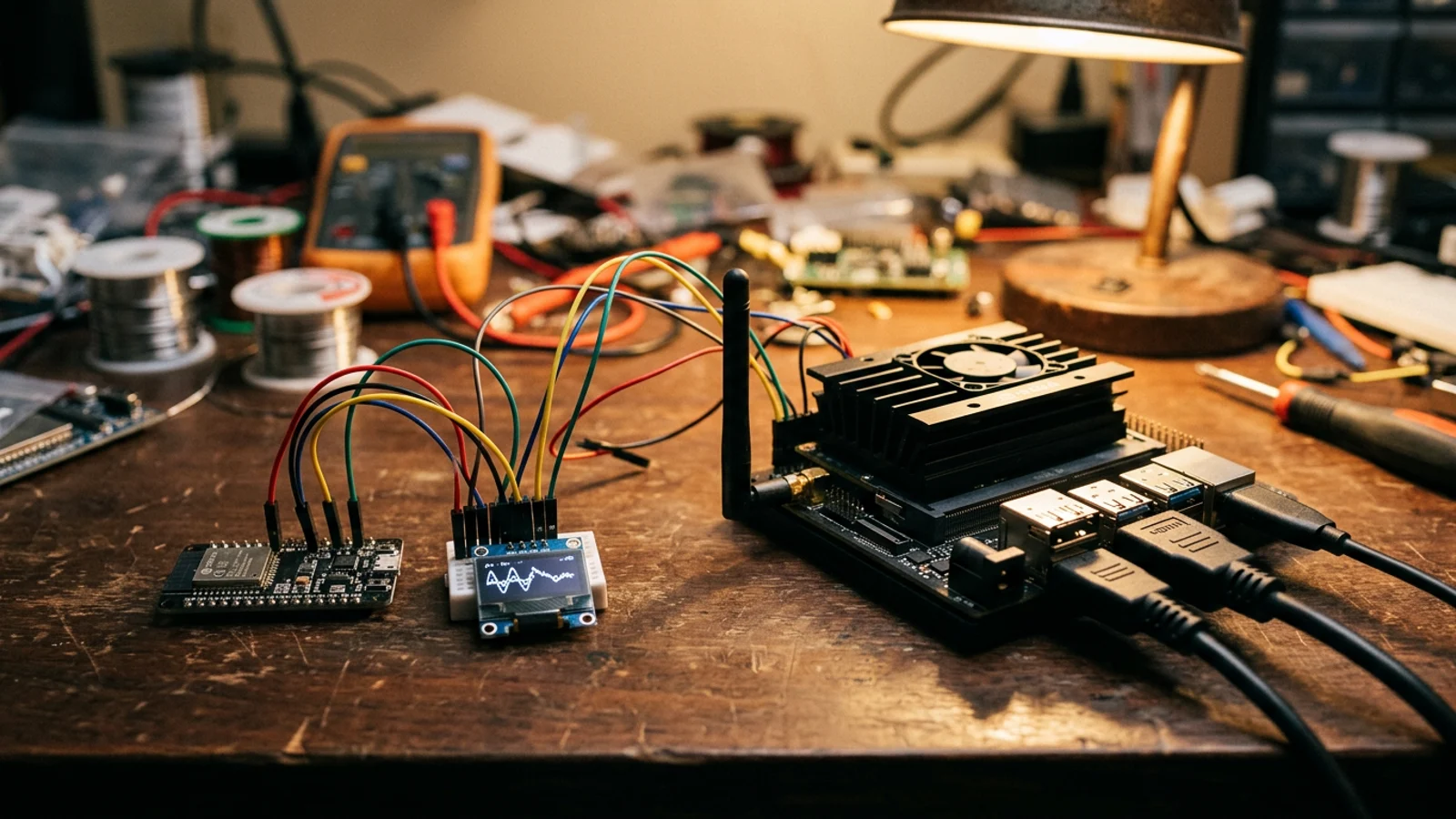
NVIDIA posts a 6.4x MLPerf edge win on Jetson AGX Thor, a dense TinyStories model skips the flash trick, and a paper splits VLA robots between cloud and a tiny local model.
Jetson AGX Thor Beats the llama.cpp Reference by 6.4x in a New MLPerf Edge Result
NVIDIA published MLPerf Inference v6.1 Edge Agentic results on September 16, 2026 showing its TensorRT Edge-LLM running Qwen3.6-27B on a single Jetson AGX Thor Developer Kit at 52.33 tokens per second, finishing all 1,007 turns of the benchmark in 24 minutes and 36 seconds versus 2 hours 37 minutes for the llama.cpp reference submission. The gain comes from NVFP4 quantization, tree-based multi-token prediction and KV cache reuse, per NVIDIA's developer blog.
This is a vendor benchmark against a stock reference implementation, not a head-to-head against a tuned llama.cpp build, and the Thor kit's 128GB of unified memory puts it at the far end of "edge" from a microcontroller. Still, it shows agentic workloads — multi-turn tool calls, not single-prompt chat — running entirely on a box that sits in a robot or a vehicle rather than a rack, a distinction SMNTCN's summary also flags.
A Dense 15-Million-Parameter Model Skips the Flash Trick
Where recent ESP32 LLM projects lean on Google's Per-Layer Embeddings to keep most weights parked in flash, 6farsi's NanoMind-S3 goes the other way: it puts Andrej Karpathy's real stories15M model — a 15.2 million parameter dense LLaMA-2 transformer trained on TinyStories — entirely resident and multiplies every stored weight on every token. It runs on a $4 ESP32-S3 DevKitC-1 with no WiFi or cloud dependency, generating short children's stories over a serial terminal at about 2.96 tokens per second, per the Hackster write-up.
A second builder, JARACH-209, pushed the same dense approach further with a 30.72-million-parameter stories42M variant on an $8 ESP32-S3, self-reporting 0.95 tokens per second with no SD card, per the project repo. Both are slower than the PLE-based 28.9M model this beat has already covered, but they trade speed for architectural simplicity — no flash lookup table, just weights and math — which matters for anyone trying to port the trick to a chip without much flash to spare.
A Paper Splits VLA Robots Between the Cloud and a Tiny Local Model
A preprint posted to arXiv on September 16, 2026, titled VLA-ULAP, argues that billion-parameter vision-language-action policies are too heavy and too latency-prone to run fully on a robot's own compute. Its proposed fix interleaves occasional calls to a large cloud VLA model with an ultra-lightweight local action predictor that handles the moments in between, aiming to keep a robot responsive when the network round-trip would otherwise stall it.
This is not on-device inference in the strict sense — the heavy model still lives off-board — and the paper is a design proposal, not a shipped robot. The honest reading is that it names the real constraint driving edge robotics right now: onboard power and bandwidth, not raw model accuracy, and it's a preprint without independent hardware benchmarks yet.
An Open Camera Module Puts 1.5 TOPS Behind Night Vision
AIMORELOGY launched a crowdfunding campaign on September 16, 2026 for the Ovis, an open-source AI vision camera module built on the CVITEK CV1842H-P SoC. It offers full-color 1080p night vision, AI-ISP support and a rated 1.5 TOPS of edge AI inference, according to CNX Software's coverage.
Crowdfunded hardware ships late and specs sometimes shift before production, so treat the TOPS figure as a stated target rather than a benchmark result. The interesting part is the pairing: night-capable full-color sensing plus an ISP tuned for on-chip AI, aimed at makers who want a security-camera-class module without sending frames anywhere.
A Color E-Paper Badge Runs Open Firmware on an ESP32-S3
ENILINX launched the TICKEY, a 3.7-inch color e-Paper smart badge and desk display built on an ESP32-S3, on a crowdfunding page published September 17, 2026, according to CNX Software. The company is shipping it with open firmware rather than a closed app ecosystem.
No AI model runs on the badge itself; it belongs here as a hardware pick because it's a fresh, dated ESP32-S3 board with an unusually generous display and an open toolchain — the kind of low-cost, well-documented board that ends up hosting someone's tiny local-inference demo within weeks of shipping.
Two very different edges show up today: a Jetson dev kit with 128GB of memory chasing agentic benchmarks, and $4–$8 microcontrollers arguing over whether dense or flash-offloaded weights make more sense for a 15-to-30-million-parameter story generator. Both are the same beat.
References & Citations
- NVIDIA Developer Blog, September 16, 2026 — https://developer.nvidia.com/blog/tensorrt-edge-llm-completes-the-mlperf-edge-agentic-benchmark-6-4x-faster-on-jetson-agx-thor/
- SMNTCN summary, September 2026 — https://smntcn.com/en/article/tensorrt-edge-llm-pokazal-rezultaty-v-mlperf-edge-s-uskoreniem-64x-6623
- 6farsi — NanoMind-S3, Hackster.io — https://www.hackster.io/6farsi/nanomind-s3-fully-dense-15-2m-param-llm-on-esp32-s3-73937f
- JARACH-209/esp32-30.7M, GitHub — https://github.com/JARACH-209/esp32-30.7M
- VLA-ULAP, arXiv, September 16, 2026 — https://arxiv.org/abs/2609.18663v1
- CNX Software — CVITEK CV1842H-P Ovis camera module, September 16, 2026 — https://www.cnx-software.com/2026/09/16/cvitek-cv1842h-p-based-edge-ai-camera-module-offers-night-vision-and-ai-isp-support/
- CNX Software — ENILINX TICKEY, September 17, 2026 — https://www.cnx-software.com/2026/09/17/enilinx-tickey-esp32-s3-color-e-paper-badge-with-open-firmware/
Subscribe to new posts from theaivibe.org
Related Posts
ESP32 Special: An $8 Chip Runs a 29-Million-Parameter LLM, and Vendors Rethink the Board Around It
A one-chip LLM, a Wi-Fi upgrade to Seeed's tiny displays, and Tuya's push to make ESP32 an AI-agent target, not just a Wi-Fi one.
A Wristband Reads Muscles, a Ring Wants Your Ideas: Edge AI Moves Onto the Body
New wearable and phone releases push transcription, gesture control and silent speech fully on-device, while ESP32 and Jetson tooling keeps pace.
Runtimes on the Move: llama.cpp, ExecuTorch and LiteRT All Update as Edge AI's Software Layer Speeds Up
llama.cpp shipped two builds in two days, ExecuTorch hit 1.0 with new NPU backends, and LiteRT tuned fp16 kernels for mobile CPUs.