Five ESP32 Builds Push Local AI From a Dev Board to a Drone's Camera
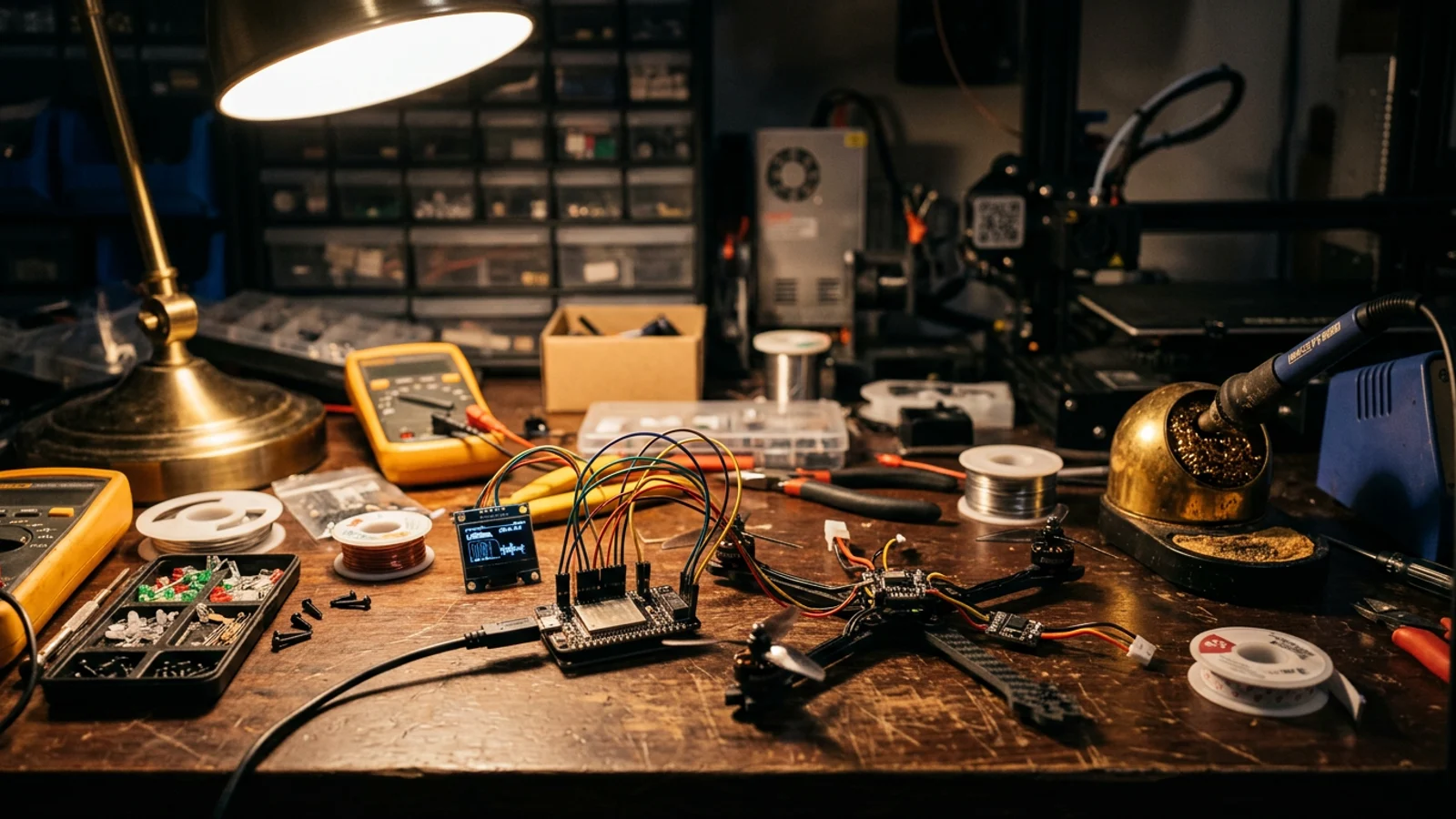
A 28.9M LLM, two phone/voice agents, a new AI-ready dev board and a drone video hack all land on the same $7 chip family.
A 28.9M-Parameter LLM Lands on an ESP32-S3
A hobbyist going by ninhnn2 published a from-scratch commit on October 21, 2026 for PLE TinyLM, a 28.9-million-parameter language model built to run on an ESP32-S3. The trick is keeping most parameters as per-layer embeddings in flash instead of RAM, so the same compact model.bin file runs on the ESP32-S3 in Xtensa C, on a desktop CPU in portable C, and on a Jetson over CUDA, according to the commit log.
This is a first release, not a benchmark drop: no tokens-per-second figures are published yet, and the project leans on a self-authored Vietnamese-language course on roofline analysis and quantization rather than a peer-reviewed paper. Still, one binary format spanning a microcontroller and a GPU board is useful plumbing for anyone building a model once and deploying it from an $8 chip up.
A $7 ESP32 Gives an LLM Hands on a Real iPhone
esp32-iphone-agent, published by developer onehumanbeing on October 11, 2026 and past 3,400 stars by October 21, turns a roughly $7 ESP32 board into hands and eyes for an iPhone: AirPlay streams the screen in, USB HID sends taps and gestures back out, and any OpenAI-compatible endpoint supplies the decisions, according to the project repo.
The honest caveat: the ESP32 here is a hardware bridge, not where the model runs. Point the endpoint at a cloud API and this is a cloud brain with a cheap body; point it at a local llama.cpp or Ollama server on the same network and the control loop stays on local hardware. Either way, it is a cheap way to let a model operate a real phone instead of a simulator.
A Knob-or-Wake-Word Voice Assistant, Model Left Open
raullenchai's esp32-thinks, created October 12, 2026 and up to 236 stars by October 19, is a personal voice assistant built around an ESP32 that listens for a wake word or a physical knob press, captures audio locally, and routes it to any OpenAI-compatible model backend, per the repo.
As with the iPhone-agent project, how much of this stays on-device depends on where the user points the endpoint. Wake-word detection and audio capture happen on the chip; the reasoning can be a small local model or someone else's cloud API. It is a solid template for builders who want the hardware fixed now and the model choice left for later.
ESP-Mosaico Pairs a New ESP32-S31 With a Touchscreen for AI-Assisted Builds
CNX Software reported on October 21, 2026 on ESP-Mosaico, a modular development platform built around the new ESP32-S31 with a 480 x 480-pixel OLED touchscreen, haptic feedback, a built-in battery, and USB Type-C, per the writeup.
Billed for AI-assisted hardware creation, the board targets a workflow rather than an inference job: letting a coding agent iterate on firmware and UI for a battery-powered touchscreen gadget without a builder touching a soldering iron for every change. No model runs on it out of the box; the AI here is in the tooling, not the silicon.
An ESP32's Hidden Radio Starts Flying 5 GHz Drone Video
Hackaday covered a new application on October 20, 2026 for the ESP32's recently revealed software-defined radio facility: streaming live video over 5 GHz from a drone, built on the transmit capability unlocked only a week earlier, per the article.
The caveat is range and robustness: this is a stock Wi-Fi radio pressed into service as a video link, not a dedicated analog or digital FPV system, and the write-up treats it as an early proof of concept rather than a flight-ready product. Still, it shows how much latent radio hardware sits unused inside an ordinary ESP32 module.
Five builds, one chip family: the ESP32 keeps turning up as the cheapest way to give an AI agent a body, a microphone, or a radio, even when the model itself lives somewhere else entirely.
References & Citations
- ninhnn2 — machineai commit, Oct 21, 2026 — https://github.com/ninhnn2/machineai/commit/a139b50505e52313bfb0b6acf9107046253a4167
- onehumanbeing — esp32-iphone-agent repo, Oct 11-21, 2026 — https://github.com/onehumanbeing/esp32-iphone-agent
- raullenchai — esp32-thinks repo, Oct 12-19, 2026 — https://github.com/raullenchai/esp32-thinks
- CNX Software, Oct 21, 2026 — https://www.cnx-software.com/2026/10/21/esp-mosaico-an-esp32-s31-based-modular-development-platform-for-ai-assisted-hardware-creation/
- Hackaday, Oct 20, 2026 — https://hackaday.com/2026/10/20/5-ghz-drone-video-with-an-esp32/
Subscribe to new posts from theaivibe.org
Related Posts
A $25 ESP32 Trains Its Own Tiny LLM While an 8B MoE Model Squeezes Under 1GB of RAM
From a from-scratch LLM on a $25 microcontroller to an 8B MoE model living in under a gigabyte, the edge keeps shrinking its memory budget.
A Viral Android AI Agent Taps Its Own Phone While a Neuromorphic Chip Teaches a Raspberry Pi to Learn Live
An open-source Android AI agent tops 2,100 GitHub stars in two days as a neuromorphic kit teaches a Raspberry Pi 5 to learn sounds on the fly.
A Game Runs Entirely on a $6 Chip While AMD Tries to Skip ROCm for Local AI
A tiny world model plays games on a Pico 2 W, AMD ships an early NPU/GPU SDK, and a measurement study checks edge-NPU VLM hype.