AMD Just Bought the 'Ollama of NPUs': What FastFlowLM Means for Local LLMs
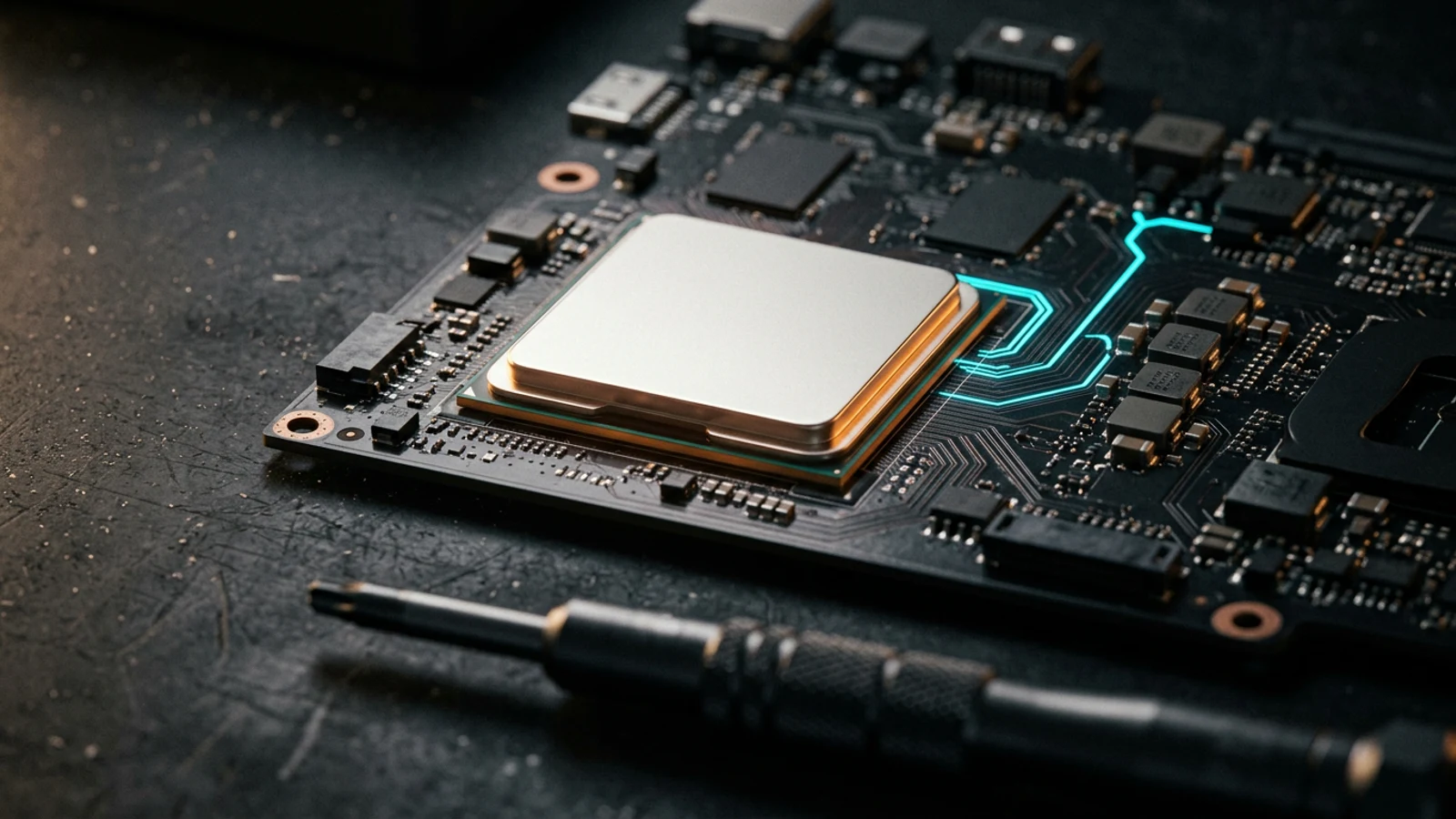
A 17MB runtime that runs LLMs on AMD's Ryzen AI NPUs — built by three academics, acquired by AMD on July 17, 2026, folded into ROCm in August. The NPU rung of the edge ladder just got real.
This section was born on eight-dollar microcontrollers, and the bench logs I keep promising will still happen on eight-dollar microcontrollers. But the beat was never really "ESP32." The beat is inference happening on the device in front of you — and in July 2026, the most consequential thing that happened to that idea involved a laptop chip, three academics, and a 17-megabyte program that a trillion-dollar company decided it needed to own.
What FastFlowLM is
FastFlowLM — FLM to its users — is a runtime that runs large language models on the neural processing units inside AMD's Ryzen AI chips. The project's own tagline is the honest pitch: "just like Ollama — but purpose-built and deeply optimized for the AMD NPUs." If you have used Ollama, you already know the experience it is copying: install, pull a model, type at it. The difference is where the math lands. Ollama and llama.cpp route inference to your CPU and GPU. FastFlowLM sends it to the NPU — the dedicated AI silicon that ships in every recent Ryzen AI chip (the XDNA2 parts: Strix, Strix Halo, Kraken, Gorgon Point) and that, on most machines, sits idle nearly all of the time.
The engineering numbers are the kind this section likes: the runtime is about 17MB, installs in roughly twenty seconds, needs no GPU, and skips the driver ceremony entirely. Context lengths go up to 256k tokens. The project claims better than 10× the power efficiency of pushing the same workload through a GPU — and that figure deserves the standard label: it is the project's own number, measured by the people with the strongest incentive to like it. I have not seen an independent replication, and this section's house rule is that vendor benchmarks are vendor benchmarks until someone neutral runs them.
The origin story is unusually academic for a project that ended up inside a chip giant. FastFlowLM was started by university researchers working on parallel NPU architectures — SDxCentral names Tao Wei and Ken Qing Yang of the University of Rhode Island and Zhenyu "Alfred" Xu of Clemson University among the founders. Three researchers looked at millions of laptops shipping with dark AI silicon and wrote the software AMD had not.
Then AMD bought it
On July 17, 2026, AMD announced the FastFlowLM team was joining its AI Group. No purchase price was disclosed. Less than a month later, on August 11, the project resurfaced as v1.0.0 under AMD's ROCm organization — the same open-source umbrella as AMD's datacenter compute stack — alongside something genuinely new: SmolVLA v1.0.0, a vision-language-action robotics policy running on the NPU. That last item is worth a slow read. A VLA model is the kind that looks at a camera feed and outputs robot actions. Running one on a laptop-class NPU, at NPU power budgets, is the bridge between "chatbot on my laptop" and "robot that doesn't need a cloud tether" — which is precisely the terrain this section cares about.
The acquisition is the tell. Chip companies do not buy 17MB hobby runtimes. AMD bought FastFlowLM because local inference on NPUs went from a demo category to a competitive one — Qualcomm, Intel, and Apple are all shipping NPUs and all racing to make them do something before the silicon ages out — and because three researchers outside the company had built the best answer for AMD's own hardware.
The caveats, stated plainly
First, the licence asterisk. FastFlowLM's orchestration code and CLI are MIT-licensed, but the NPU kernels — the part that actually makes it fast — ship as binaries, free for any use including commercial, but not source. "Open source" is a licence claim, and here it applies to the shell, not the engine. That is a legitimate way to ship software; it is not the same thing as llama.cpp, where every kernel is inspectable.
Second, the lock-in. This runs on AMD's newest NPUs and nothing else. The whole value of the llama.cpp lineage is that it runs on nearly anything with a transistor; FastFlowLM is the opposite bet — deep optimization for one vendor's silicon, now owned by that vendor. Useful if you have the hardware, irrelevant if you don't, and the incentives to keep it portable just left the building.
Third, the usual: every performance figure above is self-reported or vendor-reported. Nothing in this piece is a measurement of mine.
Why this is on Edge
Because the story is the same story. In the compute ladder piece I argued that "AI at the edge" is one continuous question — how much intelligence fits in how many watts — asked at different price points. A 28.9M-parameter model squeezed onto an $8 ESP32-S3 and a 17MB runtime lighting up the dark NPU in a $1,200 laptop are the same instinct: the computer in front of you is more capable than the software running on it admits, and somebody outside the big labs decided to prove it.
So consider the lens officially widened. Edge covers the full spectrum from microcontrollers to NPU laptops to on-device robotics — anywhere inference happens on the machine itself, with the same rules everywhere: name the builders, link the sources, label the vendor numbers, and measure what we can on our own bench. The daily dispatch is already scanning the wider beat as of today. The soldering-iron soul of this section is not going anywhere — boards are still on order, and the first bench log will still be tokens per second on hardware I can hold in one hand.
References & Citations
- FastFlowLM (2026). "Run LLMs on AMD Ryzen AI NPUs in minutes" — github.com/ROCm/FastFlowLM (MIT orchestration; binary NPU kernels, free for commercial use).
- AMD (2026-07-17). "FastFlowLM Joins AMD to Advance AI Inference" — amd.com/en/blogs/2026/fastflowlm-joins-amd-to-advance-ai-inference.html.
- Phoronix, M. Larabel (2026). "FastFlowLM Developers Join AMD To Help Push Open-Source NPU Software" — phoronix.com/news/FastFlowLM-Joins-AMD.
- SDxCentral (2026-07-20). "AMD acquires FastFlowLM to accelerate on-device AI inferencing" — sdxcentral.com (names founders Tao Wei, Ken Qing Yang, Zhenyu "Alfred" Xu; no financial terms disclosed).
Subscribe to new posts from theaivibe.org
Related Posts
A 312K-Parameter LLM Learns to Flip Switches as Pi Prices Climb Again
A tiny GPIO-control model and a Japanese TTS join the ESP32 pile-up while Raspberry Pi raises prices and a Jetson robot chases bubbles.
ESP32 Special: Small LLMs Learn to Chat, Listen and Keep the Fish Alive
A full day inside the ESP32 world: chatty microcontroller LLMs, a $5-chip speech model, and two new boards from Espressif's own community.
Wearable AI Chips Land as an ESP32 Board Learns to Run a Full Offline Voice Loop
From a Qualcomm earbud chip to an ESP32-S3 that hears, thinks and speaks with no cloud, edge AI keeps shrinking into pockets and ears.