A 1.7B Non-Transformer LLM Targets the iPhone as Mobile NPUs Get a GUI Agent Paper
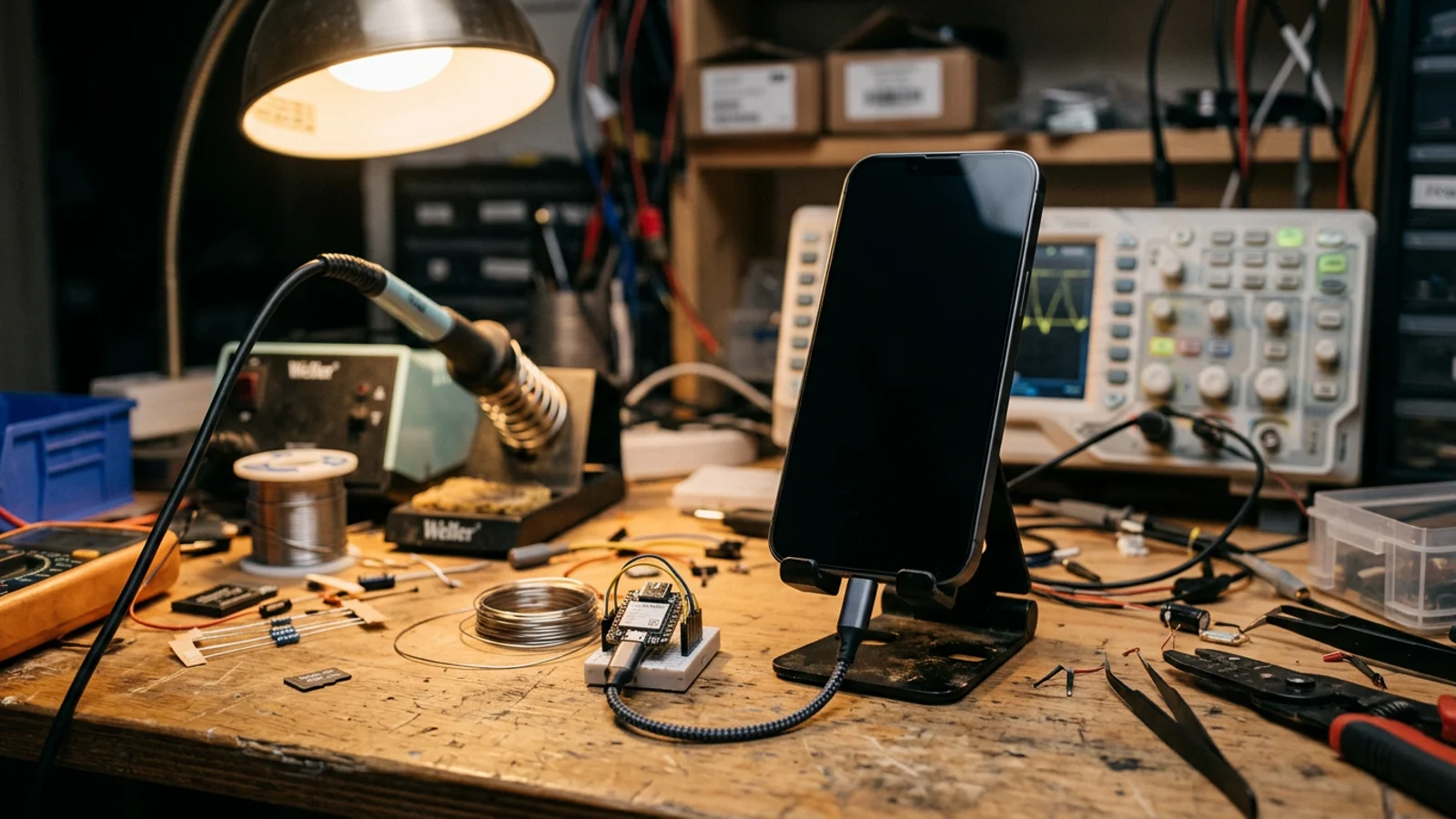
Liquid AI's LFM3 puts a 1.7B model in 1.9 GB on an iPhone 17 Pro, a new paper targets phone NPUs, and a $7 ESP32 drives an iPhone.
Liquid AI's LFM3 claims 43.6 tok/s on an iPhone 17 Pro
Liquid AI released LFM3 on or around November 16, 2026, according to businessbearings.com. It is a six-model family built on a 1.7B hybrid non-transformer backbone with a 256K context window and open weights on Hugging Face. The siblings cover vision-language, audio, omni and decision tasks at roughly 2B parameters each.
The edge numbers are vendor-measured, using Q4_0 GGUF in llama.cpp at 32K context. They are 43.6 tok/s decode in 1.90 GB on an iPhone 17 Pro, 129.6 tok/s on a Ryzen AI Max+ 395 and 237.1 tok/s on an Apple M5 Max. Liquid also says the KV cache at 128K context is 1.6 GB, against 5.6 GB for MiniCPM5-2B. Liquid's own post is not linked here because I could not open it, so everything above comes from that report.
Caveats: the benchmarks are Liquid's own, the report says license terms were not disclosed, and Liquid says the model is not recommended for agentic coding or complex multi-step reasoning. A small KV cache is what makes long context plausible on a phone, but independent tests are still missing.
Paper: fully on-device GUI agents on mobile NPUs
A preprint posted on arXiv on November 16, 2026, "Building Fully On-Device GUI Agents with Mobile NPUs", takes on a familiar problem. Phone agents that tap through apps usually depend on cloud-hosted models or remote inference. The paper looks at running the whole loop on the phone's NPU.
I only read the abstract listing, so I am not repeating any latency or accuracy figures. Check the paper for the models, phones and numbers before treating this as a result. It matters because screen-reading agents send the most private data a phone holds, and keeping that on-device is the whole point of the NPU.
Nemotron 3.5 Bolt E4B 4GB: a small conversational model built on Gemma 4
Another arXiv paper from November 16, 2026, "Nemotron 3.5 Bolt E4B 4GB", introduces an open small language model post-trained from Gemma-4-E4B-it. It is aimed at fast conversational agents, and the name points to a roughly 4 GB footprint.
The abstract frames it around speed and quality, but I have not checked the benchmarks, the license or which devices it was measured on. Those are vendor-style claims until someone reproduces them. A 4 GB model is the size that fits comfortably on a recent phone or small SBC, so this is worth watching for community quantizations.
A $7 ESP32 lets a model drive an iPhone, but the model is in the cloud
The open-source esp32-iphone-agent project by onehumanbeing is at release v1.0.6-build17, per aionradar.com on November 17, 2026. The ESP32 board takes the place of a Mac: it receives the AirPlay screen mirror and sends taps and swipes back as USB HID input. It was tested on a Seeed XIAO ESP32S3 with 8 MB PSRAM. The new release adds AirPlay audio forwarding, resumable long tasks and step-by-step replay.
The honest caveat is that this is not on-device inference. A companion iPhone app sends screenshots to any OpenAI-compatible vision model over the phone's cellular data. The ESP32 handles plumbing, not intelligence. It is still a neat, cheap hardware trick, and a locally hosted model could in principle sit behind the same API.
Rockchip RK3668 moves to Cortex-A725 and A520 cores
CNX Software reported on November 17, 2026 that more details have surfaced on the Rockchip RK3668. The Armv9 SoC now has eight cores, six Cortex-A725 and the rest Cortex-A520, and engineering samples are planned for Q1 2027.
This is a pre-release plan, not shipping silicon, and dates can slip. Rockchip chips power many low-cost SBCs, so core and sample timing is the first signal for the next wave of boards that may run local models. I did not confirm NPU specs.
Forlinx OK8275AA-C: a Qualcomm QCS8275 industrial SBC
On November 17, 2026 CNX Software covered the Forlinx OK8275AA-C. It is an industrial-grade single board computer built on Forlinx's FET8275AA-C module and a Qualcomm Dragonwing QCS8275 SoC. The listed configuration has 12 GB of LPDDR5 and 256 GB of UFS storage.
The specs come from the vendor's listing as relayed by CNX. I did not verify pricing, availability or any AI throughput. It is another sign that Qualcomm's Dragonwing parts are reaching industrial boards where on-device vision and language workloads are the pitch.
Most of today's phone-side numbers are vendor-reported or abstract-only, so the sources linked above are worth reading before anyone treats them as settled.
References & Citations
- Business Bearings — Liquid AI ships LFM3, November 16, 2026 — https://businessbearings.com/articles/liquid-ai-ships-lfm3-1-7b-non-transformer-model-runs-in-1-9-gb
- arXiv — Building Fully On-Device GUI Agents with Mobile NPUs, November 16, 2026 — https://arxiv.org/abs/2611.20772v1
- arXiv — Nemotron 3.5 Bolt E4B 4GB, November 16, 2026 — https://arxiv.org/abs/2611.20771v1
- onehumanbeing/esp32-iphone-agent on GitHub, v1.0.6-build17 — https://github.com/onehumanbeing/esp32-iphone-agent
- AI on Radar — ESP32 iPhone Agent, November 17, 2026 — https://aionradar.com/article/esp32-iphone-agent-ai-control-iphone-606c38f5
- CNX Software — Rockchip RK3668, November 17, 2026 — https://www.cnx-software.com/2026/11/17/rockchip-rk3668-switches-to-cortex-a725-and-cortex-a520-cores-engineering-samples-planned-for-q1-2027/
- CNX Software — Forlinx OK8275AA-C, November 17, 2026 — https://www.cnx-software.com/2026/11/17/forlinx-ok8275aa-c-a-qualcomm-qcs8275-industrial-sbc-with-12gb-lpddr5-256gb-ufs-storage/
Subscribe to new posts from theaivibe.org
Related Posts
A 367K-Parameter LLM Fits on a Floppy as Nordic Puts an NPU in Wi-Fi Chips
A DOS-era language model on a 486, an Arduino SBC pitched for agent memory, a Versal VLM paper, and Nordic's nRF71 NPU plus u-blox modules.
A 2-Bit LLM Kernel Triples CPU Speed in llama.cpp as Jetson Thor Gets an Industrial Box
llama.cpp merged an x86 VNNI Q2_0 kernel on November 15, a Jetson Thor box PC appeared, and an ESP32-S3 controller launched at $69.
A 0.8B Agent LLM, a 4.5M-Parameter Voice and Two 4-Bit Quantizers: Tiny AI Gets Specific
Tether's 0.8B tool-calling model, Huawei's W4A4 quantizer, a 4.5M-parameter open TTS and a lattice-quantization experiment, all with the caveats left in.