A 367K-Parameter LLM Fits on a Floppy as Nordic Puts an NPU in Wi-Fi Chips
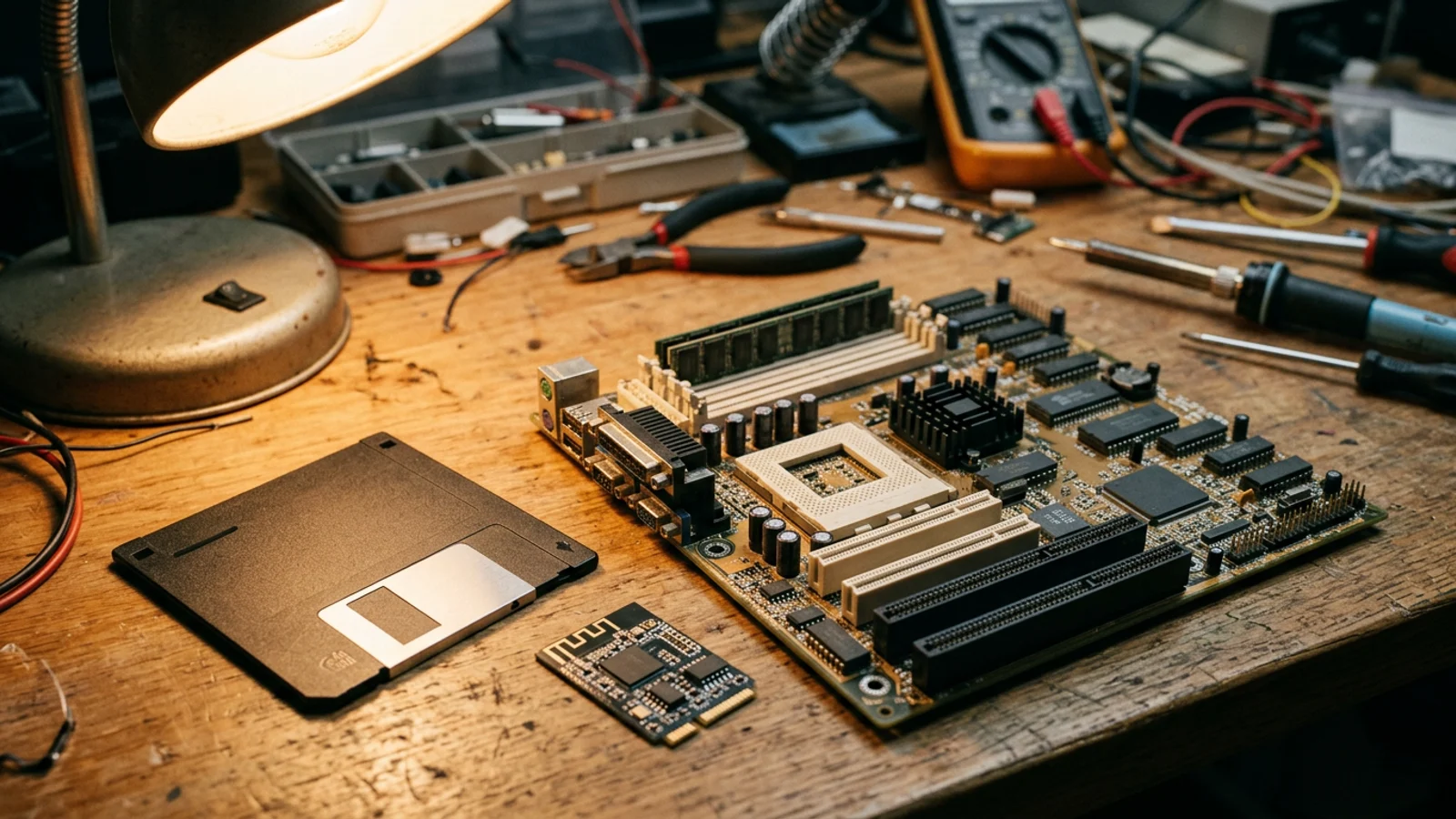
A DOS-era language model on a 486, an Arduino SBC pitched for agent memory, a Versal VLM paper, and Nordic's nRF71 NPU plus u-blox modules.
A 367K-parameter language model runs from a floppy on a 486
On November 18, 2026, hackaday.com covered a small transformer that targets a 486DX or Pentium under DOS and ships on one floppy. The network is 380 KB of 8-bit weights, needs about 540 KB of free memory, and holds roughly 3,500 facts in 367K parameters. hackster.io calls the project Tiny 2.1.
The caveat is built in. Hackaday notes that outside those facts the model makes things up freely. It also reports the C code (Turbo C 2.0) was written by one AI model and the network trained by another, so treat the provenance as the outlets' account. Neither write-up gives a speed figure that I could see.
It is a stunt, but a useful one. It shows how far weights can shrink when the task is narrow, which is the same budget a microcontroller faces.
Moorcheh pitches agent memory on Arduino's $399 VENTUNO Q
On November 18, 2026, the Arduino blog published a guest post by Tara Khani, CEO and co-founder of Moorcheh.ai. It asks whether a $399 single-board computer can index millions of technical documents and search video frames and audio logs.
This is a vendor-written partner post, so any numbers in it are self-reported. I read the summary, not benchmark tables, and I could not confirm how much of the pipeline runs locally versus calling out. Check that before treating it as on-device inference.
The idea is relevant anyway: local retrieval and memory is one of the more practical jobs for small boards.
HETEROVLM: serving a vision-language model on a Versal SoC
An arXiv paper posted on November 18, 2026, HETEROVLM, targets edge devices in vehicles and robots that serve several vision-language-model requests with different deadlines. Each request mixes a compute-bound vision encoder with a memory-bound decoder. The authors map the work across the AI Engines and programmable logic of a heterogeneous Versal SoC.
I only read the abstract, so I am not repeating any speedup. These are the authors' own results on one platform, and they have not been independently reproduced. Versal parts are also well above microcontroller class in cost and power.
The takeaway is the framing: on a robot, deadlines matter as much as throughput, so schedulers will matter as more models share one chip.
Nordic's nRF71 adds an NPU; u-blox builds modules on it
In a November 2026 announcement, Nordic Semiconductor said its nRF71 Series brings edge AI to battery-powered Wi-Fi devices through an integrated Axon Neural Processing Unit. It names keyword spotting, anomaly detection and image classification as practical workloads, and claims twenty times lower standby power. That figure is Nordic's own.
On November 18, 2026, the Adafruit blog, citing All About Circuits, reported that u-blox's new ALMA-W1 modules are built around the nRF7120 and nRF7120E.
The caveat: I saw no independent model benchmarks, and the workloads listed are small ones. Still, an NPU in a Wi-Fi part is where tiny models meet connected products.
ESP-IDF v6.1.1 listed as stable for ESP32-H2 and ESP32-P4
Espressif's documentation pages, listed on November 18, 2026, show ESP-IDF v6.1.1 as the stable SDK for both the ESP32-H2 and the ESP32-P4.
These are user-guide pages, not release notes, and I did not review the changelog, so I cannot say what changed in v6.1.1. For anyone building on those chips, it is the version the vendor currently points to.
Today's thread is how small the working set can get, from a floppy-sized transformer to NPUs in low-power radios. The claims above are mostly vendors' or authors' own, so read the sources.
References & Citations
- Hackaday, Not-So-Large Language Model Fits On A Floppy Disk, November 18, 2026 — https://hackaday.com/2026/11/18/not-so-large-language-model-fits-on-a-floppy-disk/
- Hackster.io, Bringing AI to the DOS Era, November 18, 2026 — https://www.hackster.io/news/bringing-ai-to-the-dos-era-7a21c15723e6
- Arduino blog / Tara Khani, Moorcheh on Arduino VENTUNO Q, November 18, 2026 — https://blog.arduino.cc/2026/11/18/building-agentic-memory-at-the-edge-with-moorcheh-on-arduino-ventuno-q-scale-multimodal-search-engine-to-millions-of-records/
- arXiv, HETEROVLM, November 18, 2026 — https://arxiv.org/abs/2611.23878v1
- Nordic Semiconductor, nRF71 Series edge AI announcement, November 2026 — https://www.nordicsemi.com/Nordic-news/2026/11/Nordic-brings-edge-AI-to-battery-powered-WiFi-devices-20-times-lower-standby-power-with-nRF71-Series
- Adafruit blog, u-blox ALMA-W1 modules, November 18, 2026 — https://blog.adafruit.com/2026/11/18/u-blox-brings-wifi-6e-and-edge-ai-to-low-power-iot-modules/
- Espressif, ESP-IDF User Guide for ESP32-H2 (v6.1.1), November 18, 2026 — https://www.espressif.com/en/node/11639
- Espressif, ESP-IDF User Guide for ESP32-P4 (v6.1.1), November 18, 2026 — https://www.espressif.com/en/node/11633
Subscribe to new posts from theaivibe.org
Related Posts
A 1.7B Non-Transformer LLM Targets the iPhone as Mobile NPUs Get a GUI Agent Paper
Liquid AI's LFM3 puts a 1.7B model in 1.9 GB on an iPhone 17 Pro, a new paper targets phone NPUs, and a $7 ESP32 drives an iPhone.
A 2-Bit LLM Kernel Triples CPU Speed in llama.cpp as Jetson Thor Gets an Industrial Box
llama.cpp merged an x86 VNNI Q2_0 kernel on November 15, a Jetson Thor box PC appeared, and an ESP32-S3 controller launched at $69.
A 0.8B Agent LLM, a 4.5M-Parameter Voice and Two 4-Bit Quantizers: Tiny AI Gets Specific
Tether's 0.8B tool-calling model, Huawei's W4A4 quantizer, a 4.5M-parameter open TTS and a lattice-quantization experiment, all with the caveats left in.