A Microcontroller Learns to Retrain Itself as On-Device AI Keeps Multiplying Tasks
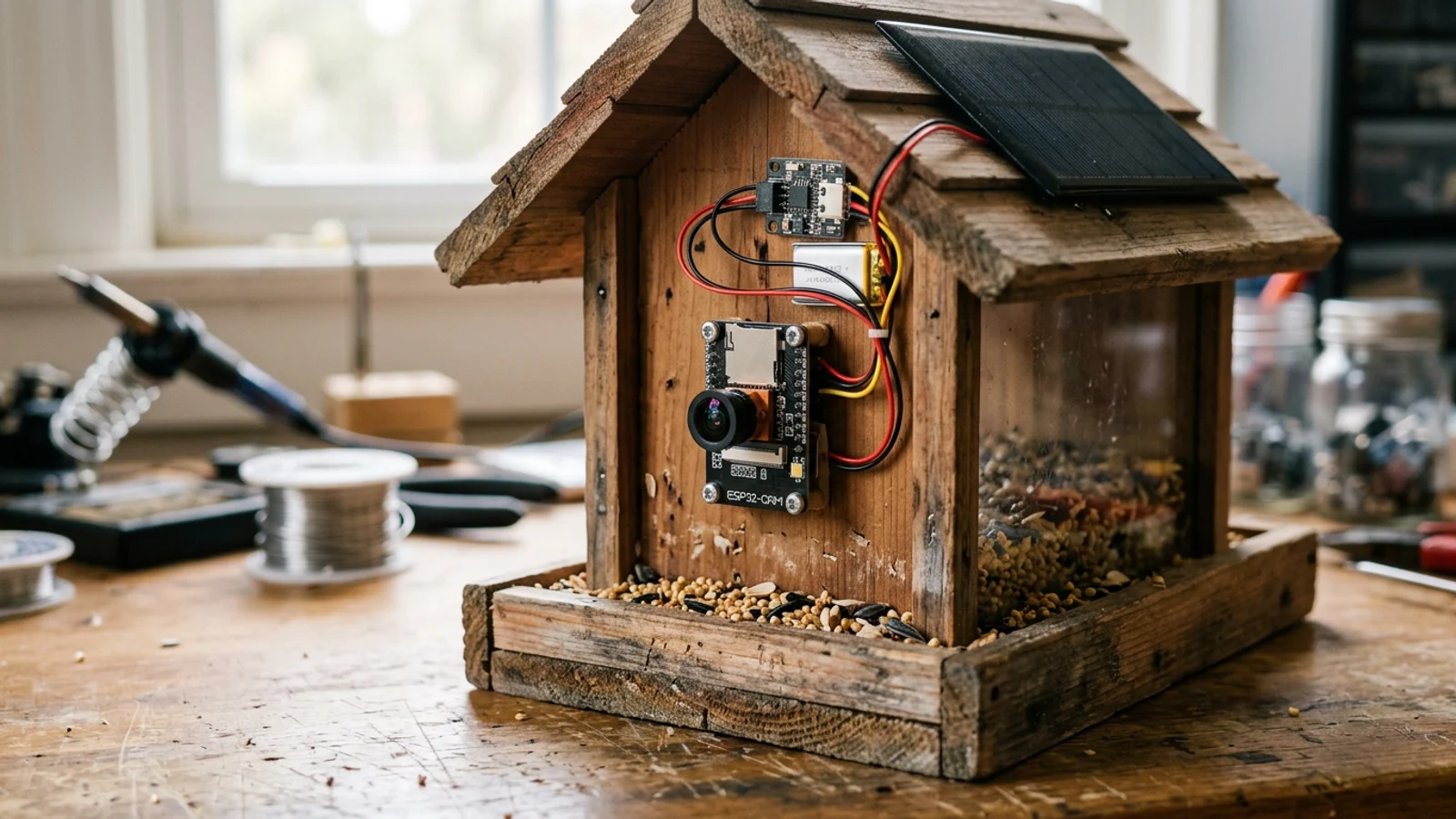
Fresh arXiv work tackles MCU vision drift and phone LLM memory pressure, while a solar bird feeder and a desktop WALL-E show the hobbyist edge staying busy.
Vision Models Learn On the Fly, Without Backprop
A paper posted on September 1, 2026 describes FORGE, a forward-only test-time adaptation method for integer-only vision models running on microcontrollers. The researchers behind the arXiv paper target a real deployment problem: quantized MCU vision models drift as the world in front of the camera changes, but the inference-only runtimes they ship in strip out backpropagation to save memory, leaving the model no way to correct itself in the field.
FORGE adapts using only forward passes and integer arithmetic, letting a camera-equipped sensor node adjust for lighting or sensor drift without leaving its 8-bit inference path or calling home for a fine-tune. The paper reports accuracy recovery on standard MCU vision benchmarks, though these are the authors' own numbers and have not been independently reproduced.
Forward-only adaptation is still new territory, and integer-only training-adjacent math carries its own error-accumulation risk. But for TinyML deployments, a technique that improves robustness without adding a floating-point unit or a network link is the unglamorous kind of progress that keeps battery-powered sensors useful for years, not months.
Phones Juggle Multiple Local Models, and Memory Becomes the Bottleneck
A September 1, 2026 arXiv paper introduces mzCache, a memory-management scheme for on-device LLM inference when a phone runs more than one AI task at once. The paper notes that most mobile LLM inference research assumes a single model running alone, which doesn't match a phone where a voice assistant, a keyboard predictor, and a background summarizer all want memory simultaneously.
The authors propose managing KV-cache and weight residency dynamically across tasks rather than statically per app, aiming to cut the memory thrashing that happens when several small models compete for the same limited RAM. Self-reported results show latency and memory-pressure gains over naive multitasking, but these are lab benchmarks on the authors' own workload mixes, not shipped phone software.
It's a narrow, plumbing-level contribution, but it's the kind of plumbing that decides whether "an LLM on your phone" means one polite assistant or a pile of models stepping on each other's RAM.
A Solar-Powered Bird Feeder Learns Its Visitors, Fully Offline
A hobbyist posted BirdWatch to r/esp32 on September 2, 2026: a solar-powered feeder built around an ESP32-CAM that identifies bird species locally. A PIR sensor wakes the board only when something lands, the camera grabs a frame, and an on-device model classifies the species before the board sleeps again, with no cloud API call and no standing network link.
It's a hobby build, not a peer-reviewed benchmark, and the builder's own post is candid that accuracy on similar-looking species is still a work in progress; no formal accuracy figure is shared beyond demo footage.
What makes it worth noting is the power budget: solar power plus PIR-gated wake cycles is the same pattern showing up across battery-run TinyML sensor nodes this year, and it's a reminder that running a model and running for months unattended are two separate engineering problems this project solves together.
A Desktop WALL-E Sees, Talks, and Drives Itself on One ESP32-S3
Maker Huy Vector built a desktop-scale WALL-E robot that talks, sees, and navigates on its own around a single ESP32-S3, according to a September 2, 2026 Hackster.io write-up. The robot pairs camera-based obstacle sensing with a voice pipeline, letting it roam a desk and react to what's in front of it without a host computer doing the thinking.
The write-up doesn't spell out exactly which parts of the pipeline run purely on the ESP32-S3 versus what might be offloaded, so "sees and talks" describes the finished demo rather than a confirmed fully-on-chip architecture. ESP32-S3 boards can run small vision and audio models locally, but they can also lean on a phone or server for the harder parts, and that boundary isn't detailed here.
Even with that caveat, it's another data point in a season full of them: hobbyists keep finding that a sub-$10 microcontroller is enough silicon to give a desk toy a sense of its surroundings.
Four small stories, one theme: the edge keeps getting more capable without getting bigger. The primary sources linked above carry the full detail behind each claim.
References & Citations
- FORGE paper — arXiv, Sept 1, 2026 — https://arxiv.org/abs/2609.01683v1
- mzCache paper — arXiv, Sept 1, 2026 — https://arxiv.org/abs/2609.01338v1
- BirdWatch build — r/esp32, Sept 2, 2026 — https://www.reddit.com/r/esp32/comments/1w59tlm/birdwatch_solarpowered_esp32cam_bird_feeder_with/
- Desktop WALL-E robot — Hackster.io, Sept 2, 2026 — https://www.hackster.io/news/desktop-wall-e-robot-talks-sees-and-roams-c28e943983e8
Subscribe to new posts from theaivibe.org
Related Posts
Jetson Thor Sprints Past llama.cpp While a 15M-Parameter LLM Still Fits an $8 Chip
NVIDIA posts a 6.4x MLPerf edge win on Jetson AGX Thor, a dense TinyStories model skips the flash trick, and a paper splits VLA robots between cloud and a tiny local model.
ESP32 Special: An $8 Chip Runs a 29-Million-Parameter LLM, and Vendors Rethink the Board Around It
A one-chip LLM, a Wi-Fi upgrade to Seeed's tiny displays, and Tuya's push to make ESP32 an AI-agent target, not just a Wi-Fi one.
A Wristband Reads Muscles, a Ring Wants Your Ideas: Edge AI Moves Onto the Body
New wearable and phone releases push transcription, gesture control and silent speech fully on-device, while ESP32 and Jetson tooling keeps pace.