A Diffusion Model and a 28.9M LLM Both Now Run on Bare Microcontrollers
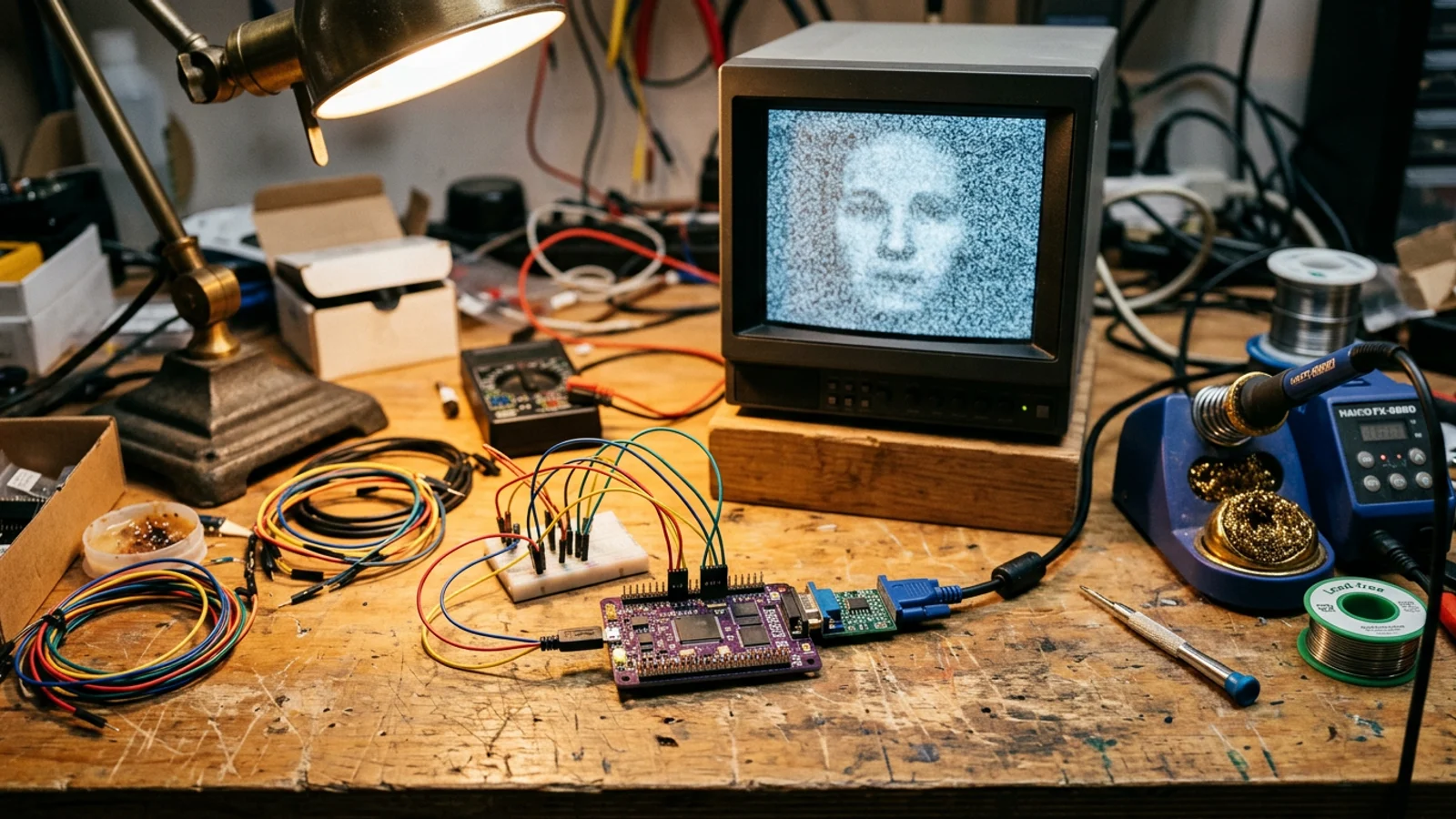
An RP2350 draws faces from noise, an ESP32-S3 writes stories, and AI smart glasses squeeze in a 1-bit model — all without a server.
A Latent Diffusion Transformer Fits Inside 4MB of RP2350 Flash
A builder known as Tim has gotten image generation running on a Raspberry Pi RP2350, using a latent flow diffusion transformer that starts from noise and iteratively steers it toward a coherent human face. Tim built two variants — 1.7 million and 2.9 million parameters — both trained on the FFHQ face dataset and quantized to 8-bit integers so both models plus the inference code fit inside 4MB of flash on a Waveshare RP2350 dev board, per the write-up on Retro Computers.
Each 128x128 RGB portrait takes roughly 10 to 20 seconds and can be viewed over USB or a VGA adapter. That is slow and low-resolution by any modern standard, and it is not going to replace a phone app. But squeezing a working diffusion pipeline — training, quantization, and inference — into a microcontroller with no GPU is a genuine engineering feat, and the project is fully open-sourced for anyone to reproduce.
A 28.9M-Parameter LLM Writes TinyStories on a Bare ESP32-S3
Developer slvDev has published esp32-ai, a 28.9-million-parameter language model that generates text entirely on an ESP32-S3, with nothing sent to a server. Only 3.9 million parameters live in SRAM; the other 25 million sit in a flash lookup table using Per-Layer Embeddings, a technique borrowed from Google's Gemma 3n. On a chip with 512KB SRAM, 8MB PSRAM and 16MB flash, it generates at 9.88 tokens per second, with the 14.9MB 4-bit model displayed live on a small screen.
Coverage from DailySynapse notes the MIT-licensed repo has already collected over 3,600 GitHub stars. The model writes TinyStories-style prose, not coherent essays, and it is a toy in the literal sense — but running a trained transformer with almost 29 million parameters on a chip that costs a few dollars, with zero cloud dependency, is exactly the kind of demo this beat exists for.
1-Bit Bonsai Squeezes 4x More Model Into AI Smart Glasses
At the Snapdragon Summit, PrismML demonstrated its 1-bit Bonsai model running locally on AI smart glasses built on Qualcomm's Snapdragon AR1 Gen 1 platform. The company says that within the same memory budget the 1-bit model fits roughly four times as many parameters as could previously run on the same glasses form factor, and claims token generation more than twice as fast as a 4-bit version of the same model while matching its output quality, according to Digital Market Reports.
These are PrismML's self-reported numbers from a vendor demo, not an independent benchmark, so treat the multipliers with appropriate skepticism until third parties test them. Still, 1-bit weight packing pushing more capable models onto AR glasses hardware — a device class with a tiny power and thermal envelope — is a real constraint being tackled, not just a marketing slide.
Orange Pi O1 Pairs an Octa-Core Sophgo BM1688 With SATA 3.0
Orange Pi has published hardware details for the Orange Pi O1, a 90 x 70mm single-board computer built around Sophgo's BM1688 processor, which pairs eight Arm Cortex-A53 cores with an NPU rated at 16 TOPS, according to LinuxGizmos. Notably for an SBC this size, it includes a SATA 3.0 port alongside the usual networking and GPIO.
16 TOPS on an octa-core A53 board is a modest but real on-device inference budget — enough for small vision and speech models running local, not a datacenter stand-in. The SATA port matters for edge deployments that need to log or buffer data locally rather than stream it out, which is precisely the use case this class of board increasingly targets.
Quectel's SE200ZC-AP Squeezes Five Camera Inputs Onto a 40mm Module
Quectel has launched the SE200ZC-AP, a 40 x 40mm smart camera module built on Rockchip's RV1126B/RV1126BJ quad-core Cortex-A53 SoC, according to CNX Software. The module packs a 12MP ISP and can drive up to five camera inputs off a single board, aimed at multi-angle inspection and security applications.
Multi-camera edge vision has usually meant multiple boards or an external switch; putting five camera lanes behind one Cortex-A53 SoC with on-chip AI ISP support is a compact way to run local vision inference — detection, ISP tuning, basic classification — without shipping raw video anywhere.
Two microcontrollers made diffusion models and small LLMs work without a network connection this week, while camera and SBC vendors kept quietly raising the local-inference floor on cheaper silicon. None of it replaces a datacenter GPU — that has never been the point.
References & Citations
- Retro Computers — Tim's RP2350 diffusion model, September 21, 2026 — https://retro-computers.co.uk/2026/09/21/tims-rp2350-image-generation-model-squeezes-diffusion-ai-into-4-mb-of-flash/
- slvDev/esp32-ai — GitHub repo — https://github.com/slvdev/esp32-ai
- DailySynapse — ESP32-S3 language model coverage — https://dailysynapse.com/news/developer-runs-small-model-on-microcontroller/
- Digital Market Reports — PrismML 1-bit Bonsai on Snapdragon glasses — https://digitalmarketreports.com/news/92455/prismml-brings-1-bit-bonsai-models-to-ai-smart-glasses-powered-by-snapdragon/
- LinuxGizmos — Orange Pi O1 SBC, September 24, 2026 — https://linuxgizmos.com/16-tops-ai-sbc-with-sata-3-0-runs-on-octa-core-sophgo-bm1688/
- CNX Software — Quectel SE200ZC-AP module, September 24, 2026 — https://www.cnx-software.com/2026/09/24/quectel-se200zc-ap-smart-module-supports-up-to-five-cameras-with-rockchip-rv1126b-bj-soc/
Subscribe to new posts from theaivibe.org
Related Posts
The ESP32 Beat Skips the LLM Today: A Desk Companion, Drumsticks, and a JavaScript OS
Three ESP32 builds this week show the chip's range — a reactive desk companion, motion-sensing drumsticks, and a scripting OS — none of them running a language model.
Tiny Audio AI Models Learn to Whisper Without Ever Calling Home
Two new speech stacks and a tool-calling model push voice AI fully on-device, while Nordic and Zephyr quietly harden the hardware underneath.
llama.cpp's Nightly Grind Teaches Phone Chips New AI Tricks While NVIDIA Ships a Rival Edge Runtime
Small llama.cpp builds keep adding Hexagon DSP ops, NVIDIA's TensorRT-Edge-LLM adds Day-0 model support, and a new leaderboard measures tokens per joule.