A 90-Million-Parameter LLM Talks From a 2004 PSP, While On-Device AI Keeps Finding Smaller Homes
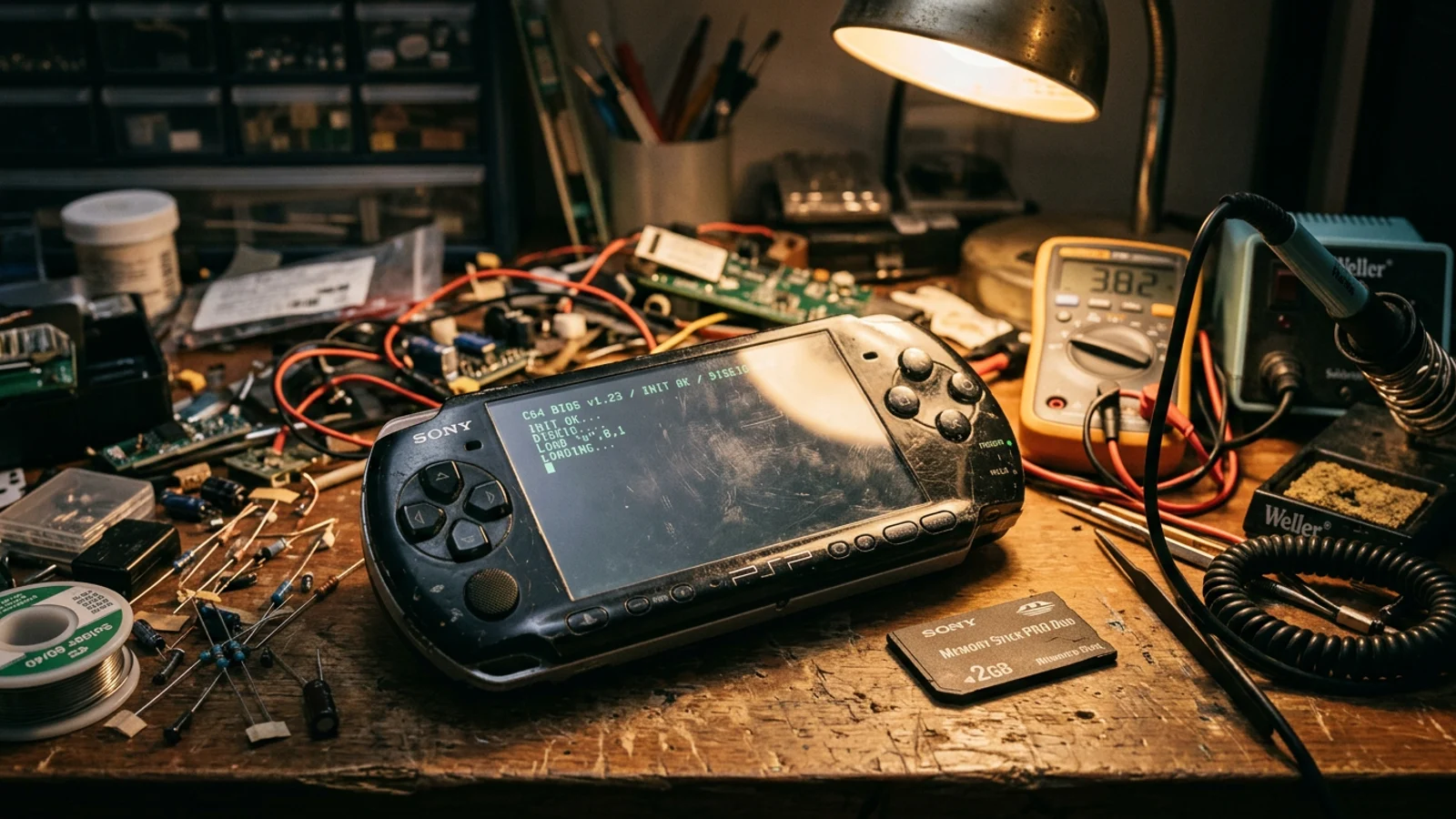
A modded Sony PSP runs a tiny LLM, a $3 chip learns to speak, and a 2B open model claims agentic skills for phones.
A 90-Million-Parameter LLM Talks on a 2004 Sony PSP
Developer thatblend built LLMPSP, a custom C runtime that boots from the PSP homebrew menu and runs Falcon-H1-Tiny-90M-Instruct, a TII model, entirely on the console's 333MHz MIPS CPU. The 52MB weight file is quantized to 4 bits in a custom FHQ4 format and streamed from a Memory Stick, with matvec kernels running on the PSP's VFPU, per a September 6, 2026 write-up on Traictory covering the original r/LocalLLaMA post by u/liright.
Speed is 0.5 to 0.6 tokens per second on a PSP-3000 — one to three minutes per reply — and only the 64MB PSP models (2000/3000/Street/Go) are supported; the original 32MB PSP-1000 can't hold the model.
This isn't a usable chatbot. It's proof that aggressive quantization and hand-written vector kernels can push transformer inference onto hardware with no AI silicon at all, designed decades before anyone imagined this use case.
A 2B Open Model Claims the Agentic Crown for Edge Devices
ModelBest and Tsinghua's OpenBMB community released MiniCPM5-2B this week, a 2.52-billion-parameter open model built to run tool calling, deep search, code generation and multi-step reasoning directly on phones and laptops. The team published weights, training data, RL infrastructure and deployment recipes for llama.cpp, Ollama and MLX under Apache 2.0, according to ModelBest's release.
The company says MiniCPM5-2B tops the Artificial Analysis Intelligence Index among open models under 4B parameters, ahead of larger rivals like Qwen3.5-4B. Those numbers are self-reported by the vendor via a third-party benchmark firm, not independently reproduced, and 'agentic' performance on a 2B model still means shorter tool chains than a 30B-class model handles, per a KOCPC write-up.
Still, a fully open, Apache-licensed 2B model with a documented agentic RL recipe lowers the bar for running tool-using assistants on modest hardware without a cloud API bill.
A $3 Microcontroller Learns to Speak, No Cloud Needed
Nepali developer Ashish Thapa, working through his new Ampixa Labs, open-sourced sanoTTS, a family of neural text-to-speech models running from 294,000 to 2.27 million parameters. The models run in real time on an ESP32-S3 board that costs roughly $3, and also compile to WebAssembly for browser use, per a report from KOCPC.
On the S3, the full pipeline — phoneme recognition through espeak-ng, an acoustic model, and waveform reconstruction — turns text into 4.54 seconds of speech in about 1.02 seconds, faster than real time. On the FPU-less ESP32-C3, the same C core needs roughly 5.7 times the clip's length to finish, so it isn't real-time on that cheaper chip yet.
It's a small project, but a useful data point on how far neural TTS can shrink: sub-3-million-parameter models producing speech without a GPU, an NPU, or a network connection.
Korea Bets on Domestic NPUs to Run Humanoid Robots
Nota Inc., a Korean model-optimization company, announced on September 8, 2026 that it will lead a government-backed sub-project pairing LG Electronics' humanoid robots with NPUs from Korean chipmaker Mobilint. Nota's job is lightweighting and optimizing large robot-control models so they run fast and accurately on domestic silicon with limited memory and compute, according to EDaily.
Details are thin: no model architecture, TOPS figures, or timeline for a working robot have been published. This is a project-selection announcement, not a shipped demo.
Still, it signals where Korea's edge-AI industrial policy is pointing — treating humanoid autonomy as an on-device optimization problem for domestic NPUs rather than something to hand off to Nvidia or Qualcomm silicon.
A Robot Arm Runs Its Own Vision-Language-Action Model Onboard
Dmitry Maslov of Hardware.ai mounted Arduino's newly released VENTUNO Q board onto an SO-101 robot arm and had it run SmolVLA, a small vision-language-action model, entirely on the board itself — two cameras and a stack of servos, no server in the loop, per his write-up on circuit.rocks.
SmolVLA is a compact policy model built for hardware-constrained deployment, but the post doesn't report task-success rates or latency numbers, so how it compares to larger VLA stacks running on Jetson-class hardware is still an open question.
The interesting part is architectural: a board built around a microcontroller-class form factor, not a GPU module, running the full perception-to-action loop without offloading inference anywhere.
Five stories today ranged from a 2004 handheld to a government-backed humanoid robot program — the throughline is that inference keeps moving closer to wherever the sensor and the actuator already sit.
References & Citations
- Traictory — 90M LLM on Sony PSP, September 6, 2026 — https://traictory.com/news/2026-09-06-90m-conversational-llm-sony-psp
- ModelBest/OpenBMB — MiniCPM5-2B release, PRNewswire, September 8, 2026 — https://www.prnewswire.com/news-releases/chinas-latest-ai-model-brings-general-purpose-agentic-capability-to-edge-devices-at-a-lower-cost-302873367.html
- KOCPC — MiniCPM5-2B write-up — https://en.kocpc.com.tw/archives/25293
- KOCPC — sanoTTS on ESP32-S3 — https://en.kocpc.com.tw/archives/25267
- EDaily — Nota Inc./LG Electronics/Mobilint humanoid NPU project, September 8, 2026 — https://en.edaily.co.kr/news/eda202609085049/
- Dmitry Maslov, Hardware.ai — Arduino VENTUNO Q robot arm running SmolVLA — https://blog.circuit.rocks/arduino-ventuno-q-runs-a-vision-model-on-a-robot-arm
Subscribe to new posts from theaivibe.org
Related Posts
Jetson Thor Sprints Past llama.cpp While a 15M-Parameter LLM Still Fits an $8 Chip
NVIDIA posts a 6.4x MLPerf edge win on Jetson AGX Thor, a dense TinyStories model skips the flash trick, and a paper splits VLA robots between cloud and a tiny local model.
ESP32 Special: An $8 Chip Runs a 29-Million-Parameter LLM, and Vendors Rethink the Board Around It
A one-chip LLM, a Wi-Fi upgrade to Seeed's tiny displays, and Tuya's push to make ESP32 an AI-agent target, not just a Wi-Fi one.
A Wristband Reads Muscles, a Ring Wants Your Ideas: Edge AI Moves Onto the Body
New wearable and phone releases push transcription, gesture control and silent speech fully on-device, while ESP32 and Jetson tooling keeps pace.