A $7 ESP32 Gives an AI Agent Hands on a Real iPhone While a 14M LLM Keeps a Fish Alive
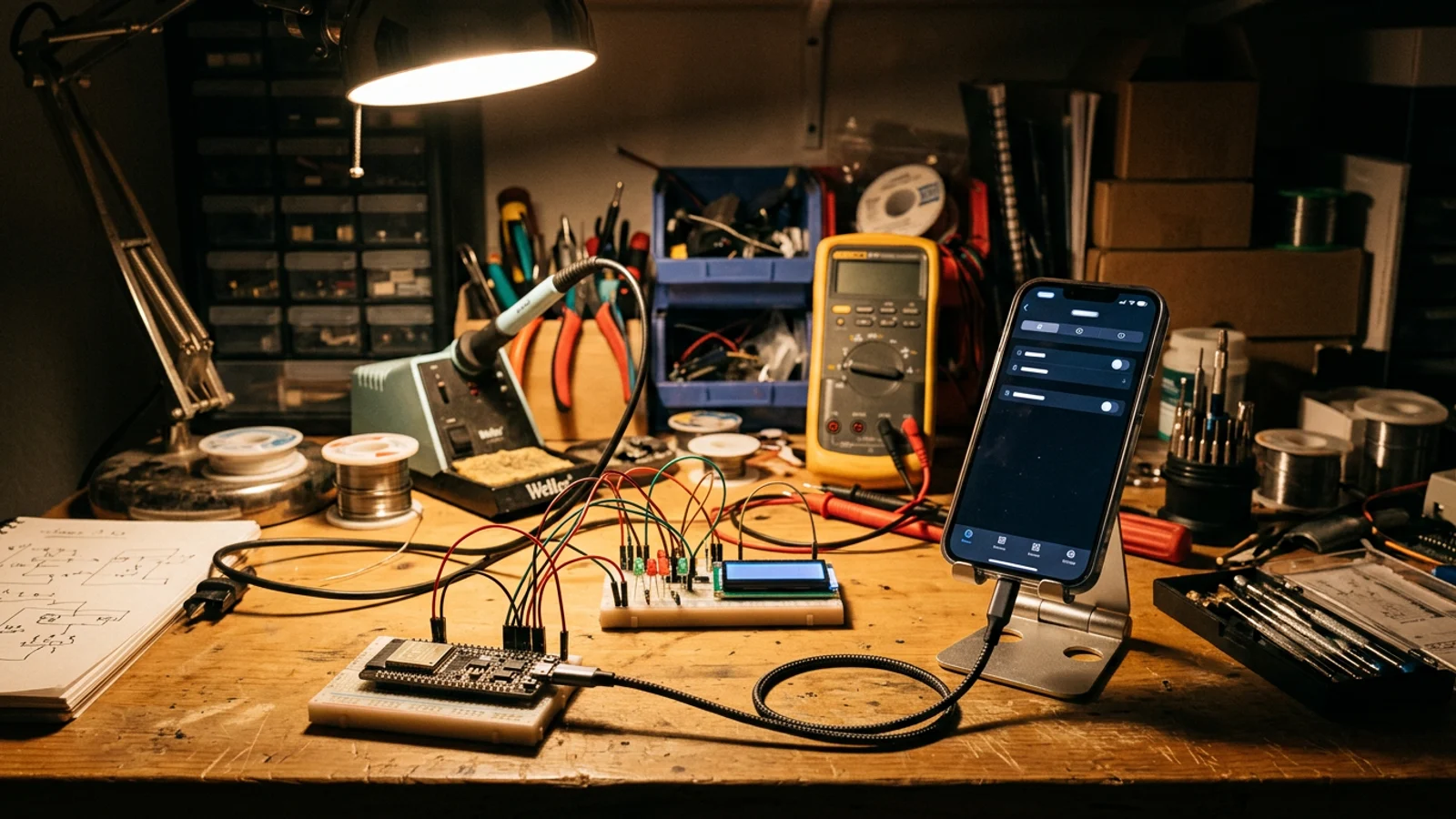
A cheap ESP32 becomes an AI agent's eyes and hands on a real iPhone, while a tiny distilled LLM runs an $8 virtual fish tank offline.
An ESP32 Lets an AI Agent Operate a Real iPhone
Developer onehumanbeing released esp32-iphone-agent on GitHub, picking up more than 4,000 stars by October 28, 2026, less than three weeks after the project started on October 11. A $7 ESP32-S3 receives the iPhone's screen over AirPlay, giving a connected AI model a live view of the interface, and emulates a USB keyboard and mouse (HID) to tap, swipe and type back into the phone. Any OpenAI-compatible model can be plugged in as the controller.
That last detail is the honest caveat: nothing about this is on-device inference. The ESP32 is a cheap bridge, not a brain — most users will point it at a cloud model like GPT-4o, so this is a cloud-with-eyes-and-hands demo more than a cloud-with-a-microphone one. The repo doesn't publish latency numbers for the full loop either.
Still, the pattern matters for this beat: a disposable microcontroller as the body an agent uses to operate stock consumer hardware, no jailbreak or Apple API required. It's the same shape as robot-control projects like quackd, just applied to a phone instead of a motor.
A 14-Million-Parameter LLM Keeps a Virtual Fish Alive on an $8 Board
Developer mediacutlet published pocket-tank on GitHub, started August 24, 2026 and trending again on October 28. It runs a 14-million-parameter language model, distilled from a 26-billion-parameter teacher, entirely on an $8 ESP32-S3, where it narrates and manages a virtual fish tank — a Tamagotchi-style pet whose only brain is a tiny LLM running fully locally.
The project doesn't publish accuracy or perplexity numbers, and a model this narrow is tuned for tank narration and simple decisions, not general chat — it's not a benchmark of broad reasoning ability.
What it demonstrates is the recipe increasingly used to get LLMs onto microcontrollers: distill a huge teacher down to tens of millions of parameters aimed at one narrow job, and the result can still run coherently offline on a chip that costs less than lunch.
A Decision Tree Watches You Drink Water, No Cloud Needed
Hackster user monxx_ie posted Smart Water Bottle Reminder: Edge AI on RT-Spark on October 28, 2026: a decision tree classifier running on an STM32 microcontroller spots drinking events from onboard sensors and reminds the user when they haven't had enough, entirely offline.
The write-up doesn't give accuracy figures for the drink-detection logic, so how often it misses a sip or false-triggers isn't documented.
Not every edge-AI win needs a neural network. A decision tree classifying a few sensor readings, with no connectivity and almost no compute, is the clearest version of what TinyML actually is for most real products on this beat.
Zephyr RTOS 4.5 Adds Two Architectures and On-Device Media Pipelines
The Zephyr Project released Zephyr RTOS 4.5 on October 28, 2026, adding support for two new architectures — Infineon's TriCore and Qualcomm's Hexagon DSP — along with a new multimedia pipeline framework called mpipe, a faster and broader network stack, and SBOM generation aimed at the EU Cyber Resilience Act.
The release notes describe new capability, not benchmarks, and don't detail how mature driver and board support is yet for either new architecture.
mpipe is the piece that matters most here: a standard way to move camera, microphone and sensor data through a pipeline is exactly the plumbing on-device voice and vision demos need, and Hexagon DSP support puts Zephyr within reach of boards built around a chip family already used for local audio inference.
A Pi Carrier Board Kickstarter Adds Jetson Support, NVMe and PoE
Australian company Rapid Analysis launched a new Kickstarter campaign on October 29, 2026 for Xerxes Home Lab, according to LinuxGizmos' report. The carrier board line, previously built around Raspberry Pi Compute Modules, now adds support for NVIDIA Jetson modules alongside NVMe storage and Power-over-Ethernet.
As a live crowdfunding campaign, pricing and ship dates are promises rather than a shipped spec sheet, and LinuxGizmos' piece doesn't list the final backer tiers.
Jetson support on a carrier board family that already serves Raspberry Pi CM4/CM5 gives one physical platform a path to either a cheap MCU-class brain or a full Jetson running real vision or LLM workloads, without redesigning the carrier — the same pattern seen when Espressif's ESP32-P4 landed on Pi-shaped carrier boards earlier this week.
From a $7 microcontroller playing hands for an AI agent to a decision tree watching a water bottle, the thread today is how little silicon it takes to do a real job offline — whether or not an LLM is involved at all.
References & Citations
- onehumanbeing/esp32-iphone-agent — GitHub, October 28, 2026 — https://github.com/onehumanbeing/esp32-iphone-agent
- mediacutlet/pocket-tank — GitHub, October 28, 2026 — https://github.com/mediacutlet/pocket-tank
- monxx_ie — Hackster, October 28, 2026 — https://www.hackster.io/monxx-ie/smart-water-bottle-reminder-edge-ai-on-rt-spark-462a9b
- Zephyr Project blog, October 28, 2026 — https://www.zephyrproject.org/zephyr-rtos-4-5-now-available-two-new-architectures-multimedia-pipelines-sboms-and-more/
- LinuxGizmos, October 29, 2026 — https://linuxgizmos.com/xerxes-home-lab-adds-jetson-support-nvme-and-poe/
Subscribe to new posts from theaivibe.org
Related Posts
A $25 ESP32 Trains Its Own Tiny LLM While an 8B MoE Model Squeezes Under 1GB of RAM
From a from-scratch LLM on a $25 microcontroller to an 8B MoE model living in under a gigabyte, the edge keeps shrinking its memory budget.
A Viral Android AI Agent Taps Its Own Phone While a Neuromorphic Chip Teaches a Raspberry Pi to Learn Live
An open-source Android AI agent tops 2,100 GitHub stars in two days as a neuromorphic kit teaches a Raspberry Pi 5 to learn sounds on the fly.
A Game Runs Entirely on a $6 Chip While AMD Tries to Skip ROCm for Local AI
A tiny world model plays games on a Pico 2 W, AMD ships an early NPU/GPU SDK, and a measurement study checks edge-NPU VLM hype.