A 312K-Parameter LLM Learns to Flip Switches as Pi Prices Climb Again
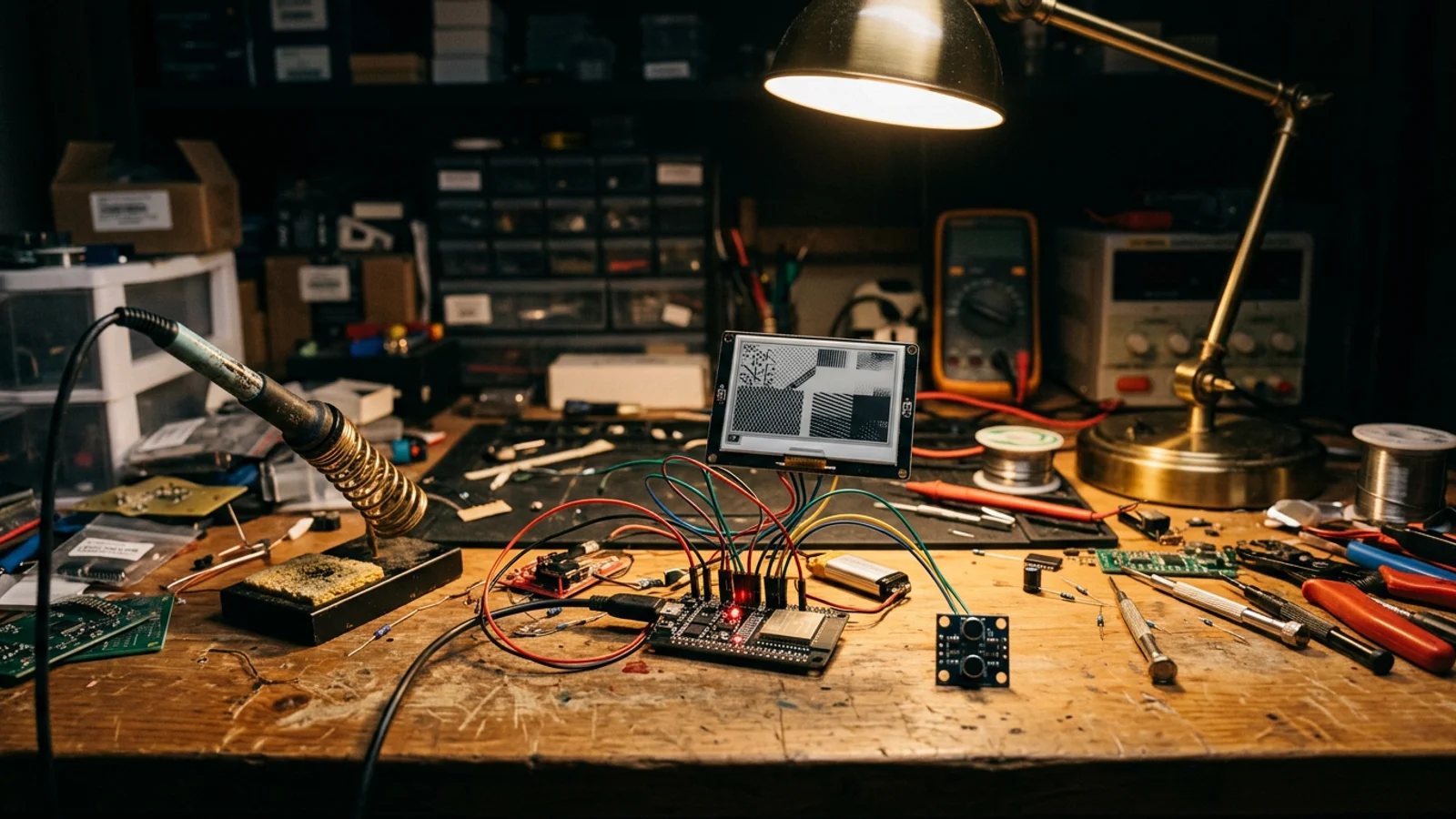
A tiny GPIO-control model and a Japanese TTS join the ESP32 pile-up while Raspberry Pi raises prices and a Jetson robot chases bubbles.
A 312K-Parameter Transformer Learns to Flip GPIO Pins
The open-source esp32-gpio-llm project puts a 312,000-parameter transformer on an ESP32-S3 that turns plain-English commands like "blink the desk lamp every two seconds" into GPIO actions, entirely offline. No Wi-Fi, no cloud API, no API key. The model occupies about 1.2MB of flash and uses roughly 302KB of PSRAM for its key-value cache, with reported command latency of 150 milliseconds to 1.5 seconds.
The honest caveat: the model never touches hardware directly. It converts language into a compact command format, and a separate firmware layer validates the pin and operation before anything executes — a sensible safety boundary, but a reminder this is narrow intent parsing, not general chat.
It is still a useful data point for the beat: task-specific micro-LLMs for appliance control now fit comfortably inside a $5 chip's spare flash, released under MIT with training, inference and firmware code public.
A 559K-Parameter TTS Speaks Japanese From an ESP32-S3
Developer ayutaz has posted sanoTTS-jp, a 559,000-parameter Japanese text-to-speech model that synthesizes speech in real time on an ESP32-S3, verified running on an M5Stack CoreS3. The pipeline does morphological analysis and accent estimation for mixed kanji-kana text on the device itself, with no external dependencies in the inference path.
The repository is young — created on August 27, 2026, with 67 stars as of this week — and the author has not published word-error or naturalness benchmarks against larger TTS systems, so judge the claim as self-reported for now.
Still, it adds a third leg to the ESP32-S3 voice stack this quarter, alongside separate ASR and GPIO-control projects on the same silicon, pointing toward fully offline voice assistants in languages beyond English.
A Jetson AGX Thor Robot Learns to Pop Soap Bubbles With a VLA Policy
Seeed Studio published a build log on September 30, 2026 describing a mobile robot that uses a Jetson AGX Thor module and an SO-ARM manipulator to track and strike a transparent soap bubble, guided by a vision-language-action (VLA) policy running on the robot's onboard compute. Seeed's write-up frames the transparent target as a stress test for perception, since bubbles reflect and refract light rather than presenting a solid edge.
The caveat: this is a vendor-adjacent demo post, not a peer-reviewed benchmark — no success-rate numbers or latency figures are published, so treat it as a capability showcase rather than a measured result.
It still matters for the beat because it shows VLA inference running on Jetson-class edge silicon rather than being piped to a cloud GPU, which is where most practical robot deployments need the compute to live.
Raspberry Pi Raises Prices Again, Memory Costs Blamed
Raspberry Pi Ltd announced on October 1, 2026 a $12.50 price increase on the 2GB variants of the Raspberry Pi 4 and Raspberry Pi 5, in a post on its own blog citing sustained DRAM and NAND cost pressure tied to AI-driven memory demand. The company's statement says it does not expect relief in the next couple of years, a line also picked up by Hackster's report.
This is the latest in a string of 2026 increases, not a one-time correction, so budget-conscious builders should expect further creep.
For edge AI specifically, the Pi's price is the floor for a lot of on-device vision and small-LLM projects; as it rises, more hobbyists will weigh RP2350-class microcontrollers or used hardware instead of a fresh Pi.
Makerfabs' New E-Ink Board Pairs an ESP32-S3 With a Mic Array and IMU
Makerfabs has added a 7.5-inch model to its MaTouch E Ink line, pairing an 800×480 four-color electrophoretic display with an ESP32-S3 controller, a four-microphone array and an IMU, according to a report published October 1, 2026 on LinuxGizmos.
The write-up covers the spec sheet rather than confirming shipped voice firmware, so the mic array is best read as an invitation for builders to pair it with existing offline ASR projects on the same chip rather than a ready-made assistant out of the box.
It is a small but notable combination for the beat: a low-power e-ink display, a wake-word-capable mic array and an IMU on one $-class board, all without a mandatory cloud link for the UI to function.
Small models keep finding new jobs on the same handful of chips — GPIO control, Japanese speech, bubble-popping robots — while the hardware under them keeps getting a little pricier and a little more specialized.
References & Citations
- opensourceforu.com — esp32-gpio-llm, September 2026 — https://www.opensourceforu.com/2026/09/esp32-s3-runs-open-source-gpio-language-model/
- ayutaz/sanoTTS-jp — GitHub, 2026 — https://github.com/ayutaz/sanoTTS-jp
- Seeed Studio blog — Jetson AGX Thor bubble robot, September 30, 2026 — https://www.seeedstudio.com/blog/2026/09/30/how-a-jetson-agx-thor-powered-mobile-robot-tracks-and-hits-a-transparent-bubble-with-vla-and-so-arm/
- Raspberry Pi — price increase announcement, October 1, 2026 — https://www.raspberrypi.com/news/price-increases-for-2gb-raspberry-pi-4-and-raspberry-pi-5/
- Hackster.io — Raspberry Pi price hike report, October 1, 2026 — https://www.hackster.io/news/raspberry-pi-announces-another-price-hike-adding-12-50-to-the-raspberry-pi-4-5-2gb-variants-99e409599904
- LinuxGizmos — Makerfabs MaTouch E Ink board, October 1, 2026 — https://linuxgizmos.com/esp32-s3-e-ink-board-with-800x480-display-mic-array-and-imu/
Subscribe to new posts from theaivibe.org
Related Posts
ESP32 Special: Small LLMs Learn to Chat, Listen and Keep the Fish Alive
A full day inside the ESP32 world: chatty microcontroller LLMs, a $5-chip speech model, and two new boards from Espressif's own community.
Wearable AI Chips Land as an ESP32 Board Learns to Run a Full Offline Voice Loop
From a Qualcomm earbud chip to an ESP32-S3 that hears, thinks and speaks with no cloud, edge AI keeps shrinking into pockets and ears.
A $300 GPU Streams a 177B AI Model From an SSD While llama.cpp Learns to Skip Ahead
Community builders push token throughput further this week — via SSD-streamed MoE experts, prompt-lookup drafting, and a wrapper for Apple's built-in on-device LLM.