A 27B AI Hits an iPhone's Neural Engine at 3 Bits While a 14M LLM Keeps a Fish Tank Alive on ESP32
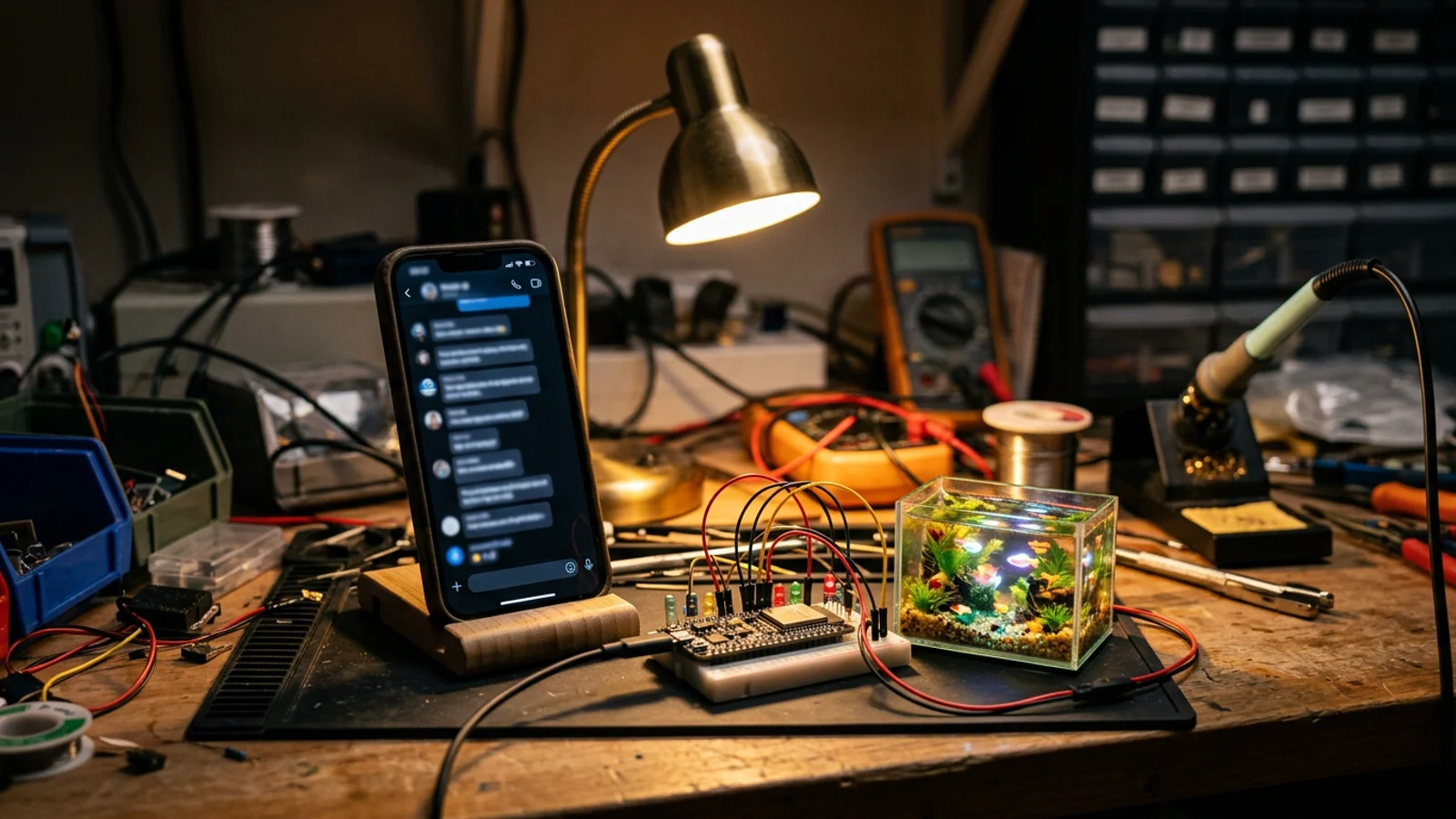
Apple's Neural Engine runs a 27B model at low bit-width, a distilled 14M LLM animates a $8 microcontroller pet, and new research questions KV-cache quant on Raspberry Pi.
A 14M LLM Keeps a Virtual Fish Tank Alive on an $8 Chip
Hobbyist project pocket-tank, posted by mediacutlet and climbing past 226 stars on GitHub as of October 18, 2026, runs a 14-million-parameter language model distilled from a 26-billion-parameter teacher directly on an $8 ESP32-S3. The model drives the behavior and dialogue of a virtual fish tank, with no cloud call for inference.
The caveat: this is a toy by design, not a benchmark win. A 14M model distilled for one narrow task (tank chatter) tells you little about general reasoning, and the distillation process and eval details are self-published in the repo rather than peer reviewed.
Still, it is a concrete demonstration that purpose-built micro-LLMs can run entirely on cheap silicon for playful, always-on applications, which is exactly the kind of workload the edge-AI crowd keeps testing for.
3-Bit Vector Quantization Brings a 27B Model to the Neural Engine
The ANEMLL Forge 0.2 release adapts Qwen3.8-27B to Apple's Neural Engine using a three-bit vector-quantization scheme for every MLP matrix, combining fixed rotations, GPTQ, and 600 steps of quantization-aware training. On an M6 chip the compiled model's prediction fidelity (KL-512 against the BF16 reference) improved from 0.1838 in the prior release to 0.0518, averaging 37.5 tokens/sec across 24 chat and coding prompts, per the project's own writeup.
A companion post, discussed on Hacker News on October 17, 2026, claims 15 to 70 tokens/sec on an iPhone 18's Neural Engine. Packed weights still take 9.74 GiB, so this is squarely a phone-with-a-lot-of-RAM story, and the fidelity metric is self-reported, not a standardized accuracy benchmark.
The point is that mainstream on-device chips are absorbing sub-2-bit MoE-scale models without resorting to full-precision fallback, a trend quant researchers have been chasing for a year.
A Raspberry Pi Audit Finds KV-Cache Compression Costs More Energy, Not Less
A new arXiv paper (2610.14475v1) builds EdgeLLM-Nano, an 8.39-million-parameter, 33.6 MB decoder-only testbed, to measure KV-cache compression methods end-to-end on a Raspberry Pi 5. The researchers found every compression backend they tried was less energy-efficient per token than uncompressed FP16, except KIVI, which came close to lossless.
They also introduce a new metric, Long-Context Decode Fidelity, after showing that standard perplexity gave an identical 5.461 score to every method tested, masking real differences a token-by-token measure could catch.
The caveat is scale: this is a nano testbed, not a production LLM, so the absolute numbers won't transfer directly. But the methodology is a useful warning that KV-cache quantization tricks popular in bigger-model papers may not pay off the way vendors assume once they hit real Pi-class hardware.
llama.cpp Adds Lower-Bit Quant Formats for Qualcomm's Hexagon NPU
In an update merged into llama.cpp's Hexagon backend this week, developers added support for Q1_0 and Q2_0 quantization formats targeting Qualcomm's Hexagon NPU, alongside tiling and vector-dot tweaks meant to cut overhead, according to oossa.com's writeup of the developer guide. The change applies to Linux and Windows builds spanning Snapdragon CPUs, Adreno GPUs and Hexagon NPUs.
No new benchmark numbers accompany the release, so it's unclear yet how much faster sub-2-bit inference actually gets on real Snapdragon hardware. This follows the earlier im2col-3D work on the same backend, and extends the set of ultra-low-bit formats a Hexagon NPU can run natively instead of falling back to CPU paths.
That matters because the bulk of today's 1-bit and sub-2-bit models, including the ones showing up weekly on Hugging Face, need a runtime that actually understands their weight packing on NPU silicon, not just on GPU.
M5Stack Revives Its E-Paper Dev Kit With an ESP32-S3 Brain
M5Stack released the PaperDIY series on October 17 and 18, 2026, an update to its 2020 M5Paper kit that swaps in an ESP32-S3 MCU paired with a 4.7-inch e-paper display running at 960×540 resolution with 16 levels of grayscale, according to CNX Software and a separate LinuxGizmos report on the Assembly Kit variant.
This is a bare-metal board launch with no AI model attached; the spec is the story — a dual-core ESP32-S3 running low-power e-paper at a resolution that's now standard across several competing kits this month.
For the edge-AI crowd, cheap, low-power e-paper front ends like this one are the kind of hardware local voice assistants and sensor dashboards increasingly use to show status without burning battery on a backlit LCD.
ESP32 Firmware Now Runs Entirely in a Browser Tab
A Show HN post on October 17, 2026 introduced esp32sim by mikroverk, a project that emulates ESP32 firmware in-browser without any physical hardware, and climbed to 180 points and 33 comments on Hacker News the same day.
It is an independent, unofficial tool, not an Espressif product, and peripheral emulation fidelity varies by commenter accounts in the thread — some GPIO and radio behavior reportedly isn't fully modeled yet.
Useful anyway: a browser-based emulator lets developers, including AI coding agents writing firmware, test build logic and sketch flow before flashing a real board, which shortens the loop for the kind of embedded work this beat covers daily.
Today's thread is quantization getting more honest: a lab audit finds KV-cache tricks that cost energy instead of saving it, even as Apple's Neural Engine and a $8 microcontroller both prove sub-2-bit weights can run real workloads when the engineering is careful.
References & Citations
- mediacutlet/pocket-tank — GitHub, Oct 18, 2026 — https://github.com/mediacutlet/pocket-tank
- ANEMLL — Hugging Face blog, Oct 16, 2026 — https://huggingface.co/blog/anemll/three-bit-mlp-vector-quantization-on-ane
- ANEMLL — Hacker News thread, Oct 17, 2026 — https://news.ycombinator.com/item?id=50133500
- EdgeLLM-Nano — arXiv 2610.14475, Oct 2026 — https://arxiv.org/abs/2610.14475
- EdgeLLM-Nano — SyncAI.news coverage — https://syncai.news/article/edgellm-nano-auditing-polar-guided-key-cache-compression-and-consistency-anchore-81fc78
- oossa.com — llama.cpp Hexagon NPU quant update — https://oossa.com/en/llama-cpp-adds-q1-0-and-q2-0-quant-support-for-hexagon-npu
- CNX Software — M5Stack PaperDIY, Oct 18, 2026 — https://www.cnx-software.com/2026/10/18/m5stack-paperdiy-kits-pair-an-esp32-s3-mcu-with-a-4-7-inch-e-paper-display/
- LinuxGizmos — M5Stack PaperDIY Assembly Kit, Oct 17, 2026 — https://linuxgizmos.com/m5stack-paperdiy-assembly-kit-opens-up-4-7-inch-e-paper-development/
- mikroverk/esp32sim — GitHub + HN, Oct 17, 2026 — https://github.com/mikroverk/esp32sim
Subscribe to new posts from theaivibe.org
Related Posts
A $25 ESP32 Trains Its Own Tiny LLM While an 8B MoE Model Squeezes Under 1GB of RAM
From a from-scratch LLM on a $25 microcontroller to an 8B MoE model living in under a gigabyte, the edge keeps shrinking its memory budget.
A Viral Android AI Agent Taps Its Own Phone While a Neuromorphic Chip Teaches a Raspberry Pi to Learn Live
An open-source Android AI agent tops 2,100 GitHub stars in two days as a neuromorphic kit teaches a Raspberry Pi 5 to learn sounds on the fly.
A Game Runs Entirely on a $6 Chip While AMD Tries to Skip ROCm for Local AI
A tiny world model plays games on a Pico 2 W, AMD ships an early NPU/GPU SDK, and a measurement study checks edge-NPU VLM hype.