A $1 Microcontroller Learns to Dream Faces as On-Device AI Keeps Shrinking
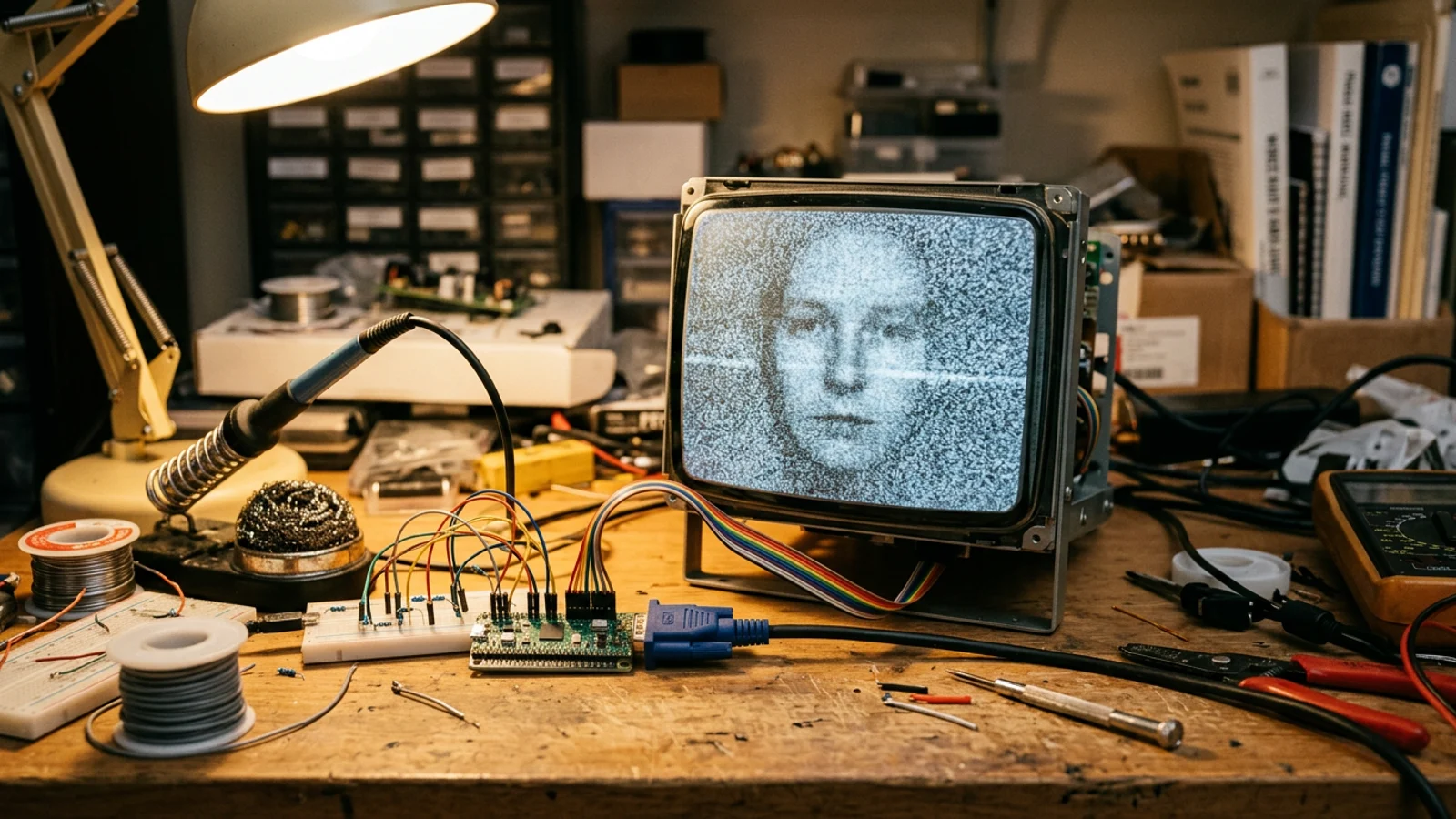
An RP2350 chip runs a diffusion model, an ESP32-S3 speaks Japanese, and researchers tackle mobile power and tiny-drone control at the edge.
A Diffusion Model Runs Entirely on a $1 Chip
In a blog post dated August 28, 2026, developer Tim (cpldcpu) got a generative image model running on the RP2350, the microcontroller inside the Raspberry Pi Pico 2. The model, a latent flow diffusion transformer trained on the FFHQ face dataset, comes in 1.7M and 2.9M parameter variants and generates 128×128 RGB faces in 10 to 20 seconds, viewable on a VGA monitor or streamed over USB. INT8 weights are streamed from flash via DMA while both Cortex-M33 cores run overclocked to 300MHz, and the whole engine plus model fits under 4MB of flash.
The honest caveat: this only generates human faces from a small set of conditioning classes, not arbitrary prompts, and each image still takes several seconds. It is not a text-to-image system.
Still, running a diffusion transformer — the same family of architecture behind Flux — on 520KB of RAM, no GPU, no cloud, is a real step for what generative AI can mean on the cheapest tier of hardware. cpldcpu's write-up has the code; CircuitDigest covers the build.
A Half-Million-Parameter Japanese TTS Speaks From an ESP32-S3
Developer ayutaz published sanoTTS-jp, a 559,000-parameter Japanese text-to-speech engine that runs in real time on an ESP32-S3, verified on an M5Stack CoreS3. According to the GitHub repo, the pipeline handles morphological analysis and pitch-accent estimation for kanji-kana mixed text entirely on the chip, with zero external dependencies at inference time.
These numbers are self-reported by the builder and haven't been independently benchmarked, and a 559K-parameter model will inevitably sound more mechanical than cloud-grade TTS. Japanese is also a hard language for on-device synthesis because accent placement usually needs a real linguistic pipeline, not just phoneme lookup.
That's the part worth noting: doing the text-normalization and accent work on the microcontroller itself, rather than pre-processing on a bigger machine, is unusual for TinyML voice projects and shows how much of the speech pipeline can move to the edge.
FPGA Control Loops Chase Tiny Drones Down to the Millisecond
A paper posted to arXiv on September 8, 2026, titled AccelMPC describes an FPGA-accelerated Model Predictive Control system aimed at tiny aerial robots, targeting order-of-magnitude gains in control rate and power efficiency over current embedded controllers.
It's a research paper, not a shipped product, and the abstract doesn't specify which FPGA board or how it compares against commodity MCU controllers in flight tests — that detail needs the full paper.
Worth watching anyway: most edge-robotics coverage lately has been about VLA policies running inference on Jetson-class boards. This is a reminder that classical control loops, not just learned policies, are also being pushed onto small, low-power silicon for the smallest robots.
A Paper Targets the Power Budget Behind Phone LLMs
Posted September 9, 2026, PELM proposes combining speculative decoding with dynamic voltage and frequency scaling to cut power draw during on-device LLM inference on mobile platforms.
The results are self-reported by the authors and, as with most inference papers, the gains will depend heavily on which chip and which model size gets tested — DVFS behavior varies a lot across mobile SoCs.
The framing matters more than the exact numbers: recent edge papers have mostly attacked memory bandwidth as the bottleneck for phone LLMs. PELM is one of the first to explicitly go after the power and thermal budget instead, which is the other wall phones hit once a model actually fits in memory.
A Coaster-Sized Linux PC Packs an NPU and a Playdate Screen
Pamir AI launched the Lapis One on September 9, 2026, a Linux mini computer built around a Rockchip NPU, with a Playdate-style low-power display and built-in KVM features, all in a coaster-sized form factor, according to Hackster's coverage.
Specifics on NPU TOPS and independent benchmarks aren't in yet — this is a fresh launch, and vendor claims about local AI performance on tiny NPU boards deserve the same scrutiny as the bigger AI PC launches.
Still, it's another entry in the growing pile of pocket-sized boards trying to make an NPU, a screen, and Linux fit on something you could leave on a desk without thinking about it.
From a face-generating Pico 2 to power-aware phone inference and a coaster-sized NPU box, the edge keeps proving it can absorb workloads that used to need a GPU rack — a few seconds and a few watts at a time.
References & Citations
- cpldcpu — personal blog, August 28, 2026 — https://cpldcpu.github.io/2026/08/28/ai-image-generation-on-a-rp-pico-2-microcontroller/
- CircuitDigest — coverage of RP2350 diffusion project, 2026 — https://circuitdigest.com/news/he-trained-a-2-9m-parameter-ai-image-generation-model-ran-it-on-a-1-rp2350-chip-and-open-sourced-the-project
- ayutaz/sanoTTS-jp — GitHub repo, September 10, 2026 — https://github.com/ayutaz/sanoTTS-jp
- AccelMPC — arXiv paper, September 8, 2026 — https://arxiv.org/abs/2609.09380v1
- PELM — arXiv paper, September 9, 2026 — https://arxiv.org/abs/2609.09662v1
- Hackster.io — Pamir AI Lapis One launch, September 9, 2026 — https://www.hackster.io/news/pamir-ai-launches-the-lapis-one-linux-computer-2c5446b94a23
Subscribe to new posts from theaivibe.org
Related Posts
Jetson Thor Sprints Past llama.cpp While a 15M-Parameter LLM Still Fits an $8 Chip
NVIDIA posts a 6.4x MLPerf edge win on Jetson AGX Thor, a dense TinyStories model skips the flash trick, and a paper splits VLA robots between cloud and a tiny local model.
ESP32 Special: An $8 Chip Runs a 29-Million-Parameter LLM, and Vendors Rethink the Board Around It
A one-chip LLM, a Wi-Fi upgrade to Seeed's tiny displays, and Tuya's push to make ESP32 an AI-agent target, not just a Wi-Fi one.
A Wristband Reads Muscles, a Ring Wants Your Ideas: Edge AI Moves Onto the Body
New wearable and phone releases push transcription, gesture control and silent speech fully on-device, while ESP32 and Jetson tooling keeps pace.