Wearable AI Chips Land as an ESP32 Board Learns to Run a Full Offline Voice Loop
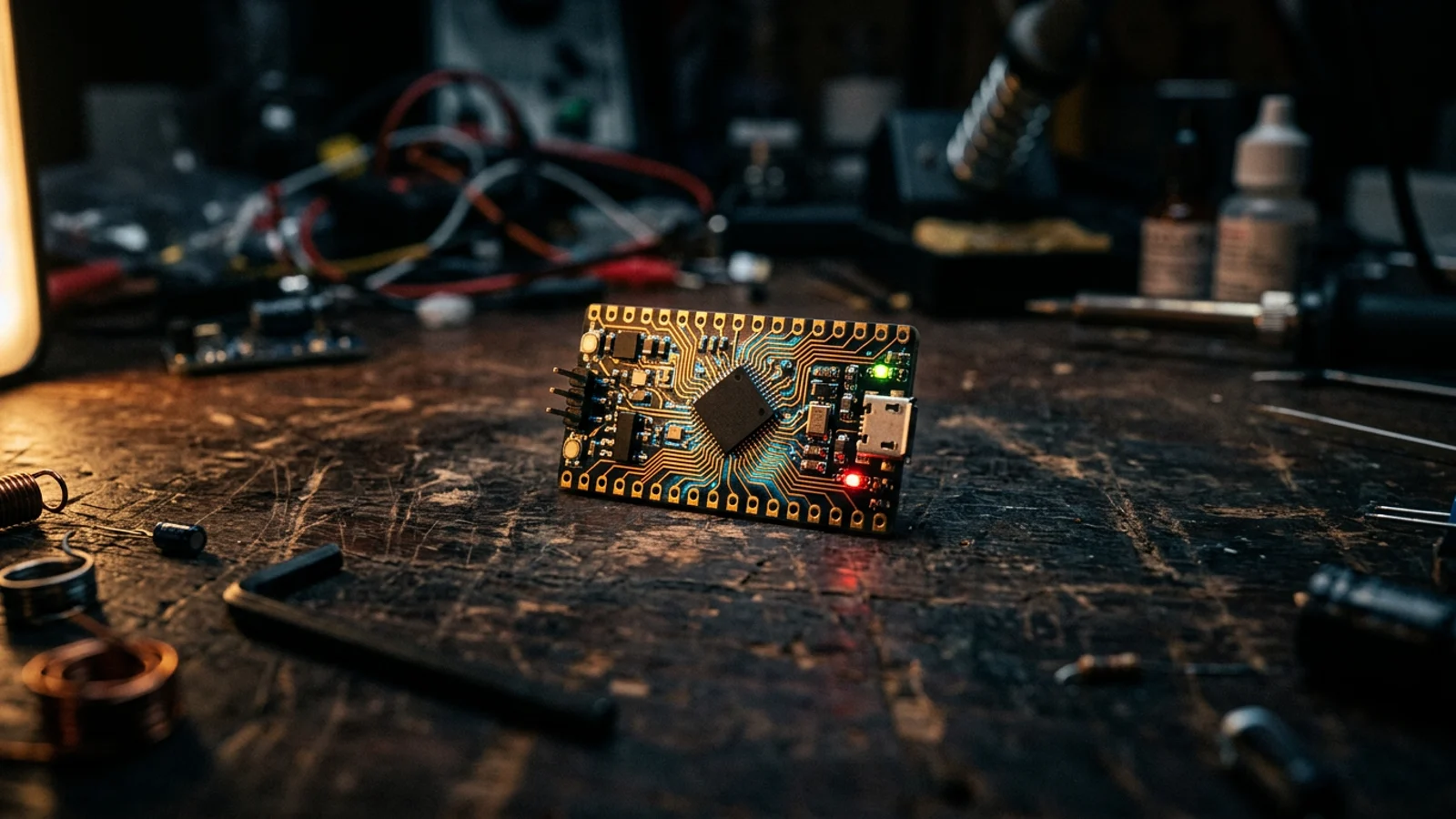
From a Qualcomm earbud chip to an ESP32-S3 that hears, thinks and speaks with no cloud, edge AI keeps shrinking into pockets and ears.
An ESP32-S3 Board Runs the Whole Voice Loop Offline
Developer Ankush Pandit published esp_ai on GitHub, a project created on September 19, 2026 that puts free-form speech-to-text, a tiny language model and text-to-speech entirely on a Freenove FNK0104B ESP32-S3 board. By September 28, 2026 it had climbed GitHub's trending list with 18 stars.
The repo is early and the star count modest, and the language model behind it is necessarily small, so do not expect conversational depth. But the whole pipeline — hearing, understanding and answering — runs on a sub-$20 microcontroller with no server round trip.
That matters because most projects calling themselves 'offline voice assistants' still phone home for the language model step. This one does not.
An Integer-Only Speech Model Skips the CPU on Mobile NPUs
Researchers describe I-Parakeet, an integer-only rebuild of NVIDIA's 0.6B-parameter Parakeet-CTC speech model that runs on a phone's NPU with zero floating-point fallback. The team fused the model's relative-positional attention into integer math, approximated the Swish activation to minimize worst-case error, and used per-layer calibration to keep accuracy intact.
Self-reported results: 4.97% word error rate on LibriSpeech test-other, running at a real-time factor of 0.048 on a Qualcomm NPU — 7.5x faster than a CPU baseline, per the paper's own benchmark.
It is a research paper, not a shipping app, and the numbers are the authors' own. But eliminating float fallback is exactly what lets speech models fully exploit integer accelerators instead of quietly leaning on the CPU.
IronEar Listens for 500 Sounds Without a Camera or the Cloud
IronEar is an open-source sensor node built on an ESP32-S3-WROOM-1 with 16MB of flash and 8MB of PSRAM. It classifies ambient audio about once per second against more than 500 categories — barking, breaking glass, running water, laughter — using TinyEar, a lightweight port of Google's YAMNet.
Nothing leaves the device: no upload, no subscription keeping the classifier alive. The build's own write-up does not include independent accuracy benchmarks, and sound-event tagging is a much lower bar than full speech recognition.
Still, it is a clean demonstration that always-on ambient listening can stay entirely private on hardware that costs a few dollars.
A 1.89-Bit Quant Shrinks Qwen3.8-Flash-Next's Coder Variant
A community team posted a release of GSQ-RCO quantized GGUFs for Qwen3.8-Flash-Next, alongside a second build that prunes half the model's experts and lands near 1.89 bits per weight for coding tasks.
These are self-reported figures from the builders themselves, with no independent benchmark cited yet, so treat the exact bit-rate claims cautiously.
The pattern matters more than the exact number: pairing expert pruning with sub-2-bit quantization is how large mixture-of-experts models get squeezed onto a single consumer GPU instead of staying locked to datacenter racks.
Qualcomm's New Earbud Chip Wants to Run AI Without Your Phone
At the Snapdragon Summit in Maui, held September 21–24, 2026, Qualcomm unveiled the Snapdragon Sound Elite Gen 2, an audio chip with an on-board eNPU meant to let earbuds, audio glasses and other hearables host AI agents and run apps from their own memory, syncing to cloud services like ChatGPT over Wi-Fi only when available.
These are vendor claims from an event announcement, not specs from a shipping product, and the chip's 'contextual awareness' feature — continuously profiling the wearer's environment — raises its own privacy questions, as coverage of the announcement notes.
Still, it pushes NPU-class AI compute into one of the smallest form factors on the beat.
A Cascading M.2 Card Stacks Rockchip NPUs to 20 TOPS
LinuxGizmos reports, as of September 29, 2026, that Forlinx Embedded has listed an M.2 AI accelerator built on Rockchip's RK1820 and RK1828 processors, rated at 20 TOPS of INT8 compute, with support for cascading multiple cards over PCIe to scale up local inference.
No price is disclosed in the listing, and a vendor listing is not the same as a shipping product with independently measured performance — the TOPS figure is Rockchip's own INT8 rating.
Even so, it is a cheap route to real NPU compute for mini-PCs and SBCs that want to run larger local LLMs without swapping in a full accelerator board.
The through-line today: the compute keeps getting smaller, but so do the caveats attached to it — self-reported benchmarks, vendor listings and early repos, all worth reading past the headline.
References & Citations
- Ankush Pandit's esp_ai — GitHub, September 2026 — https://github.com/iamankushpandit/esp_ai
- I-Parakeet paper — arXiv 2609.30846 — https://arxiv.org/abs/2609.30846
- IronEar write-up — circuit.rocks blog — https://blog.circuit.rocks/ironears-esp32-s3-sensor-hears-500-sounds-skips-the-camera
- GSQ-RCO quant release — r/LocalLLaMA — https://www.reddit.com/r/LocalLLaMA/comments/1wt4s88/release_gsqrco_ggufs_for_qwen38flashnext_plus_a/
- Snapdragon Sound Elite Gen 2 — Live Science, September 2026 — https://www.livescience.com/technology/electronics/new-kind-of-ai-audio-chip-transforms-earbuds-into-always-on-intelligent-devices-that-run-without-a-smartphone-how-does-it-work
- Snapdragon Sound Elite Gen 2 coverage — TheNextGenTechInsider — https://www.thenextgentechinsider.com/pulse/qualcomm-unveils-snapdragon-sound-elite-gen-2-for-agentic-ai-wearables
- Forlinx M.2 AI accelerator — LinuxGizmos, September 29, 2026 — https://linuxgizmos.com/forlinx-20-tops-m-2-ai-accelerator-supports-pcie-cascading-for-local-llm-inference/
Subscribe to new posts from theaivibe.org
Related Posts
A $300 GPU Streams a 177B AI Model From an SSD While llama.cpp Learns to Skip Ahead
Community builders push token throughput further this week — via SSD-streamed MoE experts, prompt-lookup drafting, and a wrapper for Apple's built-in on-device LLM.

A Classifier That Only Picks, a Model That Skips Tokens, and an AI Firm Bets 2.6B Parameters Can Do Agent Work
Liquid AI ships a 2.6B agentic model for edge hardware, a 144M classifier skips text generation entirely, and a new paper shows byte-level LLMs can beat tokenized ones with sc
Needle Threads a Raspberry Pi, an NPU Learns to Move a Robot Arm Fast, and a Biped Joins the LLM Toolkit
A tool-calling model flips switches on a Pi 5, a Qualcomm NPU speeds up a robot arm sevenfold, and a $2,500 biped joins LeRobot.