Robot Policies Start Running Like Local AI Chatbots — Straight on the Device
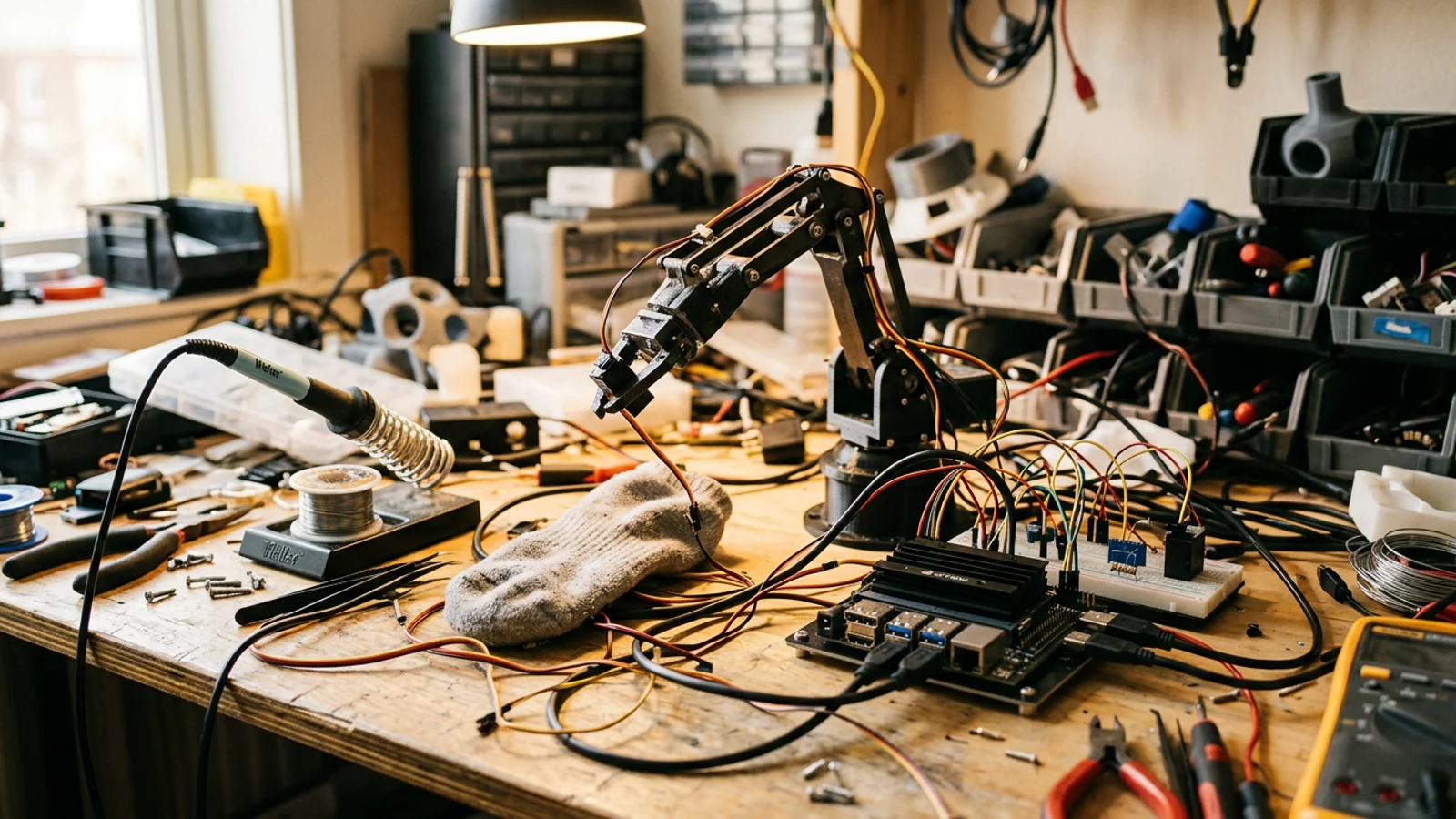
A llama.cpp-style engine ports VLA robot policies to Jetson, NVIDIA doubles entry-level robotics compute, and a $10 chip proves the floor of local AI.
A llama.cpp-Style Engine Brings VLA Robots to Jetson
PKU-SEC-Lab has open-sourced Jetson-PI, a control framework for running Vision-Language-Action policies on Jetson-class hardware, alongside Jetson-PI-Edge, the llama.cpp-based engine that actually loads and runs the models on-device. Its Foresight-Aligned Asynchronous Correction scheme lets a lightweight module predict what the environment will look like a step ahead, so the action expert keeps issuing commands without waiting on a slow vision-language call — the bottleneck that makes VLA policies stutter on low-power boards.
As of the August 2026 update, pre-converted GGUF checkpoints for PI0, PI0.5, and NVIDIA's Isaac GR00T N1.7 are live on Hugging Face, and the engine can run GR00T's full Qwen3-VL backbone, action head, and four-step action flow through either a compiled library or an HTTP server.
This is a research release, not a product — the numbers are the team's own, and it still needs Jetson Orin-class silicon and a working control loop around it. But it is one of the clearer public demonstrations that the GGUF/llama.cpp toolchain reshaping chatbots is now being repurposed to run robot policies locally, with no datacenter GPU in the loop.
NVIDIA's Jetson Orin Nano 2 Doubles Entry-Level Robotics Compute
NVIDIA introduced the Jetson Orin Nano 2 this week: 78 trillion operations per second of AI compute, 8GB of memory, and an 8-core Arm CPU in the same compact form factor as its predecessor. NVIDIA says it delivers twice the inference performance of the Jetson Orin Nano Super while using 40% less power in 15-watt mode — a vendor benchmark, not an independent one.
The board is pitched at running Gemma 4, Qwen 3, and NVIDIA's own Nemotron and Cosmos models locally for entry-level robotics and vision work, per The Robot Report's coverage.
For makers, the real story is price-to-compute: an entry Jetson that can hold a small vision-language model in memory changes what a low-cost robot brain can do without phoning home.
An Open VLA Model Teaches a DIY Robot to Fold Laundry
Hackster.io reports that a builder known as Walnut Sensei swapped the hand-built controller on a sock-picking robot for an open-source VLA model and saw the success rate jump to 96%, according to the write-up. The number is self-reported from the builder's own test runs, not a peer-reviewed benchmark, but it is a striking jump for a task — grabbing a crumpled sock off a messy floor — that scripted pick-and-place logic has always struggled with.
It is a small, DIY-scale version of a pattern showing up across research labs this month: general-purpose VLA policies, run locally, generalizing better than hand-tuned heuristics on cluttered, unstructured tasks.
A $10 Chip Runs a 135M LLM — One Answer Every 45 Minutes
Hackster.io covers Dsn Industries' project running a 135M-parameter language model entirely on a $10 ESP32-S3 microcontroller — with each response taking about 45 minutes to generate.
That is not a usable assistant by any measure, but it is a useful data point for the honest edge of the spectrum: it marks roughly where a bare Xtensa dual-core chip with no NPU currently sits when asked to run even a small transformer with no shortcuts. It is a floor, not a feature, and a reminder of why NPU-equipped boards exist at all.
D-Robotics Ships a 128 TOPS Rival to Jetson Orin NX
CNX Software reports D-Robotics' RDK S100P single-board computer pairs a 6-core Cortex-A78AE application cluster and 4-core Cortex-R52+ MCU domain with a Nash BPU rated at 128 TOPS INT8, a Mali-G78AE GPU, and 24GB of LPDDR5 — pitched as an alternative to the 16GB NVIDIA Jetson Orin NX.
The TOPS figure is D-Robotics' own INT8 spec, and the board's software stack and community support are far less mature than NVIDIA's JetPack ecosystem. Still, it is another sign that Jetson no longer has the higher-TOPS SBC lane to itself — buyers now have a real alternative to weigh against CUDA lock-in.
Five different shapes of the same trend: llama.cpp-style tooling, new Jetson silicon, a DIY VLA robot, a stubborn $10 microcontroller, and a rival NPU board — all pointing at inference that stays on the device. The sources are linked above for anyone who wants to check the numbers themselves.
References & Citations
- PKU-SEC-Lab/Jetson-PI — GitHub — https://github.com/PKU-SEC-Lab/Jetson-PI
- PKU-SEC-Lab/Jetson-PI-Edge — GitHub, Aug 2026 update — https://github.com/PKU-SEC-Lab/Jetson-PI-Edge
- NVIDIA Newsroom — Jetson Orin Nano 2, Sept 2026 — https://nvidianews.nvidia.com/news/nvidia-announces-jetson-orin-nano-2-robotics-computer-to-redefine-entry-level-edge-ai
- The Robot Report, Sept 2026 — https://www.therobotreport.com/jetson-orin-nano-2-doubles-inference-performance-robotics-edge-says-nvidia/
- Hackster.io — laundry-picking VLA robot, Sept 4 2026 — https://www.hackster.io/news/can-an-open-source-ai-model-help-a-diy-robot-pick-up-your-laundry-bd8578273e69
- Hackster.io — $10 microcontroller 135M LLM, Sept 4 2026 — https://www.hackster.io/news/10-microcontroller-runs-a-135m-parameter-llm-entirely-locally-96495df3b06e
- CNX Software — D-Robotics RDK S100P, Aug 31 2026 — https://www.cnx-software.com/2026/08/31/d-robotics-rdk-s100p-a-128-tops-alternative-to-nvidia-jetson-orin-nx-16gb-with-cortex-a78ae-r52-cores/
Subscribe to new posts from theaivibe.org
Related Posts
Jetson Thor Sprints Past llama.cpp While a 15M-Parameter LLM Still Fits an $8 Chip
NVIDIA posts a 6.4x MLPerf edge win on Jetson AGX Thor, a dense TinyStories model skips the flash trick, and a paper splits VLA robots between cloud and a tiny local model.
ESP32 Special: An $8 Chip Runs a 29-Million-Parameter LLM, and Vendors Rethink the Board Around It
A one-chip LLM, a Wi-Fi upgrade to Seeed's tiny displays, and Tuya's push to make ESP32 an AI-agent target, not just a Wi-Fi one.
A Wristband Reads Muscles, a Ring Wants Your Ideas: Edge AI Moves Onto the Body
New wearable and phone releases push transcription, gesture control and silent speech fully on-device, while ESP32 and Jetson tooling keeps pace.