One Toolkit, One Chip, One Watch: On-Device AI Keeps Colonizing the Phone Layer
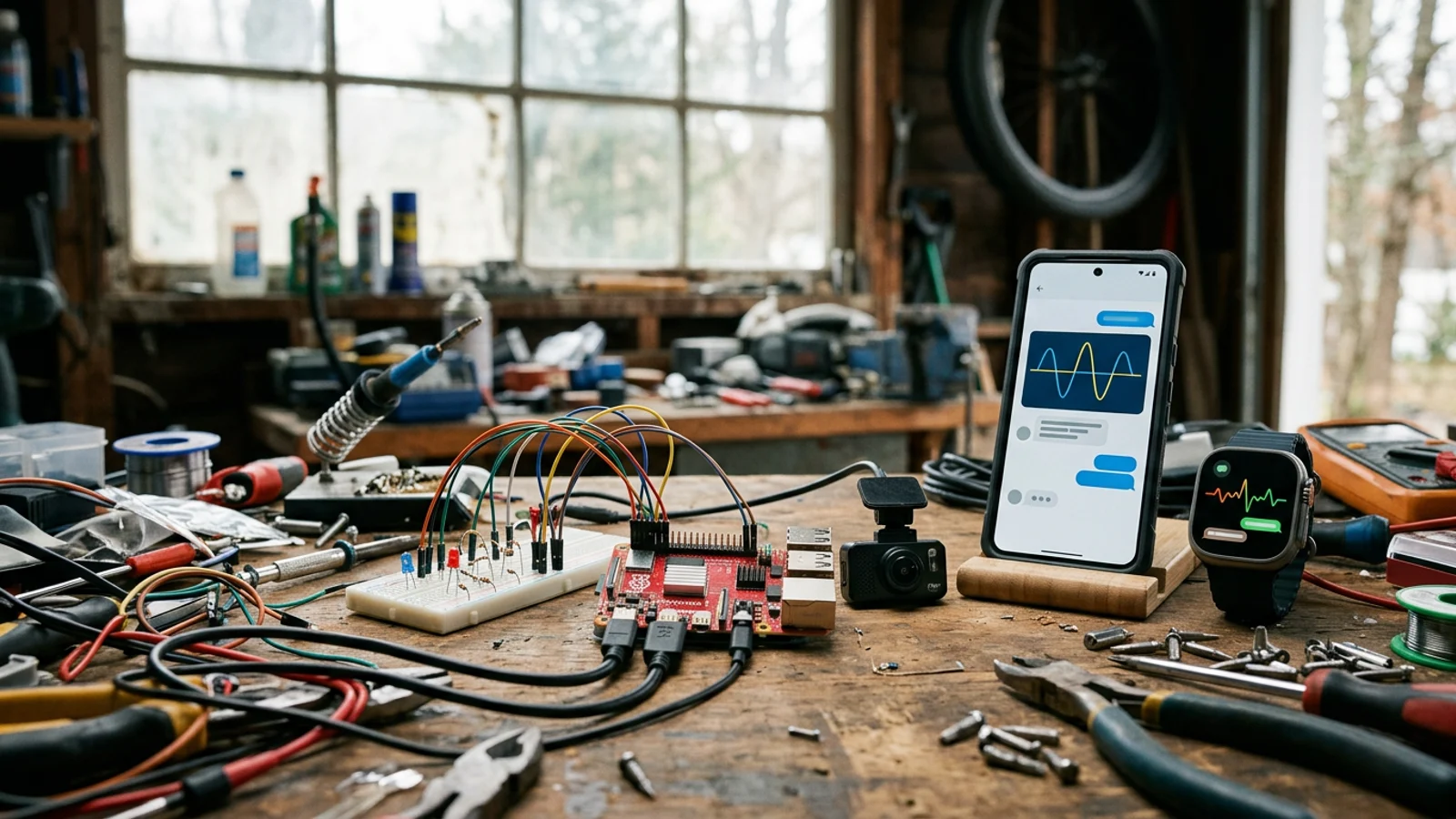
A GitHub toolkit, a 100MB cloning TTS, a Pi-powered dashcam agent, and a phone-to-watch AI rollout — all inference staying on the device.
One Kit to Run LLMs, VLMs, ASR and TTS on Apple's Core AI
A developer known as john-rocky released coreai-kit, a wrapper around Apple's Core AI framework that bundles language models, vision-language models, speech recognition, text-to-speech and speaker diarization into one on-device pipeline for iOS and macOS. The repo climbed to 46 stars and began trending on GitHub on September 8, 2026.
The caveat: this is a solo-maintained project only weeks old, with self-reported feature coverage and no independent benchmarks yet showing how the bundled pipeline actually performs against calling each Apple framework separately.
What makes it worth watching is the packaging problem it addresses. Apple's on-device frameworks for speech, vision, and language exist separately with their own APIs; a single interface that chains them lowers the bar for shipping fully local voice-and-vision apps on Apple Silicon without touching a server.
A Voice-Cloning TTS That Fits in 100MB and Never Calls Home
A developer posting as voxrtio on dev.to detailed a text-to-speech model with voice cloning that packs into 100MB at fp16 and runs generation entirely on-device, from smartphones down to a Raspberry Pi. The write-up, published in early September 2026, says the model — about 45 million parameters split between a language model and an audio decoder — was trained from scratch and bundled into a single binary.
The honest caveat: the only performance claim so far is that a budget Android phone ran generation faster than real time on a single core, and that is self-reported with full benchmarks against other devices still promised in a follow-up post.
Server-side cloning TTS systems typically run hundreds of megabytes to several gigabytes. Getting voice cloning into a footprint that fits a Pi is the kind of shrink that matters more for offline assistants than another chatbot demo.
Your Car Gets a Local AI Chat Room, Powered by a Raspberry Pi 5
ThinkOffApp published CarWatch, a project that pairs a Raspberry Pi 5 with a dashcam feed to run local AI as a chat-room-style agent watching over the vehicle. The repo, started August 9, 2026, hit 283 points and climbed GitHub's trending list on September 7, 2026, positioned as a garage-and-driveway sibling to the developer's earlier CodeWatch project.
The caveat is maturity: this is a young repo with no third-party review of accuracy or latency, and the developer's own description is the only account of what the pipeline currently detects and how well.
Still, it's a clean example of the edge-robotics pattern spreading past drones and arms into everyday vehicles: a Pi-class board doing vision inference locally, with no dependency on a cloud API to watch a parked car.
Motorola and Lenovo Push Local-First AI Onto a Watch
Lenovo and Motorola expanded their Qira personal-AI assistant, according to a company announcement carried by digitalterminal.in in early September 2026. Qira now reaches more Lenovo PCs with 16GB of memory, Motorola phones on Android 17, and for the first time a wearable, the moto watch ultra. The company describes the system as "hybrid, local-first," storing a user's personal knowledge base encrypted on-device and sending only prompts and minimal context to the cloud when needed.
The caveat: this is the vendor's own framing, with no independent teardown of how much processing actually happens on the watch versus the paired phone — a smartwatch chip running a real local LLM is a very different claim than a phone doing the heavy lifting while the watch just displays results.
Even so, it marks another major OEM standardizing a local-first assistant across a device family rather than defaulting every request to the cloud, which is the direction the whole phone-and-wearable tier keeps moving.
Nothing here is a single blockbuster release — a toolkit, a small TTS model, a dashcam agent, and a phone-to-watch rollout — but together they show the same pattern: builders and vendors alike are choosing to keep inference on the hardware in front of the user, even when the cloud option is easier to ship.
References & Citations
- john-rocky — coreai-kit repo, GitHub, September 8, 2026 — https://github.com/john-rocky/coreai-kit
- voxrtio — on-device voice-cloning TTS write-up, dev.to, September 2026 — https://dev.to/voxrtio/how-we-prepared-voice-cloning-tts-to-run-on-device-184
- ThinkOffApp — CarWatch repo, GitHub, September 7, 2026 — https://github.com/ThinkOffApp/CarWatch
- Lenovo & Motorola Qira expansion announcement, digitalterminal.in, September 2026 — https://digitalterminal.in/device/lenovo-and-motorola-expand-qira-personal-ai-to-deliver-a-more-connected-device-experience
Subscribe to new posts from theaivibe.org
Related Posts
Jetson Thor Sprints Past llama.cpp While a 15M-Parameter LLM Still Fits an $8 Chip
NVIDIA posts a 6.4x MLPerf edge win on Jetson AGX Thor, a dense TinyStories model skips the flash trick, and a paper splits VLA robots between cloud and a tiny local model.
ESP32 Special: An $8 Chip Runs a 29-Million-Parameter LLM, and Vendors Rethink the Board Around It
A one-chip LLM, a Wi-Fi upgrade to Seeed's tiny displays, and Tuya's push to make ESP32 an AI-agent target, not just a Wi-Fi one.
A Wristband Reads Muscles, a Ring Wants Your Ideas: Edge AI Moves Onto the Body
New wearable and phone releases push transcription, gesture control and silent speech fully on-device, while ESP32 and Jetson tooling keeps pace.