Needle Threads a Raspberry Pi, an NPU Learns to Move a Robot Arm Fast, and a Biped Joins the LLM Toolkit
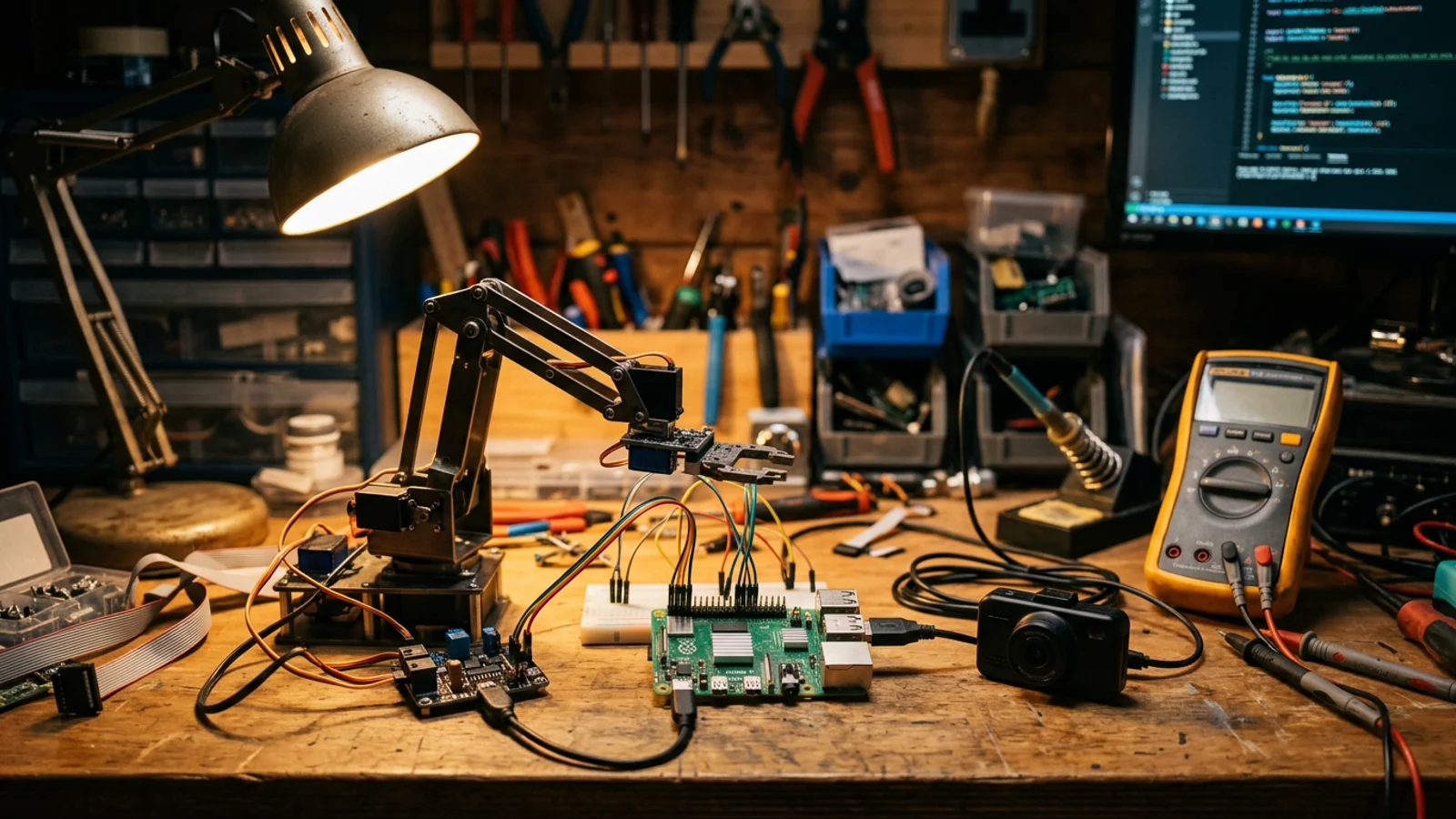
A tool-calling model flips switches on a Pi 5, a Qualcomm NPU speeds up a robot arm sevenfold, and a $2,500 biped joins LeRobot.
Needle 2 Flips a Switch on a Raspberry Pi 5, No Cloud Involved
Cactus Compute's Needle 2, a 14MB function-calling model, runs entirely on a Raspberry Pi 5's CPU and turns plain-English commands into local Python actions — no Hailo accelerator, no GPU, no internet connection. Measured operations were fast: switching an LED took 78ms, capturing a photo 76ms, reading CPU temperature 149ms, and rejecting an unrelated request 92ms, according to Electronics For U.
The model's native session used about 28MB of memory, with the full Python demo peaking near 46MB, per a writeup at Open Source For You. These are self-reported bench numbers on a specific demo, not a general chat benchmark — Needle 2 is deliberately narrow, built to map sentences onto a fixed set of tools rather than converse.
That narrowness is the point. A model this small, running this fast on stock Pi 5 silicon, makes natural-language control of GPIO pins and sensors practical for hobby projects without paying a latency or privacy tax to a remote API.
An NPU Runtime Cuts a Robot Arm's Reaction Time From 1.6s to 230ms
At KRAIN 2026 in Seoul on September 11, 2026, Nota AI ran a live demo of an SO-101 robot arm sorting colored cubes using a vision-language-action model on a Qualcomm Dragonwing IQ-9075 NPU board — no GPU server in the loop. The team built its own inference runtime, benchmarked five VLA backbones on the same hardware, and settled on GR00T N1.7, bringing end-to-end latency down from 1.6 seconds to 230ms, according to Nota AI's own writeup.
These are vendor-reported numbers from a conference demo, not an independently audited benchmark, and the hardware — a palm-sized NPU dev board — isn't yet a mainstream robotics platform. Notably, once the model was fast enough, the remaining stutter came from the camera capture thread, not the neural network.
It's a useful reminder that as edge NPUs get VLA-capable, the bottleneck shifts to unglamorous plumbing — sensor I/O and scheduling — rather than raw model speed.
A $2,500 Biped Joins the LeRobot Family, Brain Riding on a Pi 5
Maker Virgile Batto built LeRobot Humanoid, a fully 3D-printed 12-degree-of-freedom biped (six per leg) driven by RobStride CAN-FD actuators, with a Raspberry Pi 5 as its onboard controller. The full bill of materials runs around $2,500, and the project publishes open Onshape CAD, BOM, wiring, and assembly documentation, per the build's writeup on Hugging Face.
This is a hardware and documentation release, not a finished autonomous walker — the post details the mechanical platform and its integration into the LeRobot ecosystem rather than a proven walking policy running fully on-device. Still, a sub-$3,000 humanoid frame with an open BOM lowers the entry cost for anyone trying to train or port VLA policies onto legged hardware, which is exactly the kind of platform this beat's NPU and small-model work eventually needs to run on.
A Thermal Camera Tucks an STM32N6 Behind a Lynred Sensor
8devices' 8Sight T100, covered by CNX Software on September 25, 2026, pairs an STM32N6 microcontroller — ST's Cortex-M55 part with an integrated neural processing unit — with a Lynred ATI320 long-wave infrared thermal sensor in a compact module aimed at UAS, robotics, and industrial inspection, per the article.
The writeup doesn't yet publish on-device inference benchmarks for the module — whether it's running detection models locally versus streaming raw thermal frames upstream isn't confirmed. But pairing an NPU-capable MCU directly behind a thermal sensor is the kind of physical layout that makes on-sensor AI inspection possible without a separate compute board, which matters for anything battery-powered and airborne.
CarWatch Turns a Dashcam Into a Local Chat Room With Your Car
ThinkOffApp's CarWatch pairs a Raspberry Pi 5 and a dashcam with a locally-run AI agent, letting a driver ask questions about trips, footage, or sensor logs without sending anything to the cloud. The project, a garage-focused sibling to the developer's earlier CodeWatch tool, has picked up 291 GitHub stars since its August 9, 2026 creation, per the repository.
The repo is young and doesn't yet publish latency or accuracy numbers, so how well the local model handles real driving footage in practice is unverified. But it's another data point for the same pattern showing up across this beat: hobbyists gluing small local models onto a Pi 5 for tasks that used to require a cloud API key.
Five different corners of the same trend today: tool-calling models, NPU robot runtimes, open humanoid hardware, sensor-integrated MCUs, and hobbyist agents all converging on the same idea — keep the inference on the box in front of you.
References & Citations
- Electronics For U, September 2026 — https://www.electronicsforu.com/news/needle-2-runs-tool-calling-ai-on-raspberry-pi-5
- Open Source For You, September 25, 2026 — https://www.opensourceforu.com/2026/09/needle-brings-local-ai-actions-to-raspberry-pi/
- Nota AI blog, September 2026 — https://blog.nota.ai/insights/vla-edge-npu-optimization
- Virgile Batto via Hugging Face blog — https://huggingface.co/blog/nepyope/bringing-humanoids-to-lerobot
- CNX Software, September 25, 2026 — https://www.cnx-software.com/2026/09/25/compact-long-wave-infrared-camera-pairs-stm32n6-mcu-with-lynred-ati320-thermal-sensor/
- ThinkOffApp/CarWatch, GitHub — https://github.com/ThinkOffApp/CarWatch
Subscribe to new posts from theaivibe.org
Related Posts
Wearable AI Chips Land as an ESP32 Board Learns to Run a Full Offline Voice Loop
From a Qualcomm earbud chip to an ESP32-S3 that hears, thinks and speaks with no cloud, edge AI keeps shrinking into pockets and ears.
A $300 GPU Streams a 177B AI Model From an SSD While llama.cpp Learns to Skip Ahead
Community builders push token throughput further this week — via SSD-streamed MoE experts, prompt-lookup drafting, and a wrapper for Apple's built-in on-device LLM.
A Classifier That Only Picks, a Model That Skips Tokens, and an AI Firm Bets 2.6B Parameters Can Do Agent Work
Liquid AI ships a 2.6B agentic model for edge hardware, a 144M classifier skips text generation entirely, and a new paper shows byte-level LLMs can beat tokenized ones with sc