Meta Opens Muse to ESP32 Makers as a Tiny LLM Learns to Remember a Hidden Object
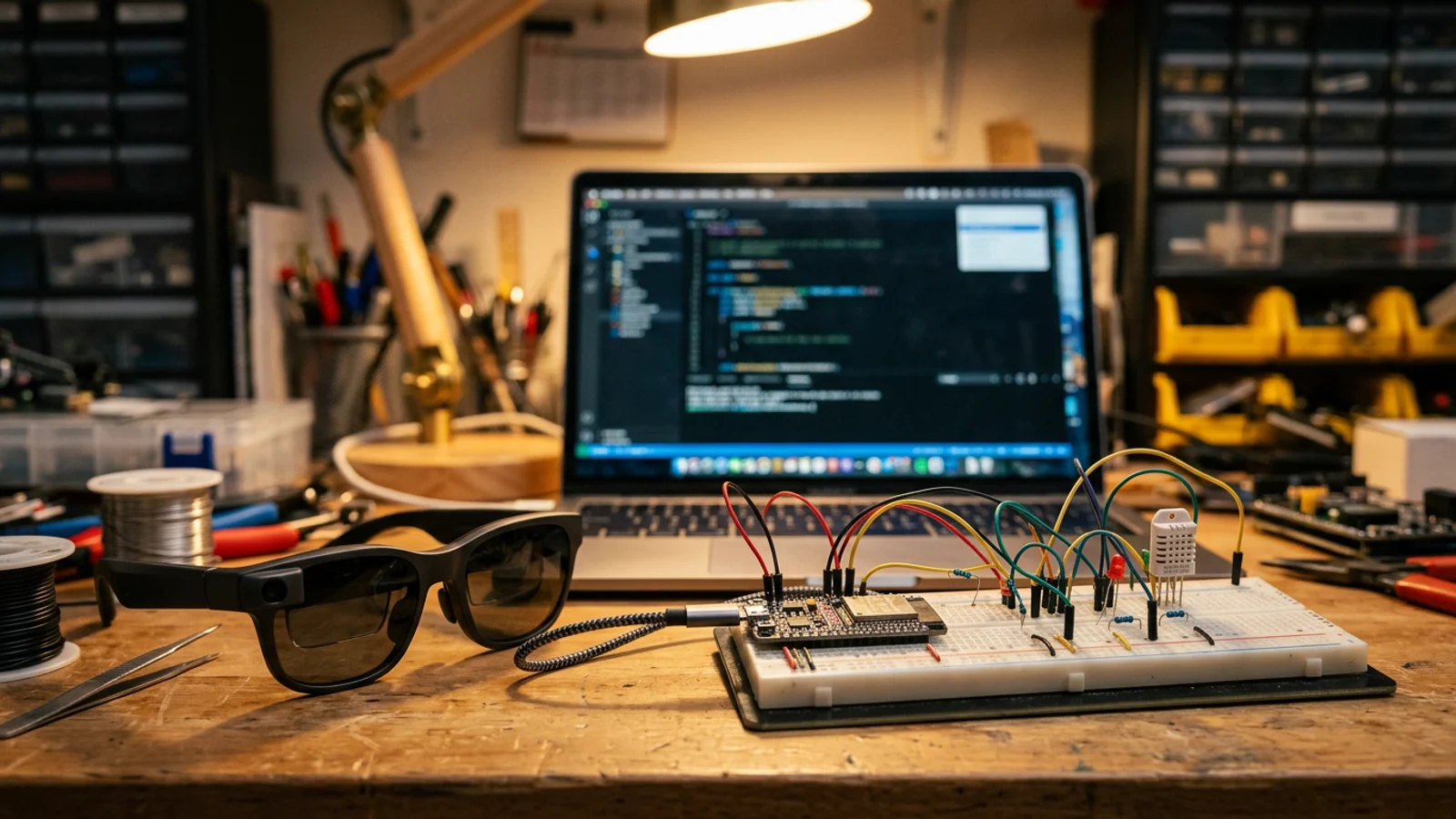
Meta ships ESP32 and Linux SDKs for its Muse AI, Qualcomm's next phones get 2nm NPUs, and a 68KB brain gives a cheap robot arm memory.
Meta's Muse AI Gets ESP32 and Linux SDKs
Meta officially released software development kits for Muse, the multimodal AI that powers its Ray-Ban Display glasses, on October 5, 2026. One SDK targets Espressif's ESP32 family, the other targets Linux, and both are built around running inference without a network connection, according to emergent.sh's report on the launch.
The ESP32 kit ships quantized models sized for 4 MB to 16 MB of flash, the report says, with example use cases listed as voice-triggered home automation, on-device object detection and gesture recognition. That is a modest footprint claim from a vendor announcement, not an independently measured benchmark, and there is no public word yet on which Muse capabilities (vision, audio, or both) actually fit in that envelope.
It matters because Muse has so far been locked inside Meta's own glasses and headsets. Handing makers an ESP32 SDK turns a proprietary wearable assistant into something hobbyists can bolt onto their own hardware, the same move that turned llama.cpp and GGUF into a de facto standard for everyone else's tiny models.
Cactus's Whistle Packs Speech Recognition Into 16.9 MB
Cactus Compute released Whistle on October 5, 2026, a speech-to-text model built to sit beside its earlier Needle tool-calling model in the same C++ engine. The team's own blog post and technical writeup put the whole model at 16.9 MB, 55M parameters with 36M active, running CPU-only across seven languages.
Cactus's self-reported numbers claim a 4.31 word-error rate on LibriSpeech test-clean versus Whisper base's 4.9, in a file nine times smaller and six times faster by their measure. Those are the builder's own benchmarks, not a third-party audit, and the model caps out at 30 seconds of audio per pass.
The pitch is a single binary that turns raw audio into tool calls on a phone, wearable or microcontroller with nothing leaving the device, matching the demand for voice pipelines that do not phone home — the same niche Whisper-tiny and Moonshine already compete in, now with a smaller contender.
llama.cpp 0.6.0 Adds Speculative Decoding for a New MoE
The llama.cpp project pushed version 0.6.0 on October 5, 2026, adding multi-token prediction (MTP) speculative decoding tuned for the Qwen4Exp family, among other changes, according to the release thread on r/LocalLLaMA pointing to the project's own repository.
Speculative decoding lets a small draft step propose several tokens that a larger model verifies in one pass, which can meaningfully speed up generation on CPUs and modest GPUs without changing output quality. The actual speedup numbers for this release have not yet been independently reproduced outside the thread's early reports.
For anyone running Qwen-class models on a laptop or Mini PC instead of a server rack, this is the kind of unglamorous runtime work that quietly keeps local inference competitive with cloud latency.
A 68 KB Model Gives a Robot Arm Memory of What It Can't See
A study published in the open-access journal Discover Informatics describes Tiny-STM, a robotic manipulation controller small enough to run entirely on an ESP32, combining a recurrent neural network with an external coordinate memory and analytical inverse kinematics in 68.4 kilobytes of quantized weights, as reported by Scienmag's coverage of the paper.
The authors report an 85 percent success rate on pick-and-place tasks where the target object is briefly occluded from the robot's camera — the memory module is what lets the arm keep reaching for something it can no longer see. That figure comes from the paper's own test setup and has not been checked against an independent lab.
It is a useful data point against the trend of vision-language-action models measured in billions of parameters: this one claims occlusion-robust manipulation on a chip that costs about ten dollars.
Qualcomm's Next Phone Chips Push Past 5 GHz on 2nm
Qualcomm used its Snapdragon Summit 2026 event in Maui, Hawaii, to unveil the Snapdragon 8 Elite Extreme Gen 6 and Snapdragon 8 Elite Gen 6 mobile platforms, built on TSMC's 2nm N2P process with gate-all-around transistors — a first for mobile silicon — and CPU clocks past 5 GHz for the first time in a smartphone chipset, according to All About Circuits' report from the event.
Those are vendor-stated process and clock-speed specs; real-world NPU throughput and battery figures for on-device AI workloads have not yet appeared in third-party reviews. Qualcomm's own benchmarks for the chips were not detailed in this coverage beyond the manufacturing claims.
Smaller, denser transistors at higher clocks are exactly what feeds the trend toward phones running larger local models — assistants, vision pipelines, and voice agents — without reaching for the cloud, so the actual on-device benchmarks when devices ship will matter more than the process node.
A quiet day for giant announcements but a busy one for small files: a 16.9 MB speech model, a 68 KB robot memory, and an SDK trying to turn a glasses-only assistant into something anyone can flash onto an ESP32.
References & Citations
- emergent.sh — Meta Muse ESP32/Linux SDKs, Oct 5, 2026 — https://emergent.sh/news/meta-opens-muse-diy-gadgets-esp32-linux-sdks
- Cactus Compute — Whistle blog post, Oct 5, 2026 — https://cactuscompute.com/blog/whistle
- Prismix — Whistle technical writeup — https://prismix.dev/news/35b78fbf1603
- r/LocalLLaMA — Whistle release thread — https://www.reddit.com/r/LocalLLaMA/comments/1wyemcb/whistle_speech_to_text_in_a_169mb_file/
- r/LocalLLaMA — llama.cpp v0.6.0 release thread, Oct 5, 2026 — https://www.reddit.com/r/LocalLLaMA/comments/1wyh03u/llamacpp_v060_released_with_mtp_speculative/
- Scienmag — Tiny-STM coverage of Discover Informatics paper — https://scienmag.com/tiny-ai-brain-lets-a-10-microcontroller-remember-hidden-objects-and-grab-them/
- All About Circuits — Snapdragon Summit 2026 hardware highlights — https://www.allaboutcircuits.com/news/3-hardware-highlights-from-qualcomms-snapdragon-summit-2026/
Subscribe to new posts from theaivibe.org
Related Posts
ExecuTorch Hits 1.0 as llama.cpp Learns to Make Instant AI Decisions
PyTorch declares its on-device AI runtime production-ready while llama.cpp adds a decision-model endpoint and two new NPU modules land for edge boards.
Seven $5 Chips Learn to Share an LLM, One Bit at a Time
A BitNet cluster splits an LLM across seven ESP32-S3 boards, a 2-bit tool-calling model lands on GitHub, and a quantization paper gets llama.cpp 15x faster on an M4 Pro.
A 4B AI Model Learns to Run a Robot Arm Entirely on Jetson Thor
NVIDIA's Cosmos 3 Edge drives a robot arm on-device, a $5-class chip gets a voice it hasn't spoken yet, and two new boards widen the SBC lineup.