DEEPX's 25-TOPS NPU Reaches Raspberry Pi 5 as Physical-AI Papers Take Aim at Jetson Thor
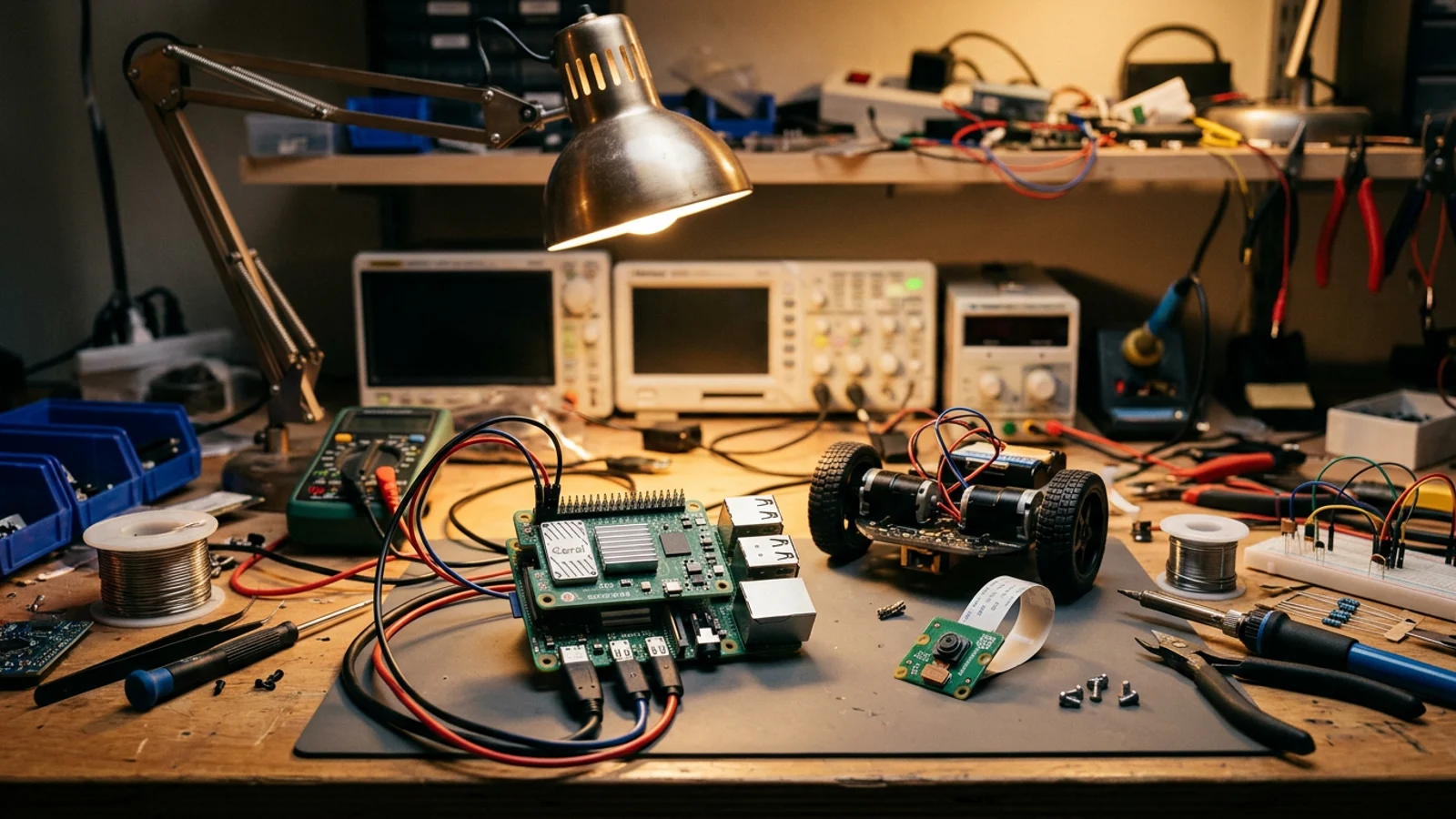
A DEEPX NPU on a Sixfab Pi 5 HAT, a physical-AI model paper, a simulated VLA accelerator, a Pi-to-LLM-agent bridge and an ESP32-P4 cache bug advisory.
DEEPX and Sixfab put a 25-TOPS NPU on the Raspberry Pi 5
On November 20, 2026, DEEPX said Raspberry Pi had published a technical article on running AI directly on a Pi 5 with the Sixfab AI HAT+, an accelerator board built on DEEPX's DX-M1M NPU. DEEPX's own newsroom post is the source here. I did not open the Raspberry Pi article itself.
DEEPX puts the DX-M1M at up to 25 TOPS and about 3 watts in typical continuous operation. Those are vendor figures, and the company says the wattage covers the NPU alone, not the Pi or its peripherals. TOPS also varies with precision and workload, so it does not predict frames per second on your model.
The inference does run on the board, with no cloud round trip. Another vision-oriented NPU option for the Pi 5 matters mostly if its software stack is as easy to use as the hardware is cheap on power.
TuringPAI: a foundation model built for on-device physical AI
An arXiv paper posted on November 19, 2026, TuringPAI: A Foundation for On-Device Physical AI, argues that models for robots and vehicles must handle spatial relationships and dynamic scenes within limited onboard compute. The authors report that it improves quantitative geometric perception over Qwen2-VL-2B.
A driving variant, TuringPAI-Drive, is reported to keep its ADE/FDE trajectory-error metrics close to a full-token HybridViT baseline while using a compressed visual-token interface the authors call MLQ. The excerpt I could read cuts off the exact percentages, so I am not quoting them.
These are the authors' own results from a preprint. Check the paper for the target hardware and for whether any latency was measured on a real device. The direction is useful for small boards: fewer visual tokens means less memory traffic.
A simulated VLA accelerator claims 1.7x over Jetson Thor
The arXiv paper Hardware Acceleration of Vision-Language-Action Models with Weight Precision Rising over the Flow Steps proposes spending fewer weight bits in the early steps of a flow-based action head and more in later ones. The authors simulated their RTL design with LPDDR5X timing. Using a fraction of Thor's memory bandwidth, they say it runs this schedule 1.7 times faster than NVIDIA's Jetson Thor in NVFP4. The abstract also cites a 9.1x reduction in a second figure that my excerpt cut off.
Treat this as a simulation. No silicon exists, and the comparison depends on the authors' modelling choices. It still shows where robot-policy bottlenecks sit: memory bandwidth in the denoising steps rather than raw compute. That is the same pressure that decides what fits on a Jetson Orin-class module today.
PHOS gives LLM agents a semantic interface to a Raspberry Pi
On November 17, 2026, Adafruit's blog described a design for connecting a Raspberry Pi to LLM agents through MCP. The Pi owns the hardware and exposes semantic tools, such as a request to describe the room, instead of raw register reads. The agent does not need to know which sensor or vision pipeline sits behind the answer. The architecture is implemented in PHOS, an open-source Raspberry Pi project.
The caveat: the part of the write-up I could read does not say where the language model runs. The Pi may only be the tool server for an agent hosted elsewhere, so this is not proof of on-device inference. The idea of coarse, meaningful tools is still a sensible way to keep a small board's I/O safe from a model.
Espressif issues a bug advisory for ESP32-P4 L1 cache at startup
On Friday, November 20, 2026, Espressif released advisory AR2026-009, Bug Advisory Concerning ESP32-P4 Applications Reading Stale Data in L1 Cache at Startup. I only saw the advisory's title and metadata, so I cannot say which chip revisions are affected or what the workaround is. Read the advisory PDF before shipping.
The ESP32-P4 is the Espressif part aimed at displays, cameras and heavier local workloads, so a cache-coherency bug at startup is worth checking if you are building vision or audio pipelines on it. Any boot-time buffer or model weights that firmware reads right after reset are the obvious place to look.
Today's pull leaned on one vendor post, two preprints, a maker write-up and a vendor advisory. All the performance numbers above are self-reported or simulated, so the linked sources are worth reading directly.
References & Citations
- DEEPX Newsroom, DEEPX NPU Turns Raspberry Pi Into a Physical AI Platform, November 20, 2026 — https://newsroom.deepx.ai/news/deepx-npu-raspberry-pi-physical-ai-2
- arXiv, TuringPAI: A Foundation for On-Device Physical AI, November 19, 2026 — https://arxiv.org/abs/2611.25474
- arXiv, Hardware Acceleration of Vision-Language-Action Models with Weight Precision Rising over the Flow Steps, November 2026 — https://arxiv.org/abs/2611.24234
- Adafruit Industries blog, Connecting a Raspberry Pi to LLM agents through MCP, November 17, 2026 — https://blog.adafruit.com/2026/11/17/connecting-a-raspberry-pi-to-llm-agents-through-mcp/
- Espressif, Bug Advisory AR2026-009 (ESP32-P4 L1 cache), November 20, 2026 — https://www.espressif.com/en/node/11645
Subscribe to new posts from theaivibe.org
Related Posts
A 26B Looped-MoE LLM Gets Squeezed to 3.85 GB for Phones as New Papers Cut Decode Costs
LookAtMyQuant packs Inkling-2-Mini into six Apple Silicon builds, while new papers tackle weight decoding, laptop fine-tuning and Cortex-M inference.
Ryzen AI NPUs Gain Unsloth and BaseRT Support as Windows PCs Pool Memory for Local LLMs
AMD's XDNA 2 NPU gets Unsloth Desktop and BaseRT support, Microsoft previews USB4 clustering for big local models, and Edge swaps in a 2.3B browser model.
A 367K-Parameter LLM Fits on a Floppy as Nordic Puts an NPU in Wi-Fi Chips
A DOS-era language model on a 486, an Arduino SBC pitched for agent memory, a Versal VLM paper, and Nordic's nRF71 NPU plus u-blox modules.