Flipper One Wants to Be the First Hacker Tool With a Local LLM — What Its 6 TOPS NPU Can Actually Run
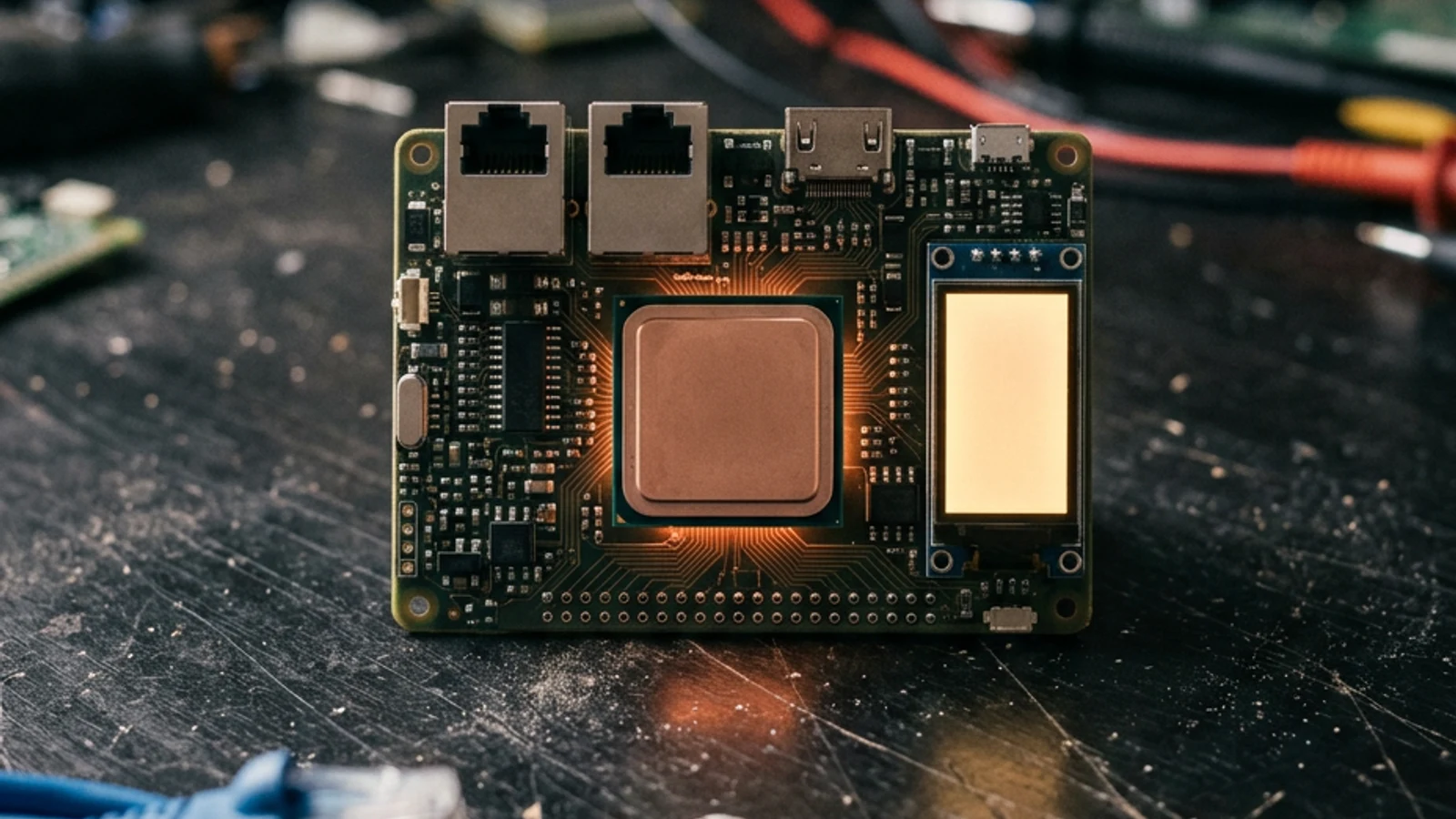
Flipper Devices' pocket Linux box promises an LLM that runs offline and knows the device inside out. Rockchip's own numbers say what a 6 TOPS RK3576 really does — and the NPU driver isn't in the kernel Flipper chose.
Flipper Zero is the $199 dolphin-shaped multi-tool that turned radio protocols into a pocket hobby. Its maker's next device is a different animal: a pocket Linux computer with two Ethernet ports, an NPU, and a promise that this section cannot ignore — an LLM that runs on the device, offline, and knows the hardware it lives in. That promise is worth taking seriously, and taking seriously means checking it against the silicon rather than the press release.
What Flipper One is
On May 21, 2026, Flipper Devices published "Flipper One — We Need Your Help", and the title is the honest part. The hardware exists as working prototypes. The software is a plan. The post is a recruitment notice for the open-source community, and it says so.
The hardware is a real step up from a microcontroller. At the center is a Rockchip RK3576 — eight cores, four Cortex-A72 at 2.2GHz and four Cortex-A53 at 1.8GHz, a Mali-G52 MC3 GPU, and the part that matters here, a 6 TOPS neural processing unit that handles INT4, INT8, INT16, FP16 and BF16. It is paired with 8GB of RAM, and — in a nice touch for anyone who has read this section's microcontroller coverage — a Raspberry Pi RP2350 handles the screen and controls as a co-processor. Around that: two gigabit Ethernet ports, Wi-Fi 6E, HDMI 2.1 capable of 4K at 120Hz, USB-C with DisplayPort, a GPIO header, and an M.2 Key-B slot that exposes PCIe, USB, SATA and a SIM interface, which is how the company intends to let people bolt on SDR modules, NVMe drives, cellular modems and, in its own words, AI accelerators.
The positioning is deliberate. This is not a Flipper Zero successor; the company describes the two as working on different layers. Zero stays the offline-protocol tool — NFC, RFID, Sub-GHz, infrared. One is about IP networks, Ethernet and Wi-Fi, and running a general-purpose Linux in your pocket. TechCrunch's Ivan Mehta reported a target price of under $350 for the base model. No ship date has been given.
The AI claim, quoted exactly
Here is the sentence that brought this device into Edge territory: "Flipper One can run LLMs locally, without an internet connection — helping users operate the device, generate configs, and get useful tips." And the one that makes it interesting rather than generic: "We want to train a specialized AI model that knows Flipper One's internals and applications inside out, so general-purpose models won't cut it."
Read those carefully and the ambition is narrower — and more credible — than "AI in your pocket." The company is not promising a chatbot that writes essays. It is promising an assistant that knows one device, can write an iptables rule or a hostapd config for it, and can do so with the Ethernet cable unplugged. That is exactly the kind of job a small model is good at, and exactly the kind of job a 6 TOPS NPU can plausibly carry. Whether it carries it well comes down to numbers Rockchip has already published.
What 6 TOPS actually runs
Rockchip maintains rknn-llm, the official toolkit for running language models on its NPUs, and the RK3576 is a supported target. Its release 1.3.0 added Qwen3.5, Gemma 4 and SmolLM3. The repository's benchmark table is the closest thing that exists to a spec sheet for Flipper One's AI promise, so here it is, RK3576 rows only, 4-bit weights (w4a16), 128-token sequences, in Rockchip's own measurements:
- Qwen3 0.6B — 24.9 tokens/s, first token in 0.47s, 513MB of memory
- Qwen3.5 0.8B — 18.8 tokens/s, first token in 1.37s, 690MB
- Gemma 4 E2B — 9.2 tokens/s, first token in 1.22s, 1.46GB
- Qwen3.5 2B — 11.0 tokens/s, first token in 1.66s, 1.24GB
- Phi-3 3.8B — 6.6 tokens/s, first token in 1.83s, 2.0GB
- Qwen3.5 4B — 5.0 tokens/s, first token in 3.98s, 2.42GB
- ChatGLM3 6B — 4.6 tokens/s, first token in 2.17s, 3.0GB — the largest model with an RK3576 entry
Two readings of that table. The optimistic one: a 2-billion-parameter model at roughly ten tokens a second is a perfectly usable assistant for the job described — a config file is a few hundred tokens, and it arrives faster than you can read it. With 8GB of RAM, even the 4B class fits with room to spare for the rest of the system. For comparison, the same toolkit on the bigger RK3588 runs Qwen3 0.6B at 32.9 tokens/s in 8-bit versus 17.2 on the RK3576 — so this is the smaller sibling, but not by an order of magnitude.
The sober one: these are vendor benchmarks at a 128-token sequence length. That is a trivial prompt. An assistant that "knows Flipper One's internals" will be fed long system prompts and long configs, and time-to-first-token scales with prompt length — the 4B model already takes four seconds before producing anything with almost no context. At realistic context sizes, the usable sweet spot on this chip is the 1–2B tier, not 4B, and the 6B row is a demonstration rather than a product. This section's standing rule applies: Rockchip's numbers are Rockchip's numbers until someone neutral runs them.
The catch: the NPU driver is not in the kernel Flipper chose
This is the part that matters more than the benchmark table. Flipper made a principled decision to build on mainline Linux — it has partnered with Collabora to push RK3576 support upstream rather than ship the Rockchip vendor kernel most RK35xx boards run. That is the right long-term call for a device meant to last. It also means the NPU does not work yet: the announcement lists NPU support, alongside hardware video decoding, as things that "still need to be added" and are "not currently supported in the mainline kernel." Rockchip's rknn-llm stack, the one all those numbers come from, runs on Rockchip's own kernel and driver.
So the honest status of the LLM promise on announcement day is: the silicon can do it, the toolkit exists, and the two are not yet connected on the operating system the company has committed to. Until an upstream NPU driver lands — work Flipper is explicitly asking the community to do — the realistic fallback is CPU inference through llama.cpp on four A72 cores with 8GB of RAM. That will run the same small models; I will not guess at what speed, because nobody has published one for this board, and guessing is how vendor numbers become folklore.
The software is further behind than the hardware
The August 12 follow-up, "Flipper OS — the operating system for Flipper One," describes a Debian base with a boot-menu profile system: a router profile, a radio-lab profile, a desktop profile, a media-box profile, each with its own kernel, device tree and applications, with user changes written to a separate overlay that can be wiped to restore the default. It is a sensible design for a device you will constantly reconfigure, and it addresses a real complaint — CEO Pavel Zhovner told TechCrunch that with a normal Linux install "it is hard to do a clean factory reset after installing packages unless you re-flash the SD card."
It is also, by the company's own account, unfinished at the architecture level. The May post calls Flipper OS "an extremely hard project" and says "we're not 100% sure how to architect it yet." FlipCTL, the small-screen UI framework, is "still at the concept and architecture stage." The August post says the team is "currently experimenting with various concepts, exploring the OSTree approach, and testing Btrfs images," and on the hardest problem — updating a system built from immutable profiles — states flatly: "As of now, there is no solution to this problem." No specialized model has been trained; the AI work is an invitation, not a deliverable.
And it might not ship at all
Earlier this year, XDA reported that Zhovner had shared photos of the first production-design prototype boards and, in the same breath, questioned whether the project made financial sense. The reason is one every edge-hardware builder will recognize: DRAM prices. Memory costs, driven up by AI datacenter demand, had pushed the bill of materials to where the business model, in his words, "doesn't hold up." He put the question to the community — chase the dream at real financial risk, or shelve it to protect the company. The May announcement is the answer, with its price target and its call for help, but the risk he named did not go away. A device that needs 8GB of RAM to run its own assistant is exposed to exactly the price curve that makes that assistant's datacenter cousins expensive.
Why it belongs on this beat anyway
Strip away the uncertainty and what remains is the clearest statement I have seen from a hardware company of what on-device AI is for. Not a general chatbot. A small model, fine-tuned on one device's documentation and tooling, running on that device's own NPU, so that the tool can explain and configure itself with no network. That is the edge thesis in one product. The 6 TOPS number and Rockchip's table say the thesis is feasible at the 1–2B model tier today; the kernel situation says it is not delivered; the DRAM situation says the whole thing is a bet.
The thing to watch is not a launch date. It is whether an RK3576 NPU driver lands in mainline Linux. The moment that happens, the benchmark table above stops being a Rockchip claim and becomes something any owner of a $350 pocket computer can verify — and this section will.
References & Citations
- Flipper Devices (2026-05-21). "Flipper One — We Need Your Help." blog.flipper.net/flipper-one-we-need-your-help/ — hardware specs, the local-LLM statements, the "still needs to be added" NPU status, and the community call.
- Flipper Devices (2026-08-12). "Flipper OS — the operating system for Flipper One." blog.flipper.net/flipper-os-the-operating-system-for-flipper-one/ — profile system, overlay design, OSTree/Btrfs experiments, the unsolved update problem.
- Mehta, I. (2026-05-21). "Flipper unveils a Linux-powered networking gadget built for hackers and tinkerers." TechCrunch — sub-$350 price target, RP2350 co-processor, Zhovner quote on factory reset.
- XDA Developers (2026-02-13). "The Flipper One has official prototypes, but it may never actually launch." — prototype PCBs and the DRAM-price business-model concern.
- Rockchip (2026). "rknn-llm" v1.3.0 — github.com/airockchip/rknn-llm; RK3576 listed as a supported platform; Qwen3.5 / Gemma 4 / SmolLM3 support.
- Rockchip (2026). "rknn-llm benchmark.md" — github.com/airockchip/rknn-llm/blob/main/benchmark.md; all RK3576 and RK3588 tokens/s, TTFT and memory figures quoted (vendor measurements, seqlen 128).
- Rockchip RK3576 datasheet v1.0 (2024-03) — 4×Cortex-A72 @ 2.2GHz + 4×Cortex-A53 @ 1.8GHz, Mali-G52 MC3, 6 TOPS NPU with INT4/INT8/INT16/FP16/BF16/TF32.
- Flipper Devices (2026). Flipper Zero product page — flipperzero.one; $199 list price.
Subscribe to new posts from theaivibe.org
Related Posts
Meta Opens Muse to ESP32 Makers as a Tiny LLM Learns to Remember a Hidden Object
Meta ships ESP32 and Linux SDKs for its Muse AI, Qualcomm's next phones get 2nm NPUs, and a 68KB brain gives a cheap robot arm memory.
ExecuTorch Hits 1.0 as llama.cpp Learns to Make Instant AI Decisions
PyTorch declares its on-device AI runtime production-ready while llama.cpp adds a decision-model endpoint and two new NPU modules land for edge boards.
Seven $5 Chips Learn to Share an LLM, One Bit at a Time
A BitNet cluster splits an LLM across seven ESP32-S3 boards, a 2-bit tool-calling model lands on GitHub, and a quantization paper gets llama.cpp 15x faster on an M4 Pro.