ESP32 Special: An $8 Chip Runs a 29-Million-Parameter LLM, and Vendors Rethink the Board Around It
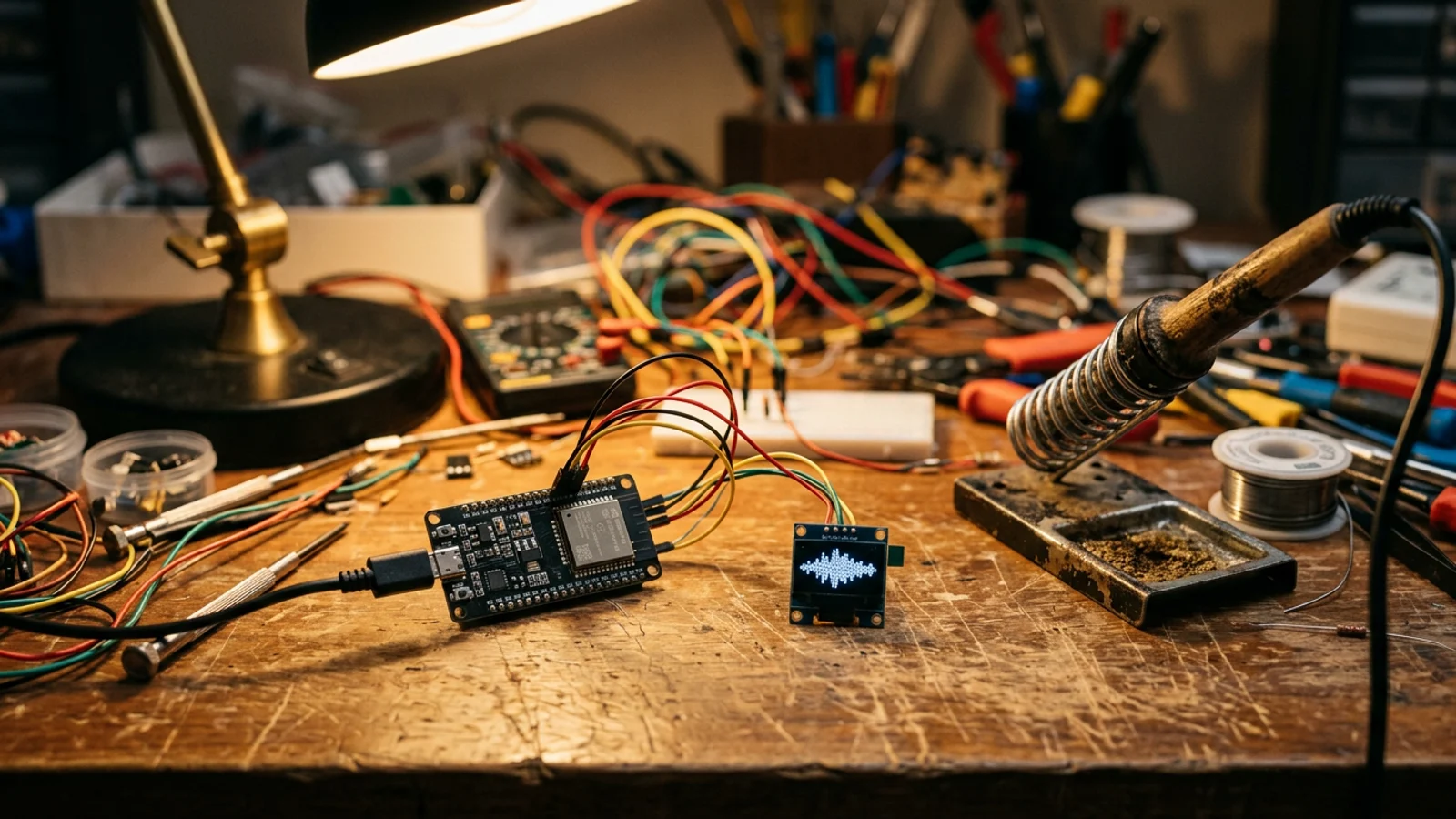
A one-chip LLM, a Wi-Fi upgrade to Seeed's tiny displays, and Tuya's push to make ESP32 an AI-agent target, not just a Wi-Fi one.
A 28.9-Million-Parameter LLM Talks From an $8 ESP32-S3
Developer zeoneo has published esp32-ai, a 28.9-million-parameter language model that generates text entirely on an ESP32-S3, a microcontroller that costs roughly $8. Nothing leaves the chip: it writes each word to a small attached screen at about 9.5 tokens per second. Most of the 25 million flash-resident parameters live in a lookup table rather than RAM, borrowing the Per-Layer Embeddings trick Google uses in its Gemma models, which is how the model fits inside a chip with 512KB of SRAM and 16MB of flash.
The builder notes the last comparable microcontroller LLM they know of had around 260,000 parameters, so this one is roughly a hundred times larger on the same class of hardware. The numbers are self-reported and the demo is text-out-to-screen, not a chatbot with input, so it's a proof of a memory trick more than a finished product.
Why it matters: storing weights in flash instead of RAM is exactly the kind of technique that keeps pushing the ceiling on what an $8 chip can hold, and it's a direct descendant of ideas Google built for phone-class hardware, now running two tiers smaller.
Seeed Adds Wi-Fi to Its Tiny XIAO Displays With ESP32-S3
On September 15, 2026, Hackster reported that Seeed Studio is expanding its compact XIAO smart-display lineup with new models built on the ESP32-S3, sitting alongside the existing Nordic nRF52840 versions in the same physical form factor.
Per the write-up, the nRF52840 boards stay the pick for battery life, while the ESP32-S3 variants trade some power efficiency for lower cost and native Wi-Fi — useful for projects that need networked telemetry or the S3's vector instructions for lightweight on-device inference. Exact SKU pricing and ship dates weren't spelled out in the piece beyond the announcement, so this reads as a lineup expansion rather than a finished retail drop yet.
Why it matters: keeping one small display shell available in both a low-power BLE chip and a Wi-Fi/AI-capable chip lets makers choose the tradeoff per project instead of redesigning the board.
TuyaOpen Frames ESP32 as an AI-Agent Target, Not Just a Wi-Fi Chip
Tuya's TuyaOpen repository was trending on GitHub again on September 16, 2026, with 1,838 stars accumulated since it was created on December 25, 2023. The project bills itself as a 'next-gen AI+IoT framework' spanning Tuya's own T2, T3 and T5AI silicon plus third-party chips including ESP32, with the stated goal of 'fast IoT and AI agent hardware integration.'
The repo's front page doesn't spell out exactly what runs on-device versus what gets routed to a server when an 'AI agent' is deployed on an ESP32 target through the framework — it's a common firmware and build layer, not a demonstrated LLM running locally on ESP32 hardware the way zeoneo's project is.
Why it matters: a commercial IoT vendor is explicitly treating ESP32 as one interchangeable target for a standardized 'AI agent' firmware stack, alongside its own proprietary chips, which says something about where the industry expects agent workloads to land next.
Today's sweep stayed inside one chip family on purpose: a flash-resident LLM, a display refresh, and a firmware framework all show ESP32-S3 being pulled in different directions — as a language-model host, a display brain, and now a standardized AI-agent target.
References & Citations
- zeoneo/esp32-ai — GitHub, 2026-09-16 — https://github.com/zeoneo/esp32-ai
- Hackster News, September 15, 2026 — https://www.hackster.io/news/seeed-studio-expands-its-compact-smart-display-range-with-new-xiao-esp32s3-powered-wi-fi-models-42e02cc818bc
- tuya/TuyaOpen — GitHub, 2026-09-16 — https://github.com/tuya/TuyaOpen
Subscribe to new posts from theaivibe.org
Related Posts
Jetson Thor Sprints Past llama.cpp While a 15M-Parameter LLM Still Fits an $8 Chip
NVIDIA posts a 6.4x MLPerf edge win on Jetson AGX Thor, a dense TinyStories model skips the flash trick, and a paper splits VLA robots between cloud and a tiny local model.
A Wristband Reads Muscles, a Ring Wants Your Ideas: Edge AI Moves Onto the Body
New wearable and phone releases push transcription, gesture control and silent speech fully on-device, while ESP32 and Jetson tooling keeps pace.
Runtimes on the Move: llama.cpp, ExecuTorch and LiteRT All Update as Edge AI's Software Layer Speeds Up
llama.cpp shipped two builds in two days, ExecuTorch hit 1.0 with new NPU backends, and LiteRT tuned fp16 kernels for mobile CPUs.