Edge Dispatch: Edge Dispatch: NVIDIA Squeezes a 4B World Model Onto the Robot Itself as Liquid AI and AMD Chase the Same Edge
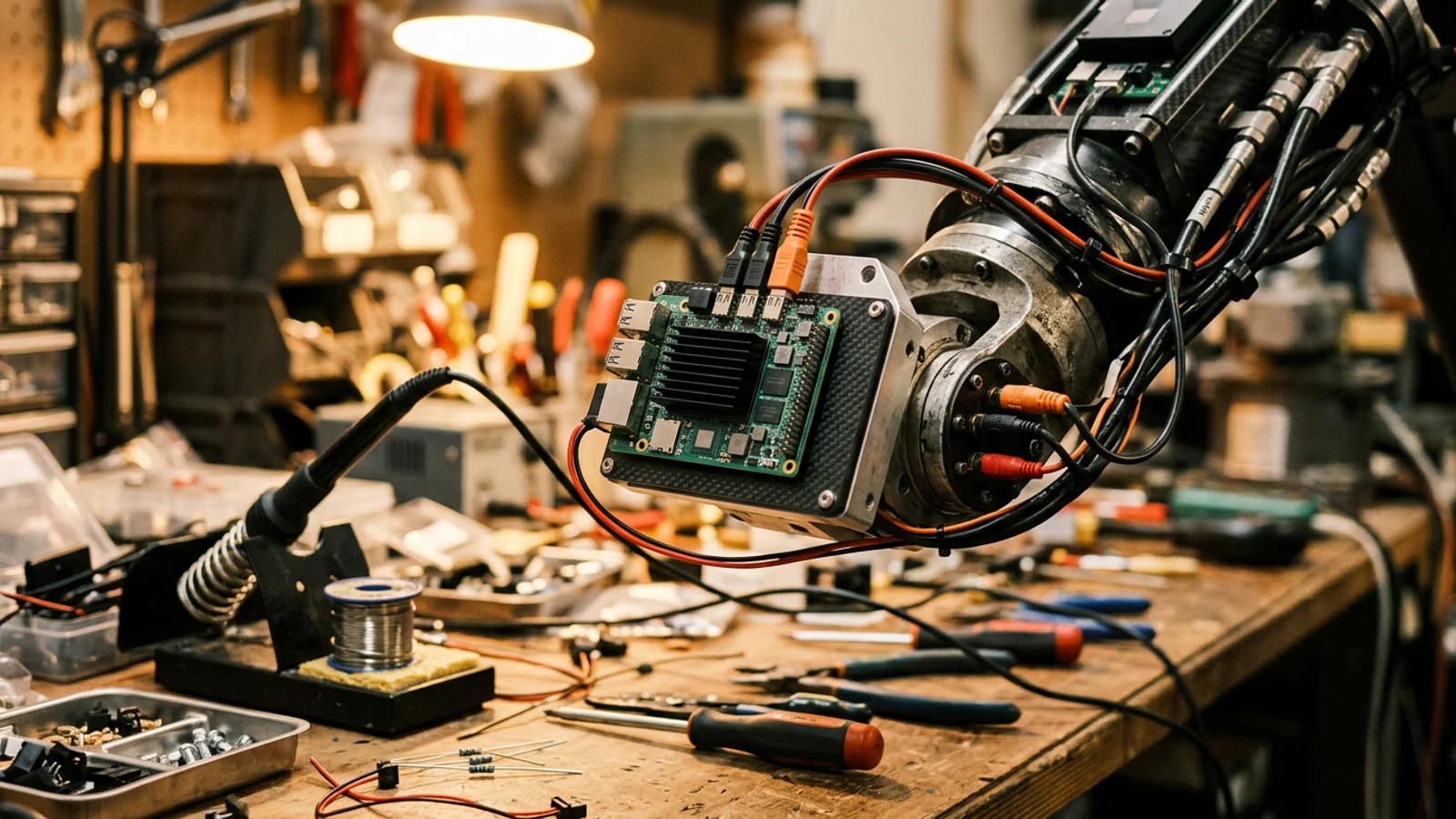
A Jetson Thor robot policy, a GGUF port for VLA models, a 2.6B tool-calling LLM, and a new AMD robotics module — all inference, no data center.
NVIDIA's Cosmos 3 Edge Puts a 4B World Model on the Robot Itself
NVIDIA published a technical post this week walking through post-training Cosmos 3 Edge, a 4-billion-parameter omni-model (with a 2B Nemotron-based reasoner) small enough to fit in memory on an NVIDIA Jetson AGX Thor. The companion announcement on the NVIDIA blog frames it as the lightweight member of the Cosmos 3 family, meant for real-time vision and action prediction directly on the robot.
The numbers NVIDIA reports are its own: a post-trained DROID action policy generates each action chunk in about 1.53 seconds at 640x540 and 15 Hz, while a chunk covers roughly 2.13 seconds of motion, so the arm keeps moving without a data-center GPU in the loop. In closed-loop RoboLab tasks the policy reaches 22.9% success — a modest, self-reported figure that NVIDIA presents as proof of concept rather than a finished product.
The honest read: this is a real on-device inference result, not a cloud demo with a robot arm attached, but the success rate shows how far embodied edge models still have to go before they're reliable.
Open-Source Project Ports Robot VLA Policies Into GGUF for Jetson
The Jetson-PI-Edge repo from PKU-SEC-Lab shipped pre-converted GGUF checkpoints in August 2026 for PI0, PI0.5, and NVIDIA's Isaac GR00T N1.7, letting the full Qwen3-VL backbone, action head, and four-step action flow run through a llama.cpp-derived engine on Jetson hardware.
The accompanying research, described in the team's paper on arXiv, claims an 8.66x improvement in control frequency over naive PyTorch and 5.41x over vla.cpp on Jetson Orin — self-reported benchmarks from the authors, not yet independently reproduced.
Why it matters for tiny hardware: it's the same quantize-and-run pattern that made small LLMs practical on laptops and phones, now applied to vision-language-action robot policies instead of chatbots.
Liquid AI's LFM2.5-2.6B Targets Constrained Hardware With Tool Calling Built In
Liquid AI released LFM2.5-2.6B this week, a 2.6-billion-parameter model with a 128,000-token context window and native tool calling, according to VentureBeat. Both the post-trained model and a base checkpoint are on Hugging Face with day-one support across llama.cpp, MLX, vLLM, SGLang, and ONNX.
Liquid AI reports roughly 220 tokens/sec decode on an Apple M5 Max and 113 tokens/sec on an AMD Ryzen AI Max+ 395, using under 2.5 GB of memory, plus around 30 tokens/sec on a smartphone through its Apollo app. These are company-reported figures; no Raspberry Pi throughput number is given despite the framing, though the sub-2.5GB footprint is the part that plausibly fits Pi-class RAM.
It's another entry in the trend of shrinking useful agentic models rather than chasing raw benchmark scores — a Pi-sized memory budget with real tool calling attached.
AMD's New Kria Module Chases Deterministic Robot Control
AMD unveiled a Ryzen AI Embedded X100 series and a new Kria AI Robotics platform this week, reported by The Robot Report. The pitch is deterministic real-time control, unified CPU-GPU-NPU memory, and an open software stack pitched as not locking developers into one vendor's tooling.
No independent latency or throughput benchmarks have surfaced yet — this is a platform announcement, not a measured result. AMD is positioning it as an alternative on-device robotics stack alongside NVIDIA's Jetson Thor line, competing on openness and unified memory rather than raw TOPS.
Worth tracking because a second serious silicon vendor targeting on-robot inference, rather than cloud-tethered control loops, changes the buying calculus for robotics teams choosing edge compute.
Four different companies, four different bets on the same premise: robot control and small-model inference belong on the device, not in a rack somewhere else. The self-reported numbers deserve scrutiny, but the direction is consistent.
References & Citations
- NVIDIA Technical Blog — Post-Train Cosmos 3 Edge, Aug 2026 — https://developer.nvidia.com/blog/post-train-nvidia-cosmos-3-edge-for-on-device-robot-control/
- NVIDIA Blog — Jetson Thor robotics edge AI agent — https://blogs.nvidia.com/blog/jetson-thor-robotics-edge-ai-agent/
- PKU-SEC-Lab — Jetson-PI-Edge repo, Aug 2026 — https://github.com/PKU-SEC-Lab/Jetson-PI-Edge
- arXiv — Jetson-PI: Foresight-Aligned Asynchronous Inference paper — https://arxiv.org/html/2607.12659v4
- VentureBeat — Liquid AI LFM2.5-2.6B, Aug 2026 — https://venturebeat.com/technology/no-cloud-no-gpus-no-problem-liquid-ais-new-model-lfm2-5-2-6b-brings-powerful-ai-agents-to-devices-as-small-as-a-raspberry-pi
- The Robot Report — AMD Kria AI Robotics platform, Aug 2026 — https://www.therobotreport.com/amd-unveils-kria-module-real-time-control-unified-memory-robots/
Subscribe to new posts from theaivibe.org
Related Posts
Meta Opens Muse to ESP32 Makers as a Tiny LLM Learns to Remember a Hidden Object
Meta ships ESP32 and Linux SDKs for its Muse AI, Qualcomm's next phones get 2nm NPUs, and a 68KB brain gives a cheap robot arm memory.
ExecuTorch Hits 1.0 as llama.cpp Learns to Make Instant AI Decisions
PyTorch declares its on-device AI runtime production-ready while llama.cpp adds a decision-model endpoint and two new NPU modules land for edge boards.
Seven $5 Chips Learn to Share an LLM, One Bit at a Time
A BitNet cluster splits an LLM across seven ESP32-S3 boards, a 2-bit tool-calling model lands on GitHub, and a quantization paper gets llama.cpp 15x faster on an M4 Pro.