Edge AI Learns to Hear Without Any Dedicated AI Silicon At All
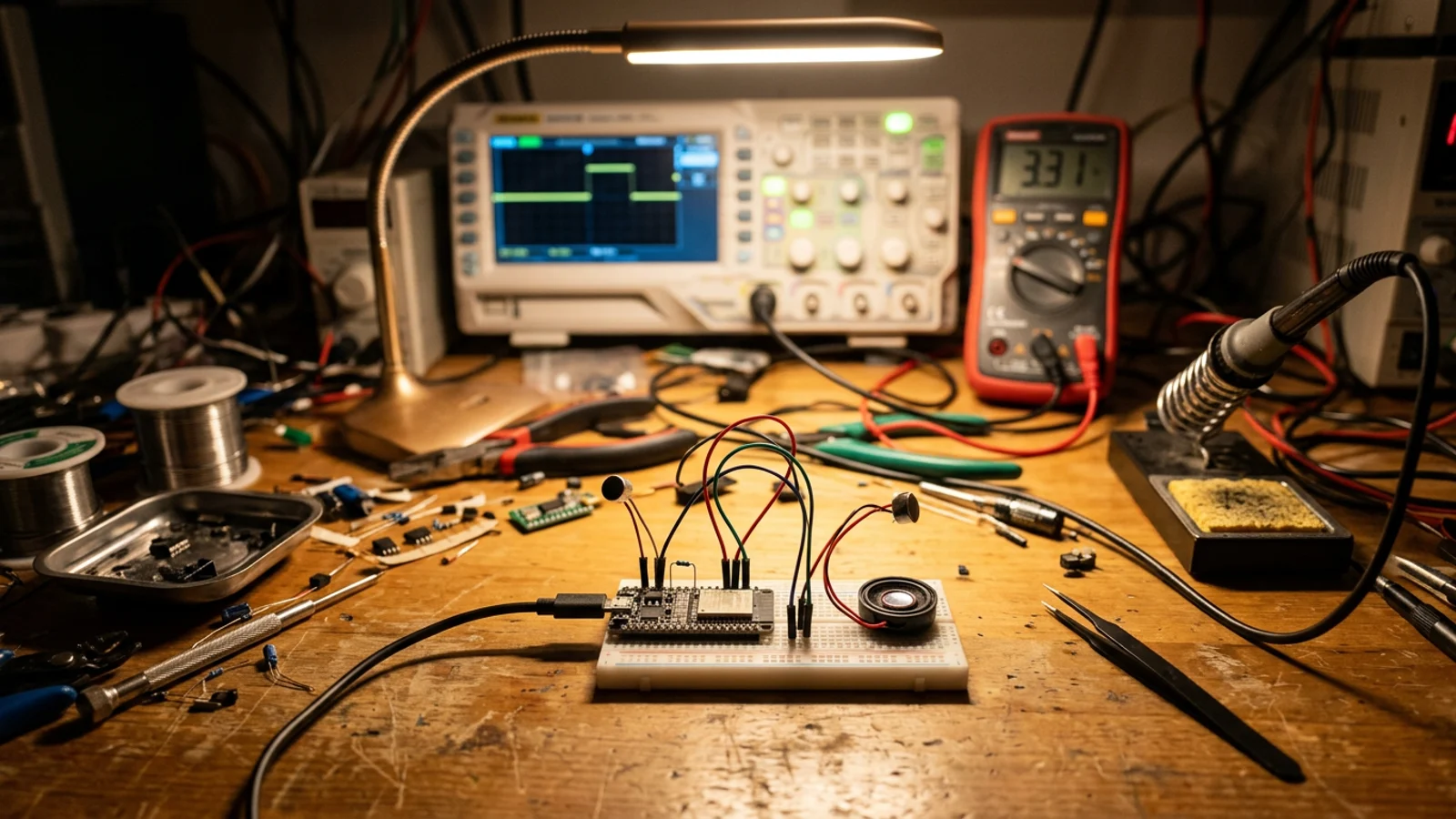
A microcontroller runs open-vocabulary speech recognition with no neural accelerator, while NPU boards and an $8 chip push tiny-LLM throughput further.
Open-Vocabulary Speech Recognition With No Neural Chip
A new paper called Oído runs open-vocabulary English speech recognition entirely on an ESP32-S3 that has no neural accelerator — just a 240 MHz dual-core Xtensa chip with 512 KB of SRAM. Its 13-million-parameter Conformer-CTC model, quantized to int8, reaches 3.70% word error rate on LibriSpeech test-clean, within 0.12 points of full precision, and the authors report it beats Whisper tiny and Moonshine tiny run full precision on a laptop in noisy, reverberant audio.
The honest caveat is in the authors' own numbers: on real silicon the system takes about 1.97x the duration of the audio to transcribe it, so a four-second command finishes roughly 8.7 seconds after it ends. It's accurate, not fast — and the two-core version gives wrong answers on actual hardware, so it stays disabled. Still, open-vocabulary ASR with zero dedicated AI silicon is a real step past fixed keyword spotting.
Hand-Tuned SIMD Pushes an $8 Chip's LLM to 22.59 Tok/s
Developer slvDev's open-source esp32-ai project already ran a 28.9-million-parameter toy-story language model on an $8 ESP32-S3. In a write-up published October 12, 2026, InsiderLLM measured the unmodified build at 10.34 tokens per second with the display disabled, then applied five changes — SIMD for the output head, an int4 head, SIMD across the rest of the model, moving logits into fast internal RAM, and an int4 core — and reached 22.59 tokens per second, a 2.18x speedup, with every build writing the identical 200-token story byte for byte.
This is a fixed toy story, not a general assistant, and the gains come from manual kernel work rather than a new runtime. But it's a useful data point for how far transformer inference can be pushed on microcontroller SIMD instructions without extra silicon.
An STM32N6's NPU Does Offline Speech-to-Text
A hobbyist project documented by CircuitDigest runs offline speech-to-text on an STM32N6570-DK board using the chip's onboard Neural-ART NPU, which ST rates at up to 600 GOPS, alongside an Arm Cortex-M55 running up to 800 MHz. Audio is converted to log-mel spectrograms on the M55, then a 7.2-million-parameter model called CynipsNet v1.0 runs on the NPU, reporting 5.32% word error rate on LibriSpeech test-clean and 14.84% on test-other with greedy decoding and no language model, at roughly 0.2 W peak during inference.
The model trained partly on 248 hours recorded with the board's own microphone, and the developer notes power draw hasn't been optimized. English only, best within about a meter of the mic, no punctuation — but it's a clean example of dedicated NPU silicon doing real ASR work a bare microcontroller couldn't.
DeepX's NPU Puts Small Models on a Raspberry Pi HAT
South Korean NPU maker DeepX detailed, in reporting carried by Chosun Biz on October 15, 2026, how its DX-M1M chip runs vision and language models on a Raspberry Pi 5 through Sixfab's AI HAT+ add-on board. DX-M1M is rated at up to 25 TOPS, draws about 3 W on its own during continuous operation, and carries 2 GB of dedicated LPDDR4X memory separate from the Pi's own RAM.
In the demo, Qwen3 1.7B generated 4.64 tokens per second with a 599 ms time-to-first-token — modest numbers that reflect a chip built mainly for CNN and vision-language workloads, not raw LLM throughput. The pitch is one low-power NPU handling CNN, VLM and small-LLM tasks for robots and smart cameras, not chatbot speed.
A Cellular SBC Bundles 16 TOPS Into One Board
CNX Software reported on October 15, 2026, that Orange Pi has launched the O1, a single-board computer built around SOPHGO's BM1688 octa-core Cortex-A53 SoC with a built-in 16 TOPS AI accelerator, plus onboard 4G/5G cellular connectivity.
BM1688 isn't new silicon — SOPHGO has shipped it elsewhere before — but pairing it with a cellular modem on one board targets portable or remote AI-camera and edge-inference use cases without a separate dongle. As with most vendor TOPS figures, that number is the chipmaker's own accelerator spec, not an independently measured benchmark.
None of these are flagship launches — they're a paper, a tuned-up hobby benchmark, two NPU boards and an SoC spec sheet — but together they trace how much work is going into squeezing real inference, not just keyword spotting, onto chips that cost single-digit dollars or draw a few watts.
References & Citations
- Oído paper — catalyzex.com, 2026 — https://www.catalyzex.com/paper/oido-open-vocabulary-speech-recognition-on-a
- InsiderLLM — esp32-ai benchmark, Oct 12, 2026 — https://insiderllm.com/blog/newsletter-2026-10-12/
- CircuitDigest — STM32N6 offline ASR, 2026 — https://circuitdigest.com/news/this-stm32n6-turns-speech-into-text-offline-using-its-npu-and-a-7-2m-parameter-asr-model
- Chosun Biz — DeepX DX-M1M on Raspberry Pi 5, Oct 15, 2026 — https://biz.chosun.com/en/en-it/2026/10/15/MGVHY7J3J5GUVHUXYLFZ7CA45M/
- CNX Software — Orange Pi O1 SBC, Oct 15, 2026 — https://www.cnx-software.com/2026/10/15/orange-pi-o1-sbc-features-16-tops-sophgo-bm1688-ai-soc-supports-4g-5g-cellular-connectivity/
Subscribe to new posts from theaivibe.org
Related Posts
ESP32 Special: Two Offline Voice-AI Builds Debut While a New Chip Powers a Display Board
Two fresh ESP32 voice-AI repos go fully offline, a mystery ESP32-S31 chip shows up on a display board, and an ESP32 radio hack learns to transmit.
A 35B MoE Vision AI Learns to Fit a Phone While a $7 ESP32 Hijacks an iPhone
OpenBMB squeezes a 35B MoE vision model onto an iPhone, Google shrinks multimodal search to 191MB, and a $7 ESP32 learns to tap a real iPhone's screen.

A Hexagon NPU Learns New AI Tricks While Edge Robots Get Lighter World Models
llama.cpp opens a path to Qualcomm's Hexagon NPU, a 2-bit automation model surges on GitHub, and a lighter world model targets robot arms.