ESP32 Special: Two Offline Voice-AI Builds Debut While a New Chip Powers a Display Board
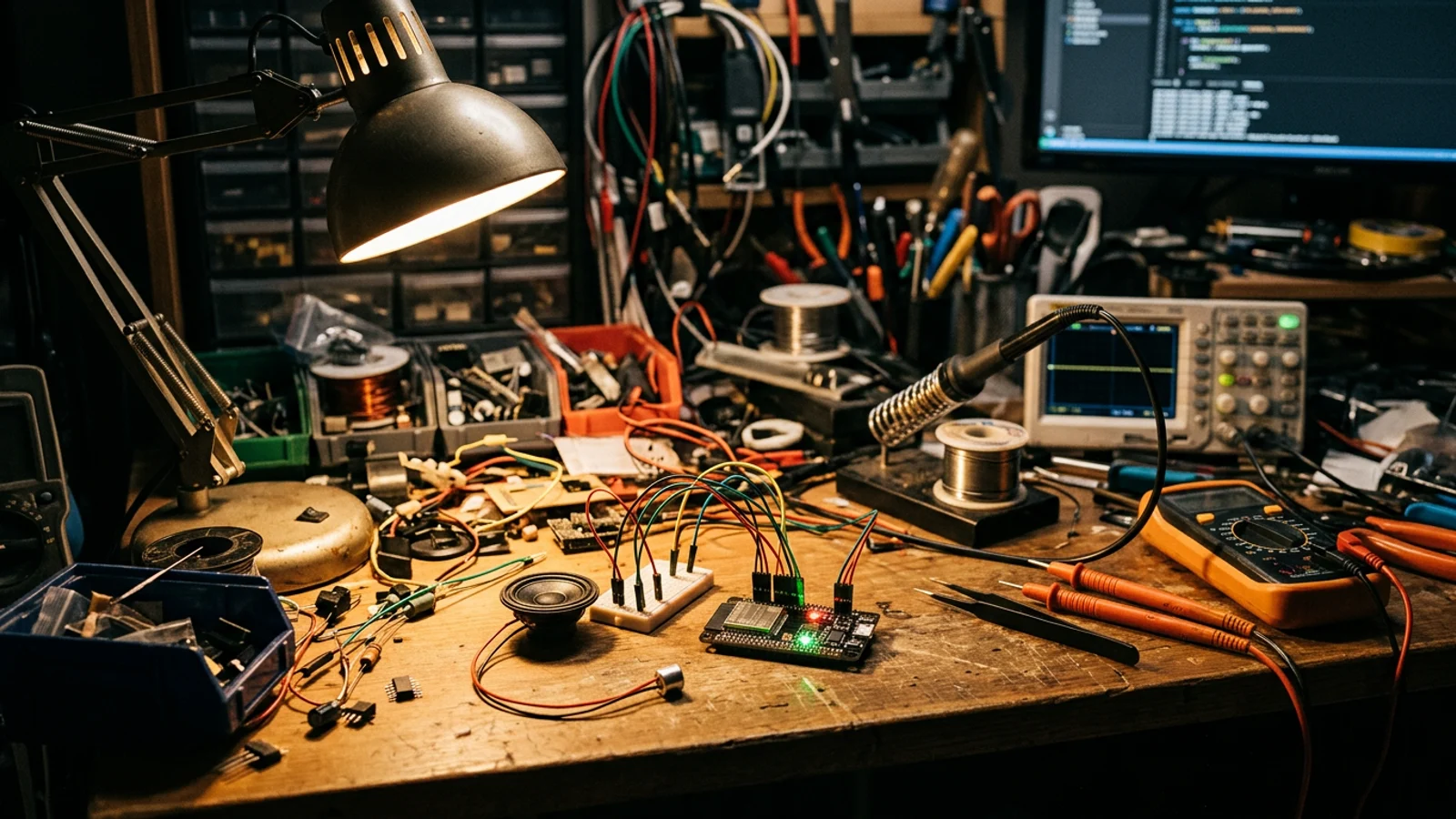
Two fresh ESP32 voice-AI repos go fully offline, a mystery ESP32-S31 chip shows up on a display board, and an ESP32 radio hack learns to transmit.
A Freenove ESP32-S3 Board Runs a Full Offline Voice Assistant
Developer iamankushpandit published esp_ai on GitHub, with the latest push dated October 13, 2026. The project packs free-form speech recognition, a small language model, and text-to-speech onto a single Freenove FNK0104B ESP32-S3 board, with no network call needed between hearing a question and speaking an answer.
The repo is early — 48 stars, no published latency or word-error-rate numbers, and the model size behind "tiny LLM" isn't specified yet beyond fitting on-chip. That makes it a proof of concept more than a benchmarked product.
It still matters for the beat: it's another entry in a growing pile of DIY ESP32 voice stacks built specifically to skip cloud APIs, running the whole hear-think-speak loop on a sub-$10 board.
A New Offline Speech Engine Targets ESP32-S3 and P4, No LLM Bundled
Developer tlack released babytalk, created September 26 and updated October 13, 2026 — an optimized, fully offline speech-to-text and text-to-speech system aimed at the ESP32-S3 and ESP32-P4, written for MicroPython and the Atom ecosystem.
Unlike esp_ai, babytalk doesn't bundle a language model; it's pitched as the voice I/O layer other projects can wire a model into. The repo is young (41 stars) with no public accuracy or latency figures yet.
The honest read: this is infrastructure, not a demo. It lowers the bar for hobbyists wiring voice onto ESP32 boards without rolling their own STT/TTS pipeline from scratch, and it's a different project from the handful of ESP32 voice assistants already covered on this beat.
A New ESP32-S31 Chip Shows Up on a 4.3-Inch Display Board
CNX Software reported on October 14, 2026 that VIEWE's PLCM-UES31S043H800V480C-U appears to be the first third-party development board built around Espressif's new ESP32-S31, paired with a 4.3-inch, 800x480 capacitive touchscreen.
Caveat: the article notes this looks like one of the earliest sightings of the ESP32-S31 in the wild, so a full datasheet, pricing, and any NPU details for the new silicon aren't locked down yet.
Worth tracking anyway — every new Espressif die eventually becomes a target for on-device inference ports, and a display-equipped dev board is usually the first place hobbyists start wiring up vision or voice demos.
An ESP32 Radio Hack Adds Transmit, One Week After Receive-Only
Hackaday reported on October 13, 2026 that the ESP-SDR project, which surfaced the week before with raw access to the 2.4 GHz radio built into many ESP32 variants for receiving signals, now adds transmit capability on the same hardware.
It's a firmware-level hack, not an AI feature, and comes with the usual caveats around spectrum rules and stability at this early stage.
Why it belongs on this beat: the same raw-radio access that makes transmit possible is the kind of low-level silicon exposure that eventually feeds mesh networking and distributed-inference experiments on ESP32 clusters.
An all-ESP32 day: two offline voice stacks building on the same $10-class silicon, a brand-new chip variant just surfacing on a display board, and a radio hack pushing further into the chip's raw hardware. Check the repos and threads linked above for the details.
References & Citations
- iamankushpandit/esp_ai — GitHub, October 13, 2026 — https://github.com/iamankushpandit/esp_ai
- tlack/babytalk — GitHub, October 13, 2026 — https://github.com/tlack/babytalk
- CNX Software — VIEWE ESP32-S31 board, October 14, 2026 — https://www.cnx-software.com/2026/10/14/viewe-4-3-inch-esp32-s31-display-development-board/
- Hackaday — ESP-SDR Can Now Transmit, October 13, 2026 — https://hackaday.com/2026/10/13/esp-sdr-can-now-transmit/
Subscribe to new posts from theaivibe.org
Related Posts
A 35B MoE Vision AI Learns to Fit a Phone While a $7 ESP32 Hijacks an iPhone
OpenBMB squeezes a 35B MoE vision model onto an iPhone, Google shrinks multimodal search to 191MB, and a $7 ESP32 learns to tap a real iPhone's screen.
A Hexagon NPU Learns New AI Tricks While Edge Robots Get Lighter World Models
llama.cpp opens a path to Qualcomm's Hexagon NPU, a 2-bit automation model surges on GitHub, and a lighter world model targets robot arms.
A 1-Bit AI Trick Shrinks a 70B Model to Fit on a $200 GPU
Samsung's sub-1-bit quantization paper gets a reality check, plus fresh research on tiny LLMs and ESP32 voice silicon.