An ESP32 Speaks, Chats, and Gets a New $21 Brain in Today's All-Microcontroller AI Special
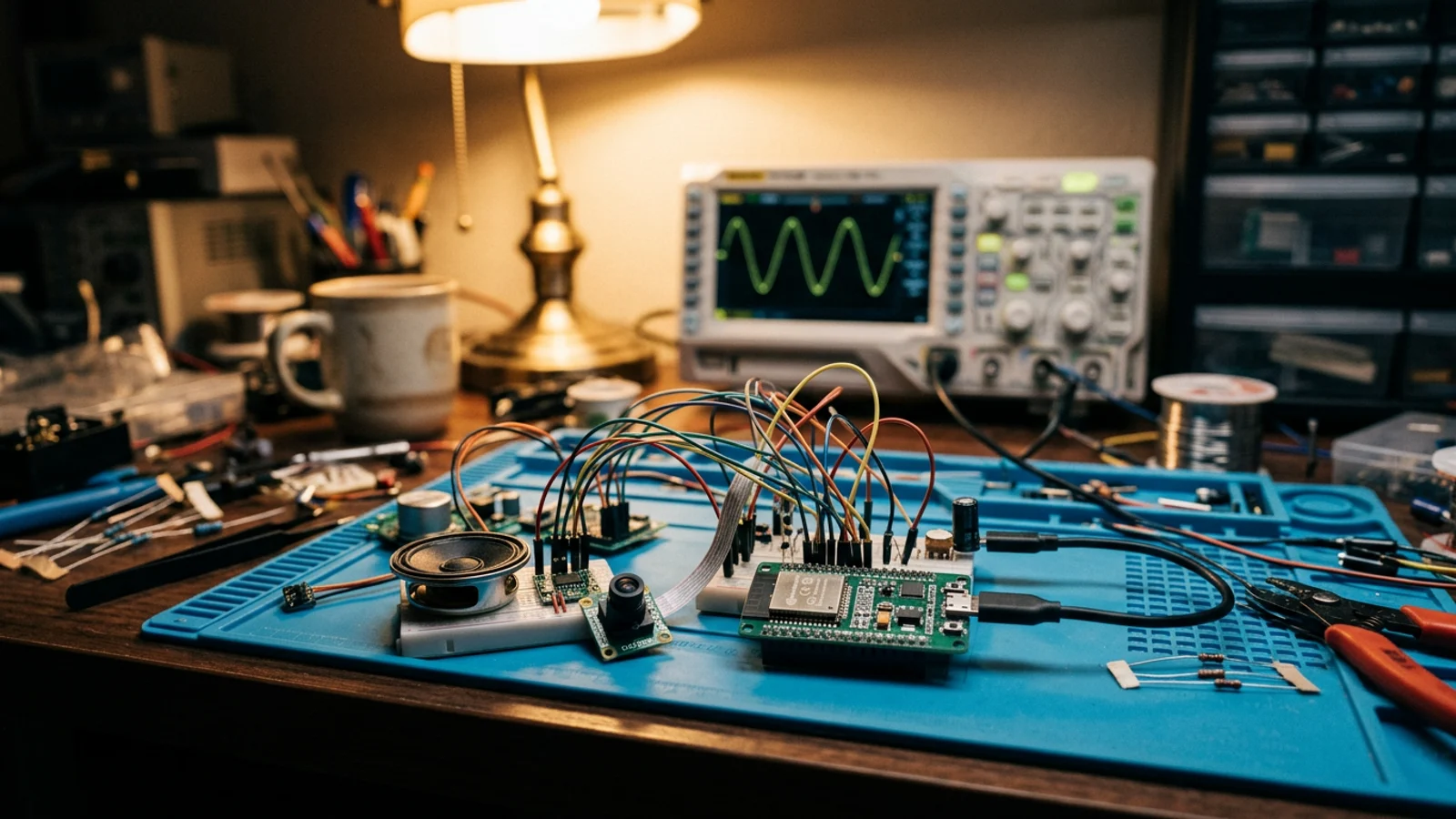
A 3.8MB voice model, an early ChatML LLM, and a $21 board all land on the ESP32 this week.
A 3.8MB Voice Model Speaks Straight From an ESP32-S3
Developer lokutor-ai pushed ito to GitHub, a streaming text-to-speech model built for the ESP32-S3. The model has 3.3 million parameters and ships as 3.8 MB of weights, small enough to sit in flash alongside the rest of a firmware image. The repo describes natural-sounding speech generated with no cloud call, created on October 2, 2026 and now circulating on GitHub's trending feed.
The project is young — 32 stars, no published benchmark against commercial TTS engines, and the README itself frames this as an early build rather than a finished product. There is no public audio comparison yet against cloud TTS quality, so treat the "natural-sounding" claim as the developer's own description until independent samples surface.
What matters is the size. A sub-4 MB voice model that runs fully on-chip keeps joining a growing list of offline voice pipelines on ESP32-class silicon, pushing the question of whether a smart speaker needs a server at all further toward "no."
An Early ChatML Agent Runs Directly on the ESP32-P4
Developer cyfrit published p-for-llm (PFor), a small language model running on the ESP32-P4. The repo describes Instruct (ChatML) and Agent modes, with inference running at roughly 9 tokens per second on the chip's RISC-V core.
The developer's own description calls both capabilities "extremely early and highly unstable," which is an honest flag worth repeating: this is a proof that a ChatML-style chat format and basic tool-calling structure can execute on microcontroller-class hardware, not a usable assistant yet. No benchmark numbers or sample transcripts beyond the author's note have been published.
Even so, the framing matters more than the polish. Pairing an agent-style interface with a sub-$15 chip keeps nudging the floor for "where can a language model physically run" lower, following the same trajectory as other ESP32 LLM experiments documented this year.
A $21 Board Pairs an ESP32-P4X With a WiFi 6 Co-Processor
CNX Software reported on November 4, 2026 that Wireless Tag's WT99P461-S1 board combines an ESP32-P4X with an ESP32-C61 on the same WT01P461-S1 module first seen on the ESP32P4C61-TINY board last June. The board is priced at $21 and adds Ethernet, WiFi 6, RS485, CAN bus, and MIPI CSI/DSI camera and display connectors.
The listed price and spec sheet come from the vendor's own board page as relayed by CNX Software; actual retail availability and shipping region were not confirmed in the report, so treat the $21 figure as the manufacturer's quoted price rather than a confirmed street price.
The combination is the interesting part: the P4X brings more compute headroom for the kind of small models and vision pipelines running on ESP32-P4 boards elsewhere in this dispatch, while the C61 co-processor handles WiFi 6 radio duty efficiently — a cheap, full-featured base for builders who want camera input and a chat-capable model on the same board.
Three ESP32 stories, three different jobs: speaking, chatting, and simply having enough radio and compute to try either. None of it is finished software, but the chip keeps absorbing more of the stack it used to need a server for.
References & Citations
- lokutor-ai/ito — GitHub, created 2026-10-02 — https://github.com/lokutor-ai/ito
- cyfrit/p-for-llm — GitHub repo — https://github.com/cyfrit/p-for-llm
- CNX Software — WT99P461-S1 board report, 2026-11-04 — https://www.cnx-software.com/2026/11/04/21-esp32-p4x-and-esp32-c61-full-featured-board-offers-ethernet-wifi-6-rs485-can-bus-mipi-csi-dsi-and-more/
Subscribe to new posts from theaivibe.org
Related Posts
Apple Watch's On-Device AI Learns to Eavesdrop While a Tiny Korean VLM Teaches Robots to See
A watch beta, a microcontroller voice SDK, a lightweight robot-vision model and a new ExecuTorch release all push inference further onto the device itself.
llama.cpp Splits Liquid AI's LFM3 Across Multiple NPUs While a 29MB Automation LLM Chases Microcontrollers
A new llama.cpp build spreads LFM3 over several Qualcomm NPUs, a sub-30MB model targets tiny automation, and Raspberry Pi prices climb again.
A $25 ESP32 Trains Its Own Tiny LLM While an 8B MoE Model Squeezes Under 1GB of RAM
From a from-scratch LLM on a $25 microcontroller to an 8B MoE model living in under a gigabyte, the edge keeps shrinking its memory budget.