Apple Watch's On-Device AI Learns to Eavesdrop While a Tiny Korean VLM Teaches Robots to See
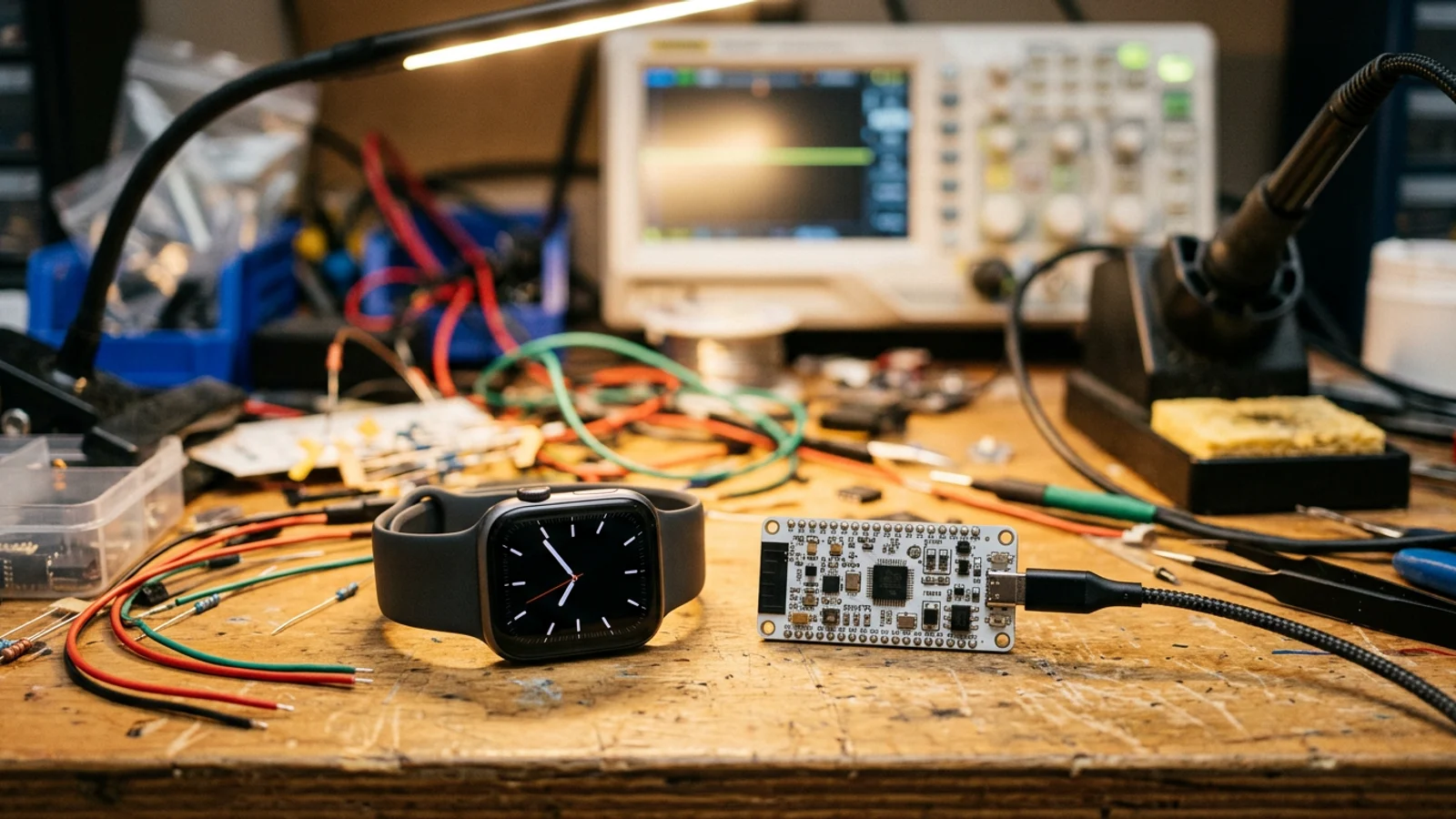
A watch beta, a microcontroller voice SDK, a lightweight robot-vision model and a new ExecuTorch release all push inference further onto the device itself.
NC AI's 3B Vision Model Targets Robots, Not Chatbots
South Korean developer NC AI announced on November 3, 2026 a new lightweight vision-language model called VAETKI Vision 3B, built specifically to run on robots and industrial edge devices rather than in a cloud chat window. The company says the 3B model scored 63.8 on an average of three spatial-reasoning benchmarks (BLINK, ERIQ, ERQA), beating larger 4B and 8B open models including Qwen3-VL-4B and Ministral-3-8B in its 'immediate response' mode that skips chain-of-thought reasoning for real-time control.
These are NC AI's own benchmark numbers, not independently verified, and the model is not yet released publicly — it is positioned as the vision core for the company's in-progress VLA and world-model stack for domestic industrial and defense robotics clients. The model processes video in 4-second, 8-frame windows to catch motion cues like welding-arm trajectories.
If the claims hold up outside NC AI's own tests, it is another data point for a trend running through this beat all year: vision models built from the ground up for low-latency, low-power edge inference rather than shrunk-down versions of large general models.
Apple Watch Starts Listening Locally, With a 30-Second Clock
Apple opened developer beta testing on November 2, 2026 for Audio Intelligence on Apple Watch Series 12 and Ultra 4, running under iOS 27.3. Two of the four features are the interesting ones for this beat: Live Rewind captures the last 15 seconds of speech as text when a user double-presses the digital crown, and Siri Recaps generates a running summary of a conversation — deadlines, prices, action items — without storing raw audio or identifying speakers.
Apple says the S11 chip's secure enclave handles raw audio in hardware-protected memory, a lightweight on-watch model detects active speech, and the compressed text (not audio) is what travels to the paired iPhone and, for final summarization, to Private Cloud Compute before deletion. Live Rewind snippets erase after 30 seconds unless saved; Recaps erase after seven days.
The caveat matters: this is on-device detection and compression feeding a cloud summarization step, not a fully local pipeline. Apple's own privacy claims about what Private Cloud Compute can and cannot see have not been independently audited at this stage of the beta.
A Voice SDK Claims 133ms on a Microcontroller, No Cloud
Applied Brain Research announced general availability on November 2, 2026 of a speech AI SDK for Zephyr RTOS running on Alif Semiconductor's Ensemble family of AI-accelerated microcontrollers. The package bundles Niagara, a streaming full-vocabulary speech recognizer, and Nith, a streaming text-to-speech engine, both built on the company's own state-space models rather than transformer architectures.
On the Ensemble E8 chip, ABR reports an average first-audio-to-first-token latency of 133 milliseconds at 15 mW of added active power — company figures, not independently measured, but directionally consistent with what streaming voice on a microcontroller needs to feel conversational. Nothing in the pipeline touches a server; audio, recognition and synthesis all run on the chip.
ABR is demoing Niagara on the E8 at electronica 2026 in Munich (November 10–13, Alif booth C5.170), and a free evaluation license is open now through its developer portal — a reasonable next check before trusting the latency claim on a real product's microphone and enclosure.
ExecuTorch 1.2.0 Adds Real-Time Speech and a First-Class Cortex-M Target
PyTorch's ExecuTorch project shipped version 1.2.0, a release that adds real-time speech inference through Voxtral Realtime and promotes Arm Cortex-M to a first-class embedded target alongside backend improvements and a smaller binary footprint. The release notes, published on the project's GitHub, frame this as expanding on-device AI 'to more models and more hardware' rather than a single headline feature.
Cortex-M is the workhorse core inside millions of cheap microcontrollers, so first-class support in a mainstream runtime matters more than the speech demo itself — it means model exporters and quantization tooling built for phones and laptops are now explicitly supported down to MCU-class silicon, not an afterthought.
As with any runtime release, the real test is what developers manage to run in their own builds over the next few weeks, not the release notes.
Nordic's New Wi-Fi Chip Targets a 20x Standby Power Cut
Nordic Semiconductor announced the nRF71 Series on November 3, 2026, a new line of SoCs combining ultra-low-power Wi-Fi 6, Bluetooth Low Energy and Thread radios on one chip. The company's headline claim is up to 20 times lower standby power than prior battery-operated Wi-Fi designs — a vendor figure, not yet third-party benchmarked, but a concrete spec attached to a dated announcement.
Standby power is the bottleneck for always-connected battery devices that also need to run local inference — sensors, wearables, trackers that need to wake instantly without draining a coin cell over weeks. A radio that sips power while idle leaves more of the energy budget for the compute side, which is exactly where on-device voice and vision models are competing for milliwatts.
Five different layers of the same story today — a robot's eyes, a watch's ears, a microcontroller's voice, a runtime's reach and a radio's standby draw — all pointing the same direction: more of the thinking happens where the sensor is.
References & Citations
- IT BizNews — NC AI VAETKI Vision 3B, Nov 3, 2026 — https://www.itbiznews.com/news/articleView.html?idxno=230065
- Emergent.sh — Apple Watch Audio Intelligence beta, Nov 3, 2026 — https://emergent.sh/news/apple-watch-ai-audio-intelligence-enters-beta
- The Meridiem — Apple Watch always-on AI capture, Nov 3, 2026 — https://www.themeridiem.com/ai/2026/11/03/apple-watch-gets-always-on-ai-conversation-capture
- DigestX — Applied Brain Research Zephyr/Alif speech SDK, Nov 3, 2026 — https://digestx.tech/tools/applied-brain-research-speech-ai-sdk-zephyr-alif
- PyTorch ExecuTorch — v1.2.0 release notes, GitHub — https://github.com/pytorch/executorch/releases/tag/v1.2.0
- CNX Software — Nordic nRF71 Series announcement, Nov 3, 2026 — https://www.cnx-software.com/2026/11/03/nordic-semi-nrf71-wireless-chips-to-deliver-20-times-lower-standby-power-for-battery-operated-wifi-devices/
Subscribe to new posts from theaivibe.org
Related Posts
llama.cpp Splits Liquid AI's LFM3 Across Multiple NPUs While a 29MB Automation LLM Chases Microcontrollers
A new llama.cpp build spreads LFM3 over several Qualcomm NPUs, a sub-30MB model targets tiny automation, and Raspberry Pi prices climb again.
A $25 ESP32 Trains Its Own Tiny LLM While an 8B MoE Model Squeezes Under 1GB of RAM
From a from-scratch LLM on a $25 microcontroller to an 8B MoE model living in under a gigabyte, the edge keeps shrinking its memory budget.
A Viral Android AI Agent Taps Its Own Phone While a Neuromorphic Chip Teaches a Raspberry Pi to Learn Live
An open-source Android AI agent tops 2,100 GitHub stars in two days as a neuromorphic kit teaches a Raspberry Pi 5 to learn sounds on the fly.