An ESP32 Becomes an AI's Hands on an iPhone, While Another Logs Car Data With On-Chip AI
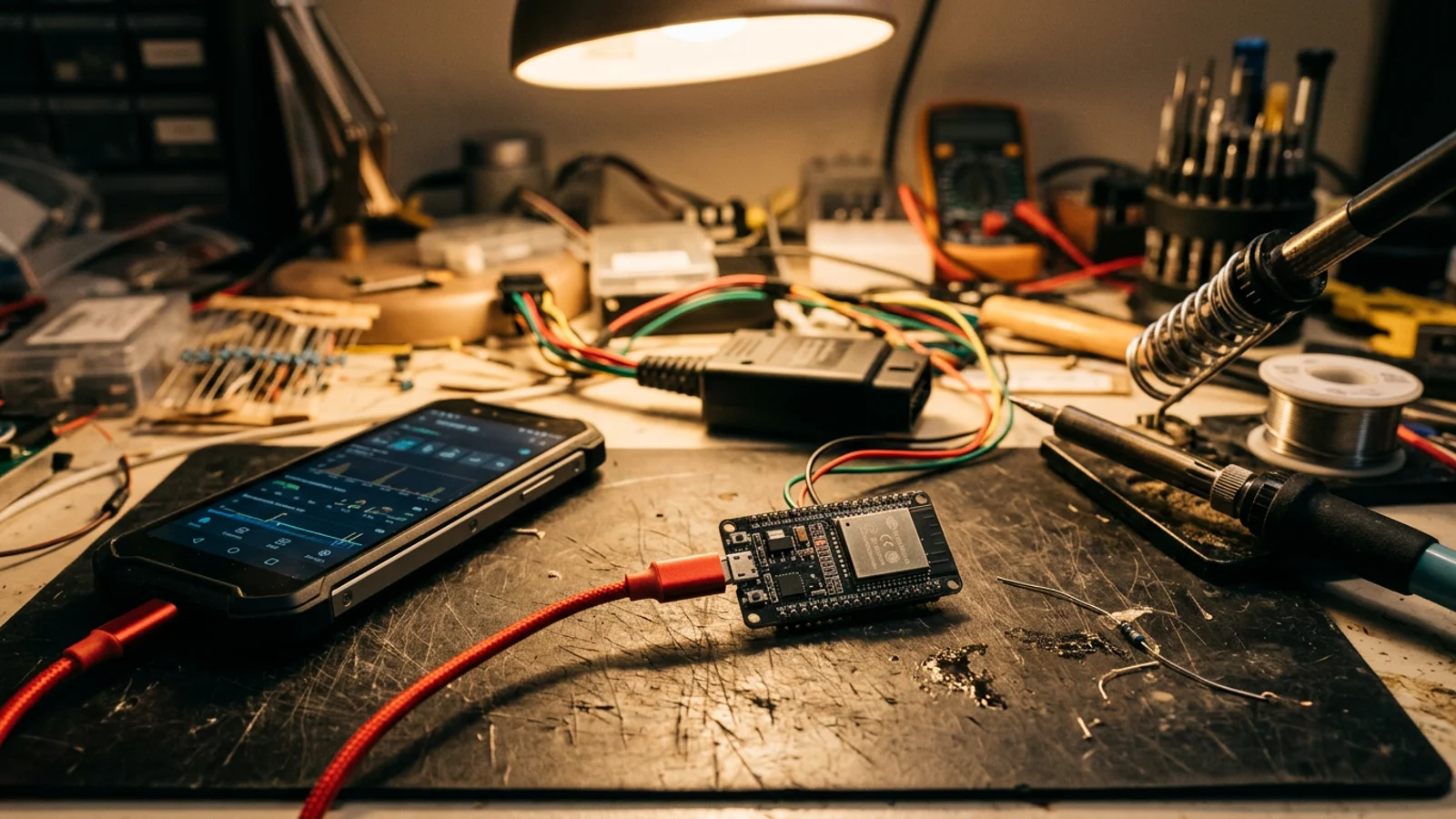
Today's ESP32 roundup: a $7 board that lets a remote model drive an iPhone, an OBD2 logger with on-chip neural nets, an Agora link for ESP32 voice and Pinscope.
A $7 ESP32 gives a remote AI model eyes and hands on a real iPhone
The GitHub repo onehumanbeing/esp32-iphone-agent ("Manina AI") describes a way to let an AI model use a real iPhone with a roughly $7 ESP32. According to the repo description, the board supplies the "eyes" through AirPlay screen mirroring and the "hands" through USB HID input, and the model can be any OpenAI-compatible endpoint. The project was created on October 11, 2026, and showed about 5,300 stars when we checked on November 25, 2026.
The caveat is the one that matters: the ESP32 is the peripheral here, not the brain. The reasoning happens on whatever model server you point it at, so this is not on-device inference on the microcontroller. I read the repo description and did not verify the setup or reliability. Still, it shows how cheap a hardware actuation layer for a phone agent has become.
OpenCarMind runs neural networks on an ESP32 car-data logger
Builder AlveeeRahman's OpenCarMind is an open-source OBD2 logger and dashboard for the ESP32. The README says an ESP32 board plus a Bluetooth OBD-II adapter becomes a car data logger that runs neural networks on the chip, with no phone, account or internet connection required.
The claims are the author's own. I did not find benchmarks, model sizes or accuracy figures in the material I reviewed, so what the networks detect and how well is unverified. Even so, it is the kind of fully local, sensor-driven TinyML use that fits a microcontroller: modest models, a steady data stream and no cloud dependency.
Espressif connects esp-webrtc-solution to Agora's real-time network
On November 25, 2026, Espressif's developer portal published a post on connecting esp-webrtc-solution to Agora's SDRTN, Agora's global software-defined real-time network. The post is framed around conversational AI, so ESP32-powered devices can now exchange real-time data with Agora's network.
Read this as tooling, not local inference. In this kind of setup the ESP32 handles capture, playback and transport, while the language model runs in the cloud. I have only read the post's summary, so check it for supported chips and the exact SDK versions before building on it.
Pinscope offers remote access and vulnerability tracking for ESP32 and Zephyr devices
CNX Software covered Pinscope on November 25, 2026, describing a web-based remote-access and vulnerability-tracking service. It targets microcontroller-class devices such as the ESP32, ESP8266 and Raspberry Pi Pico 2 W, plus boards running Zephyr and Linux SBCs.
It has no AI component. It matters to this beat because fleets of ESP32 devices running local models, or acting as voice and vision nodes, still need updating and patching. I did not see pricing or independent testing in the coverage, so treat the capabilities as the vendor's description.
A thin day for true ESP32 inference: one on-chip builder project, one cloud-assisted agent and two tooling items. As always, the sources are linked above.
References & Citations
- onehumanbeing — esp32-iphone-agent (GitHub repo, created October 11, 2026) — https://github.com/onehumanbeing/esp32-iphone-agent
- AlveeeRahman — OpenCarMind (GitHub repo) — https://github.com/AlveeeRahman/OpenCarMind
- Espressif Developer Portal — Conversational AI on ESP32 with Agora, November 25, 2026 — https://developer.espressif.com/blog/2026/11/conversational-ai-esp32-agora/
- CNX Software — Pinscope, November 25, 2026 — https://www.cnx-software.com/2026/11/25/pinscope-a-web-based-remote-access-and-vulnerability-tracking-solution-for-esp32-zephyr-pico-2-w-and-linux-sbcs/
Subscribe to new posts from theaivibe.org
Related Posts
Tencent's WePM Folds Three Jobs Into One Small AI Model While an ESP32-S3 Voice Agent Keeps Its Brain on the LAN
Tencent opens a 2B/4B vision-language model with a 3.19 GiB GGUF build, plus an NPU eye-gaze monitor, an ESP32 voice agent, and two edge-AI hardware announcements.
Local LLM Runtimes Tick Forward: llama.cpp Adds Qualcomm and Audio Speedups, LiteRT 2.4.0 Ships Quietly
llama.cpp builds from November 22-23 touch Qualcomm OpenCL, audio and Intel SYCL, while LiteRT 2.4.0 lands without notes and a VLA demo targets the Ventuno Q.
A 26B Looped-MoE LLM Gets Squeezed to 3.85 GB for Phones as New Papers Cut Decode Costs
LookAtMyQuant packs Inkling-2-Mini into six Apple Silicon builds, while new papers tackle weight decoding, laptop fine-tuning and Cortex-M inference.