Local LLM Runtimes Tick Forward: llama.cpp Adds Qualcomm and Audio Speedups, LiteRT 2.4.0 Ships Quietly
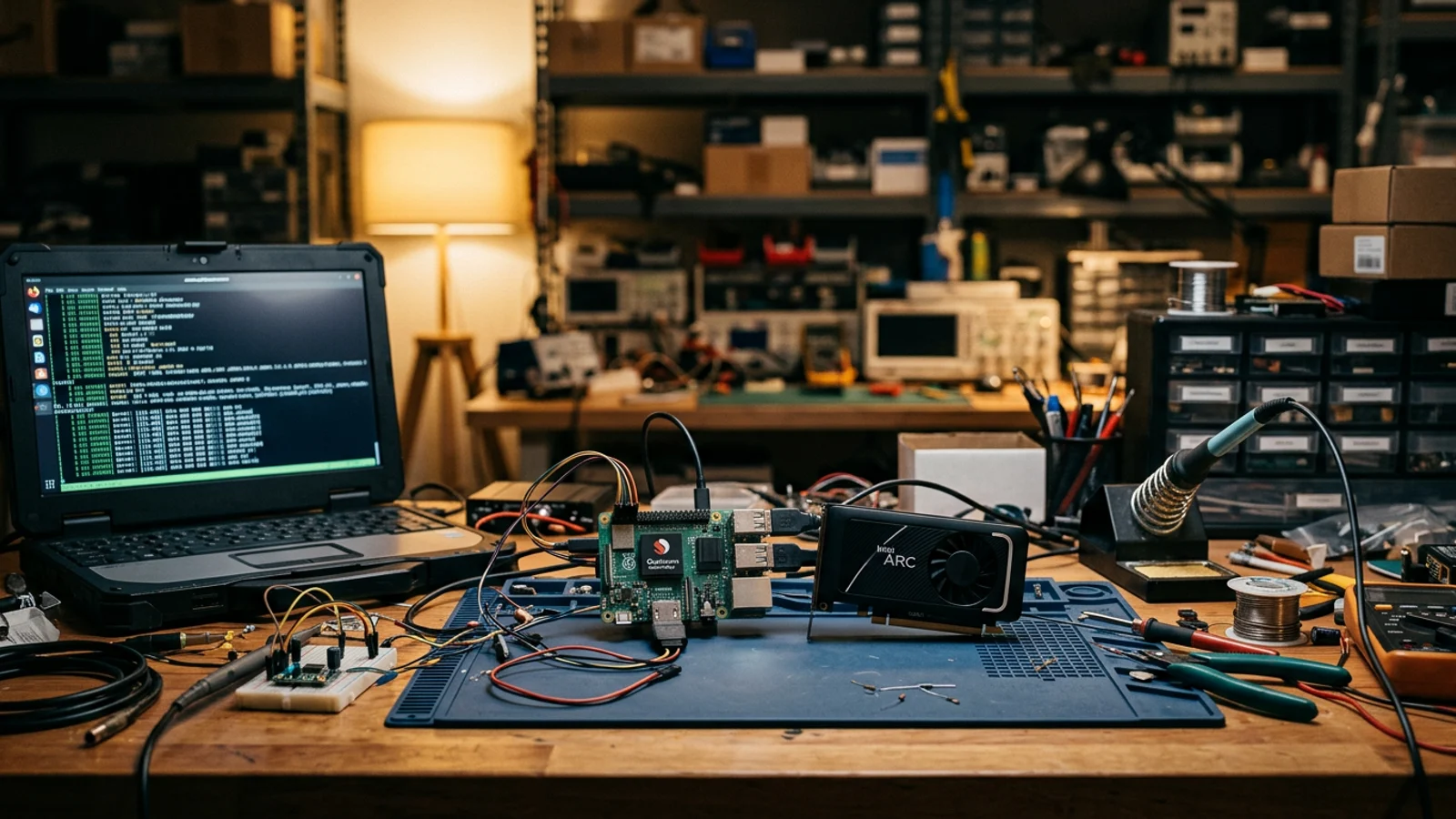
llama.cpp builds from November 22-23 touch Qualcomm OpenCL, audio and Intel SYCL, while LiteRT 2.4.0 lands without notes and a VLA demo targets the Ventuno Q.
llama.cpp's weekend builds: Qualcomm GEMM, faster audio FFT, a big SYCL kernel win
Four llama.cpp pre-release builds from November 22-23, 2026 each touch a different edge target. Build b12648 (November 23) adds an OpenCL q4_k GEMM for speculative-decoding verification and enables it for a Qualcomm part labeled X2. The commit credits Qualcomm's Hongqiang Wang. Build b12644 (November 23) replaces the recursive audio FFT in the multimodal (mtmd) code with iterative stages and adds a forward/inverse test. It lists no timing numbers.
Build b12621 (November 22) bounds the SYCL CONV_TRANSPOSE_1D input loop. The contributor reports kernel speedups from 2.9x to 710x on an Intel Arc Pro B70, using shapes from a codec decoder's upsampling stack. These are self-reported kernel timings, not end-to-end speech latency. The same page says the full backend test suite aborts on an unrelated assert, on both the base and the patch. A further build, b12651, adds a WebGPU ROLL operator and, per OpenSourceCoder, publishes no benchmarks.
For context, the project's v1.0.0 announcement (November 13) says API and ABI breaks will now come with major-version bumps. Several of these commits are marked as written with AI assistance. Builds are pre-releases, so pin a version before relying on any of this.
LiteRT 2.4.0 appears on Maven and PyPI without release notes
Per a Fora Soft guide to on-device Android AI, LiteRT 2.4.0 was published to Google Maven and PyPI on November 20, 2026. As of November 22, Google had posted no notes for it, so that outlet advises planning upgrades from the 2.3 notes.
Those 2.3 notes are on Google's LiteRT page. They describe 2.3.0 as focused on large language model efficiency and cross-platform GPU and NPU use, plus type-safe Swift APIs for iOS and macOS. I could not confirm what changed in 2.4.0, so treat it as unreviewed. The practical point for anyone shipping phone-side models is to test the package before bumping it.
Ref-YOLO-World targets text-side recomputation for edge referring detection
A paper posted to arXiv on November 20, 2026, Ref-YOLO-World, takes on referring expression comprehension: finding the object a phrase describes. Its abstract opens by noting that many accurate methods build image-dependent multimodal representations that must be recomputed for every new query. The title says the authors decouple the text-side computation so that work is not repeated.
I read only the opening of the abstract, so I cannot report accuracy or latency figures, and any speedups are the authors' own claims until someone reproduces them. The design goal is still a sensible one for small hardware: cache the language side and keep the per-frame cost on the detector.
A Hackster build runs a VLA robot-arm demo on the Ventuno Q
On November 22, 2026, Hackster published "Run VLA on Ventuno Q" by the user dmitrywat. Its teaser describes a robot arm sent to grab toy ducks, driven by a vision-language-action policy on Arduino's Ventuno Q board.
The summary I could read does not say which model, runtime or frame rate is involved, or whether any step runs off the board. That is the question to check in the write-up. VLA inference on a board in this class is the kind of edge robotics result worth following, but a demo video is not a benchmark.
A quiet day for headline launches, with the useful movement in release notes and commit logs. The linked pages are the place to check exact versions and claims.
References & Citations
- ggml-org/llama.cpp build b12648 (Qualcomm OpenCL q4_k GEMM), November 23, 2026 — https://github.com/ggml-org/llama.cpp/releases/tag/b12648
- ggml-org/llama.cpp build b12644 (mtmd audio FFT), November 23, 2026 — https://github.com/ggml-org/llama.cpp/releases/tag/b12644
- ggml-org/llama.cpp build b12621 (SYCL CONV_TRANSPOSE_1D), November 22, 2026 — https://github.com/ggml-org/llama.cpp/releases/tag/b12621
- OpenSourceCoder, llama.cpp b12651 WebGPU ROLL support, 2026 — https://opensourcecoder.com/news/llamacpp-b12651-webgpu-roll-support/
- ggml-org on Hugging Face, llama.cpp v1.0.0, November 13, 2026 — https://huggingface.co/blog/ggml-org/llama-cpp-v1
- Fora Soft, On-Device AI on Android (LiteRT 2.4.0), November 22, 2026 — https://www.forasoft.com/blog/article/neural-networks-on-android-369
- Google AI Edge, LiteRT October release (2.3.0) — https://developers.google.com/edge/litert/releases/litert_oct
- arXiv, Ref-YOLO-World, November 20, 2026 — https://arxiv.org/abs/2611.27756v1
- Hackster, dmitrywat, Run VLA on Ventuno Q, November 22, 2026 — https://www.hackster.io/dmitrywat/run-vla-on-ventuno-q-bef924
Subscribe to new posts from theaivibe.org
Related Posts
An ESP32 Becomes an AI's Hands on an iPhone, While Another Logs Car Data With On-Chip AI
Today's ESP32 roundup: a $7 board that lets a remote model drive an iPhone, an OBD2 logger with on-chip neural nets, an Agora link for ESP32 voice and Pinscope.
Tencent's WePM Folds Three Jobs Into One Small AI Model While an ESP32-S3 Voice Agent Keeps Its Brain on the LAN
Tencent opens a 2B/4B vision-language model with a 3.19 GiB GGUF build, plus an NPU eye-gaze monitor, an ESP32 voice agent, and two edge-AI hardware announcements.

A 26B Looped-MoE LLM Gets Squeezed to 3.85 GB for Phones as New Papers Cut Decode Costs
LookAtMyQuant packs Inkling-2-Mini into six Apple Silicon builds, while new papers tackle weight decoding, laptop fine-tuning and Cortex-M inference.