An AI Racing Drone Beats Humans While a Jetson VLA Model Sprints 12x Faster
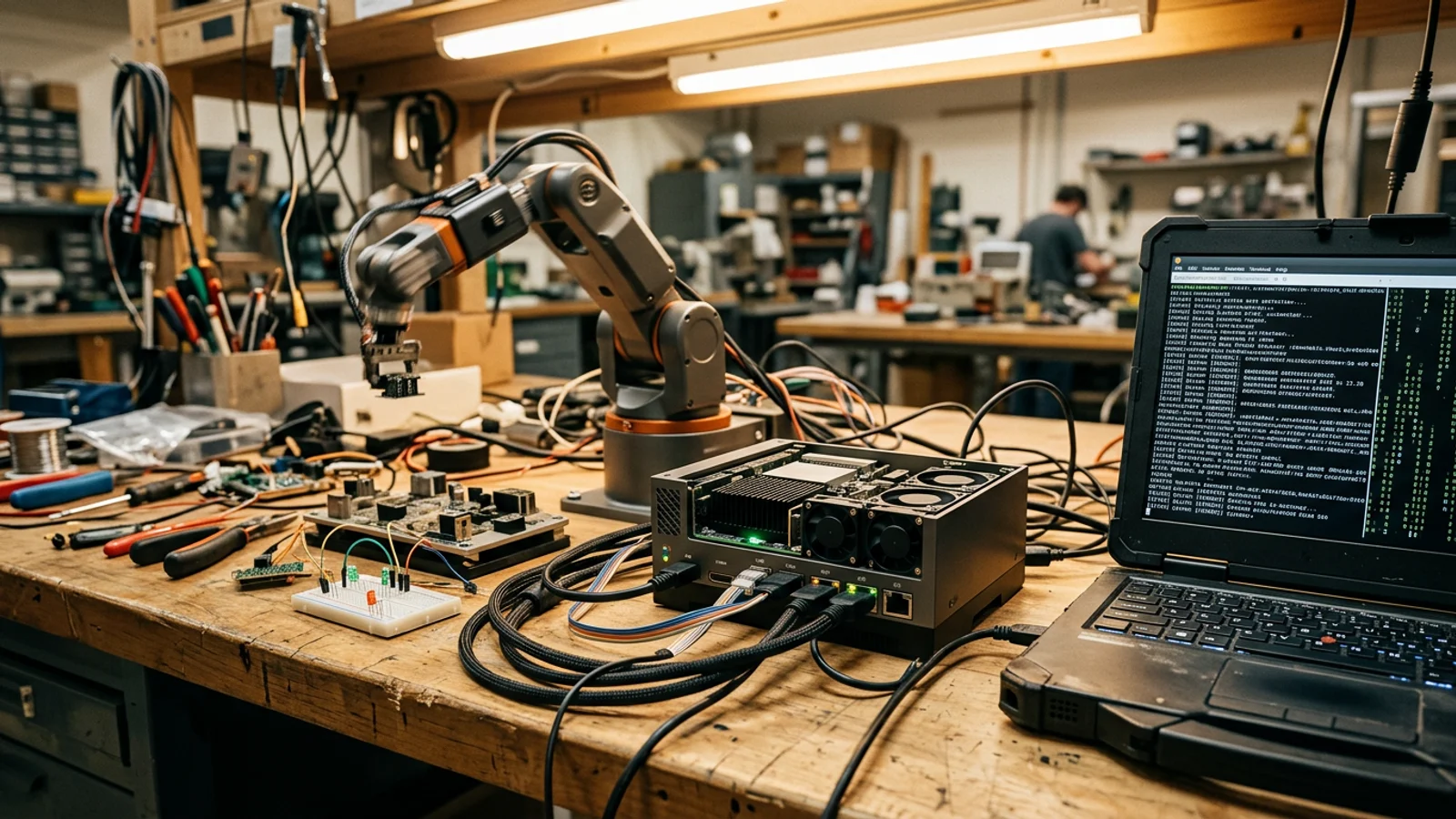
A single-camera drone outflies champion pilots, a Jetson runtime slashes VLA latency, and Reachy Mini learns to remember people on a Pi.
A Jetson VLA Gets a 12x Speed Boost
A new inference runtime called FlashRT, built by GitHub user LiangSu8899, claims to cut the decision latency of NVIDIA's π0.5 vision-language-action policy running on a Jetson AGX Thor from roughly 266 to 304 milliseconds down to 22.2 milliseconds, lifting the control loop from 3.8 Hz to 45.1 Hz on the LIBERO-spatial benchmark.
On the project's own numbers, that turns a single pick-and-place task that took 23.5 seconds with the stock OpenPI and LeRobot stack into one finishing in 5.4 seconds, with all four test arms succeeding. The gains come from restructuring how the flow-matching sampling step talks to the GPU, not from a new model.
This is one benchmark on one LIBERO-spatial task, reported by the repo's own README — not independently reproduced or peer-reviewed. Still, the gap between a VLA model that 'works' and one that can steer a robot arm in real time usually comes down to exactly this kind of runtime plumbing, and Jetson Thor is quickly becoming the platform people optimize against.
A Single Camera Beats Champion Drone Pilots
TU Delft's MAVLab demonstrated MonoRace, a racing drone that reportedly outflies world-champion human pilots at speeds up to 100 km/h while navigating with nothing but a single onboard camera — no motion-capture rig, no LiDAR — according to Hackster's October 16, 2026 writeup.
The honest caveat: the piece doesn't spell out exactly what compute the vision model runs on in flight versus what's run off-board, and no independent benchmark exists beyond the claim itself. MAVLab has a long history of squeezing perception models onto gram-scale flight hardware, which makes the claim plausible, but it's worth treating as a lab demo until a paper with hardware specs lands.
If it holds up, it's a reminder that edge AI in robotics increasingly means doing more with less sensing — one camera feed replacing an entire tracking rig is itself a compute and power win.
A Tabletop Robot Gets a Memory That Survives Reboots
Qdrant engineers built a local, on-device semantic memory layer for Reachy Mini, the open-source tabletop robot from Pollen Robotics and Hugging Face that runs on a Raspberry Pi with 4GB of RAM. The system, described in a Qdrant Edge blog post, lets the robot store and retrieve facts about people and past conversations from a vector database running directly on the Pi, so a restart no longer wipes everything the robot 'knew.'
The caveat is that this is a memory and retrieval layer, not a faster or smarter language model — Reachy still depends on whatever LLM is handling conversation at any given moment, and the write-up focuses on architecture, not benchmarked recall accuracy.
What's notable for tiny hardware is that the whole stack — robot, LLM, and a searchable vector store — now fits and runs on a single Raspberry Pi, no cloud database required to remember a face.
A Carrier Board Adds NVMe and PoE to Jetson Modules
Rapid Analysis launched a crowdfunding campaign on October 16, 2026 for Xerxes Pi 2026 and Xerxes Nano, carrier boards that add NVMe storage, Power-over-Ethernet, and OCuLink connectivity to both Raspberry Pi compute modules and NVIDIA Jetson modules, following up on a 2025 campaign for the original Xerxes Pi, according to CNX Software.
It's a crowdfunding campaign, not a shipped product, so final pricing and specs can still shift before backers receive hardware.
Carrier boards like this matter because Jetson Orin and Thor modules running local VLA policies or vision-language models need fast storage and clean power delivery to run continuously in a robot chassis — the kind of plumbing that turns a dev kit into something you can bolt onto a project.
Six New Tiny Boards Pair ESP32-S3 With a Touchscreen
Seeed Studio introduced its XIAO IPS touch display series on October 17, 2026: six compact development boards built around either the XIAO ESP32-S3 Plus or the XIAO nRF52840 Plus, with IPS LCD options ranging from 0.96 inches to 1.47 inches, per CNX Software.
These are general-purpose display modules, not AI accelerators — no NPU or extra compute beyond the host SoC.
The appeal for this beat is practical: the ESP32-S3 boards in this lineup are the same class of chip already running offline wake-word and small-model voice pipelines elsewhere on this beat, and a built-in touchscreen gives those projects a UI without wiring up a separate display module.
Today's crop leans toward plumbing over flash — a faster runtime, a persistent memory layer, a sturdier carrier board — the unglamorous work that turns edge-AI demos into things people can actually bolt onto a robot.
References & Citations
- LiangSu8899/FlashRT — GitHub, Oct 2026 — https://github.com/LiangSu8899/FlashRT
- Hackster — TU Delft MonoRace drone, Oct 16, 2026 — https://www.hackster.io/news/humans-are-no-match-for-this-ai-racing-drone-7cb686167bff
- Qdrant — Reachy Mini local memory blog post — https://qdrant.tech/blog/reachy-robot-memory-qdrant-edge/
- CNX Software — Xerxes Pi 2026 / Xerxes Nano, Oct 16, 2026 — https://www.cnx-software.com/2026/10/16/xerxes-pi-2026-and-xerxes-nano-carrier-boards-offer-nvme-poe-and-oculink-for-raspberry-pi-and-jetson-modules/
- CNX Software — Seeed XIAO IPS display series, Oct 17, 2026 — https://www.cnx-software.com/2026/10/17/seeed-studio-xiao-ips-display-series-features-esp32-s3-or-nrf52840-soc-with-0-96-inch-to-1-47-inch-lcd-options/
Subscribe to new posts from theaivibe.org
Related Posts
AMD Opens Its NPU Stack to AI Agents While Qualcomm Puts an LLM on Your Face
AMD ships an official NPU SDK, hobbyists wake up an older Ryzen chip's idle silicon, and new hardware arrives already quoting on-device LLM speeds.
Edge AI Learns to Hear Without Any Dedicated AI Silicon At All
A microcontroller runs open-vocabulary speech recognition with no neural accelerator, while NPU boards and an $8 chip push tiny-LLM throughput further.
ESP32 Special: Two Offline Voice-AI Builds Debut While a New Chip Powers a Display Board
Two fresh ESP32 voice-AI repos go fully offline, a mystery ESP32-S31 chip shows up on a display board, and an ESP32 radio hack learns to transmit.