Edge Dispatch: AMD's Ryzen AI Halo Jumps to 192GB While Qualcomm Pushes On-Device AI Agents
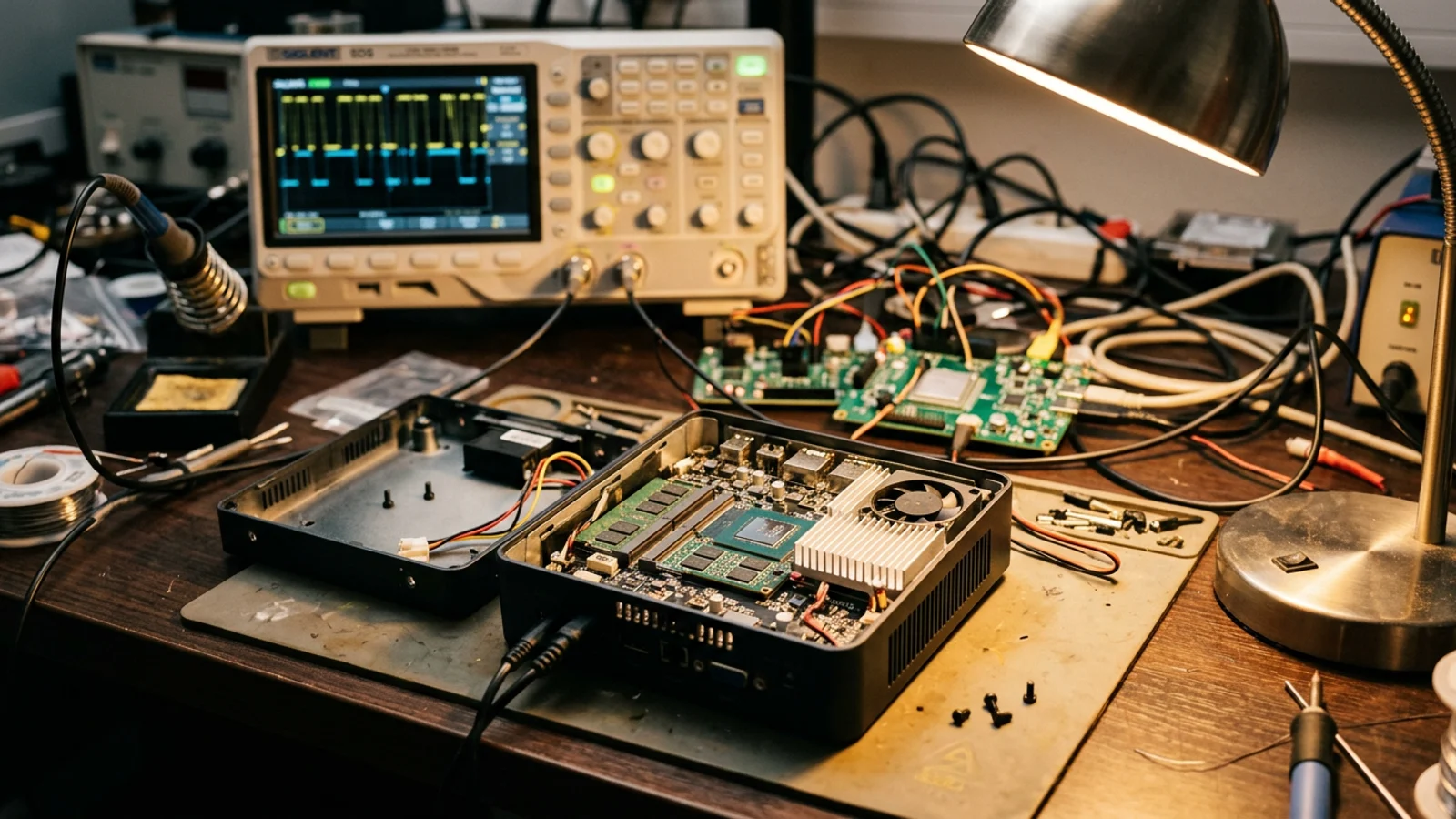
AMD bumps its NPU mini PC to 192GB of unified memory, Qualcomm ships five agentic apps for Snapdragon X, and Korea rethinks its NPU strategy.
AMD's Ryzen AI Halo dev box just got a bigger memory pool — again
AMD's Ryzen AI Halo developer platform, built around the AI Max 300-series chips, is now shipping with the Ryzen AI Max+ 395 and up to 128GB of unified memory, according to xda-developers. Days later, AMD's own product page quietly raised the ceiling again: as of August 19, 2026, a newer Halo configuration built around the Ryzen AI Max+ PRO 495 lists support for 192GB, as reported by mayhemcode.com.
The honest caveat: this is a mini PC, not a phone or a microcontroller, and 192GB of unified memory is a spec sheet claim tied to a still-narrow product line. AMD has not published independent third-party benchmarks for the 192GB configuration, and pricing for the PRO 495 variant has not surfaced yet.
What makes it relevant to this beat is the memory architecture, not the raw number. Unified memory shared between CPU, GPU and NPU is what lets a desk-sized box run large local models without a discrete GPU, and AMD moving that target twice in a matter of weeks signals it sees local LLM hosting as the actual use case for this hardware, not gaming or workstation graphics.
Qualcomm lines up five apps that claim to run agentic AI locally on Snapdragon X
Qualcomm published a rundown naming five independent software vendors — AnythingLLM, Pokee AI, LLMWare, Deepgram and Memories.ai — building what it calls agentic AI apps that run natively on PCs with Snapdragon X Series processors, per Qualcomm's own onQ blog. AnythingLLM is pitched as local-first, with screen-aware dictation and document agents that avoid cloud calls; Pokee AI claims it sustains hundreds of thousands of tokens of context on-device for enterprise reasoning tasks.
This is a vendor blog, and every performance and battery-life claim in it is Qualcomm's or its partners' own framing. There is no independent benchmark here, and "agentic" is doing a lot of marketing work — the actual mix of on-NPU inference versus CPU fallback in each app is not detailed.
Still, the list is a useful signal of what software vendors think an NPU-equipped AI PC is for in mid-2026: not chatbots, but multi-step task agents that stay off the network by default. Whether these apps hold up under real workloads is a separate question worth checking independently.
South Korea moves to cut GPU reliance with an 'open AI computing' push
South Korea is building what it calls an open AI computing ecosystem meant to shift national AI infrastructure away from GPU-centric design toward domestically made NPUs, according to Digital Today. This is a broader policy push distinct from any single vendor's product, aimed at making Korean NPU silicon a viable substitute in government and industrial deployments.
A concrete example of the pitch already running in production: Posco DX has built an unstructured data analysis platform for factory floors that pairs GPUs for model training with domestic NPUs — from Deepx and Mobilint — for real-time inference on fire monitoring, worker-safety detection and cargo verification, per The Herald Business. Posco DX says the NPU path cuts infrastructure costs by roughly 50% and power draw by roughly 90% versus GPU-based systems at equivalent inference performance — a self-reported figure with no independent audit cited.
The pattern matters for the edge beat because it is industrial policy meeting inference hardware directly: a government trying to make cheap, low-power NPUs the default for on-site AI rather than an afterthought bolted onto GPU infrastructure.
A hobbyist project gets XDNA1's oldest Ryzen NPUs talking to Linux
Developer Jonas-Augustinus-Linus released version 1.1.0 of Open NPU Lab, a project aimed at making Ryzen NPUs — starting with the older XDNA1 silicon in chips like the Ryzen 7 PRO 7840U — actually do something under Linux, per the project's GitHub release notes. The repo's own README is candid about the gap it is filling: on XDNA1, the in-tree amdxdna driver lets Linux see the NPU, but "no shipped runtime will execute a model on it," leaving iree-amd-aie as the one open path that actually targets the chip, according to the repo itself.
This is a small, CPU-checked, honest-benchmark project, not a production runtime — the author frames it as a reusable path for XDNA1 and XDNA2 owners and future-device experimenters rather than a finished product.
It matters because official NPU support tends to skip older silicon first. Plenty of Ryzen AI laptops sold in the last two years shipped with first-generation XDNA1 hardware that vendor runtimes largely ignore, so a working, if modest, community path for that exact chip closes a real gap.
A solo developer claims a Jetson inference engine that beats llama.cpp — self-reported, worth watching
Developer Jared Frost describes building genie-ai-runtime, an inference engine designed around Jetson's unified memory architecture, and benchmarking it against llama.cpp on the same hardware across transformer (Qwen), pure state-space (Mamba) and hybrid attention/Mamba-2 (Falcon-H1) architectures, all quantized to Q4_K_M, per the author's own writeup. The post frames unified memory handling as the deciding factor at longer context lengths, testing 0 to 32k tokens.
This is a single developer's blog post with self-reported numbers and no third-party reproduction yet, so the "beats llama.cpp" claim should be read as a starting point for scrutiny, not a settled result. The benchmark methodology and raw numbers are referenced via an internal issue tracker link rather than a public dataset.
Still, Jetson boards remain one of the more capable rungs of the edge-hardware ladder, and a from-scratch runtime built specifically around Jetson's memory model — rather than a general-purpose engine ported to it — is exactly the kind of niche optimization worth tracking if independent numbers follow.
Today's thread is memory and sovereignty: AMD widening its unified-memory ceiling, Qualcomm betting on local agents, Korea betting on domestic NPUs, and two independent developers doing the unglamorous work of making older or unusual silicon actually run something.
References & Citations
- xda-developers.com, Aug 2026 — https://www.xda-developers.com/amd-ai-halo-mini-pc-now-available/
- mayhemcode.com, August 19, 2026 — https://www.mayhemcode.com/2026/08/192gb-mini-pcs-explained.html
- Qualcomm onQ blog, August 2026 — https://www.qualcomm.com/news/onq/2026/08/agentic-ai-apps-snapdragon-x-series
- Digital Today, August 2026 — https://www.digitaltoday.co.kr/en/view/94884/south-korea-launches-open-ai-computing-ecosystem-to-cut-gpu-reliance
- The Herald Business — https://biz.heraldcorp.com/article/10843427
- Jonas-Augustinus-Linus, GitHub release v1.1.0 — https://github.com/Jonas-Augustinus-Linus/ryzen-npu-linux/releases/tag/v1.1.0
- Jonas-Augustinus-Linus, ryzen-npu-linux repo — https://github.com/Jonas-Augustinus-Linus/ryzen-npu-linux
- Jared Frost, jared-hpc.com — https://jared-hpc.com/posts/genie-ai-runtime-jetson-edge-llm/
Subscribe to new posts from theaivibe.org
Related Posts
ExecuTorch Hits 1.0 as llama.cpp Learns to Make Instant AI Decisions
PyTorch declares its on-device AI runtime production-ready while llama.cpp adds a decision-model endpoint and two new NPU modules land for edge boards.
Seven $5 Chips Learn to Share an LLM, One Bit at a Time
A BitNet cluster splits an LLM across seven ESP32-S3 boards, a 2-bit tool-calling model lands on GitHub, and a quantization paper gets llama.cpp 15x faster on an M4 Pro.
A 4B AI Model Learns to Run a Robot Arm Entirely on Jetson Thor
NVIDIA's Cosmos 3 Edge drives a robot arm on-device, a $5-class chip gets a voice it hasn't spoken yet, and two new boards widen the SBC lineup.