AMD, Qualcomm and NVIDIA All Chase the Same Local-AI Bottleneck: Memory
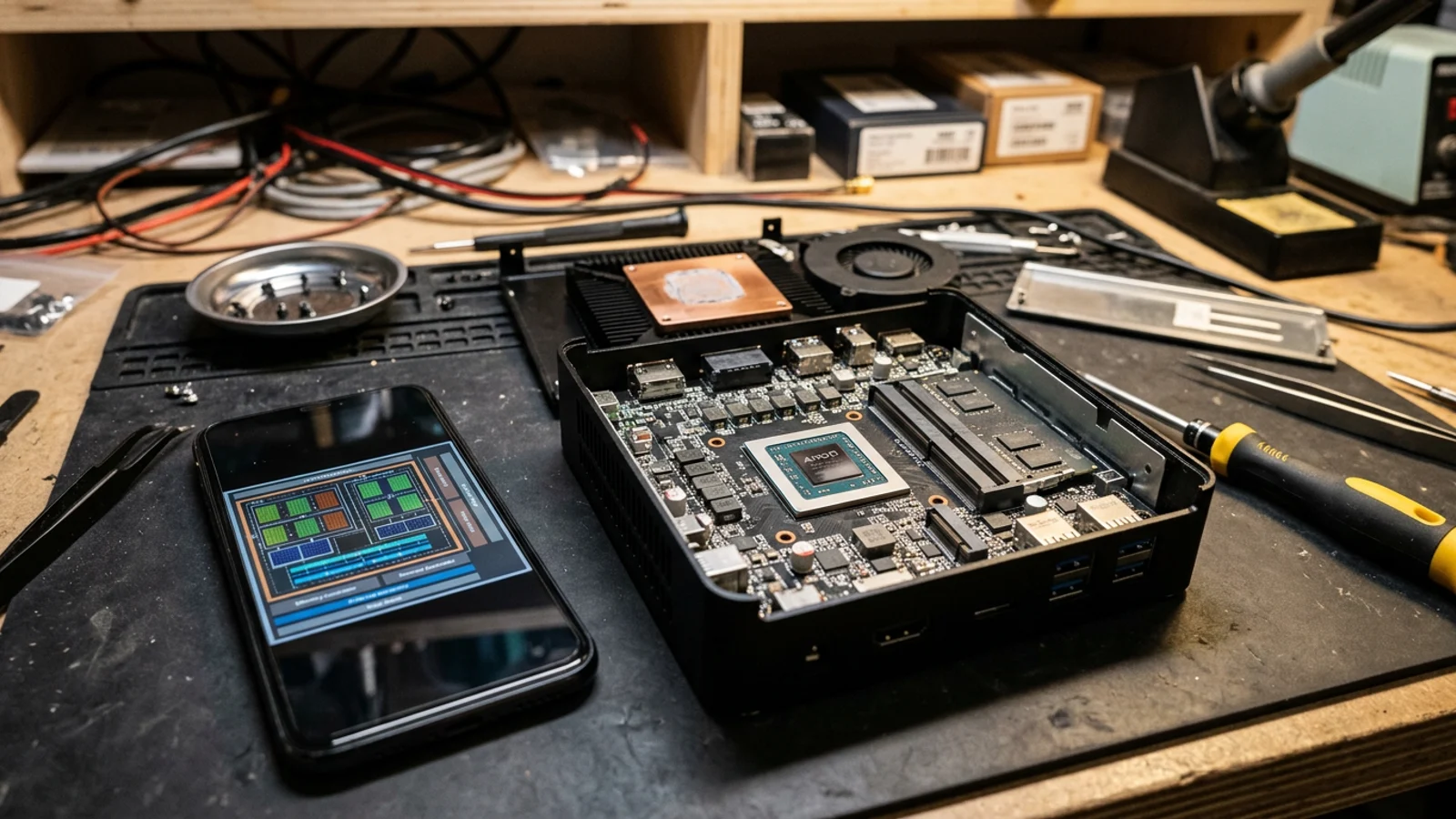
Three chipmakers and a mini-PC builder all attack the same problem this week: getting AI inference closer to memory, not just closer to silicon.
AMD's New Embedded Chip Bets on Shared Memory, Not Raw TOPS
AMD's Ryzen AI Embedded X100 series, detailed in an analysis by Jon Peddie Research, pairs up to 16 Zen 5 CPU cores, 40 RDNA 3.5 compute units, and an XDNA 2 NPU rated at roughly 50 TOPS around a single unified memory pool: up to 128GB at 273 GB/s, backed by a 32MB shared cache that lets the CPU, GPU, and NPU touch the same data without copying it between separate memory islands.
That's the pitch for robotics and industrial control specifically — sensor pipelines that move camera and lidar data through perception, planning, and control software waste time and power on memory shuffling between accelerators. AMD is targeting that path directly rather than chasing a bigger TOPS number.
The caveat: these are AMD's own architecture claims ahead of independent robotics benchmarks, and embedded silicon like this typically reaches shipping hardware months after the spec sheet appears. Still, unified CPU/GPU/NPU memory is exactly the kind of change that matters more for edge robots than another peak-throughput figure would.
Qualcomm Puts AI Cores Inside the GPU Pipeline Itself
Qualcomm disclosed its Adreno Neural Fusion architecture on September 2, 2026, putting dedicated Matrix Cores inside each of three GPU slices on its next flagship Snapdragon chipset, running AI models directly in the graphics pipeline rather than routing them to a separate NPU, according to tbreak.com's reporting on the disclosure. An 18MB Adreno High Performance Memory cache keeps tile-based rendering, frame buffers, and AI compute local to the graphics subsystem.
Qualcomm claims up to 40% power savings with the feature enabled — a vendor figure, not an independently measured one — and says Unity and Unreal already support it, per Tech Times.
If it holds up outside Qualcomm's own testing, folding inference into the render pipeline itself — instead of ping-ponging between GPU and NPU — could change how phones handle on-device generative upscaling and effects without draining battery.
NVIDIA's PAIR Turns Your Home Network Into One Inference Pool
NVIDIA published its PAIR (Personal AI Router) beta on September 3, 2026 — free, open source software that discovers compatible PCs on a local network and routes independent AI inference requests to whichever machine has spare capacity, working with Ollama and LM Studio across GeForce RTX 20-series-and-newer GPUs, RTX PRO workstation cards, DGX Spark, and Apple M4-or-newer silicon.
Alongside PAIR, NVIDIA's IFA 2026 post on the NVIDIA Blog reports up to 1.9x higher llama.cpp throughput on an RTX 5090 and up to 1.4x on vLLM across two DGX Spark clusters, via new kernel and speculative-decoding work — self-reported figures from NVIDIA's own benchmarking, not third-party numbers.
The idea matters because agentic workflows fan out into many small parallel jobs; a single local GPU often becomes the bottleneck even when other machines nearby sit idle. PAIR treats a house or office full of PCs as one inference cluster instead.
MINISFORUM Packs 192GB of Local AI Memory Into a Mini NAS
At IFA 2026 in Berlin on September 4, 2026, MINISFORUM unveiled the MS-S1 MAX-P495 workstation and AI Agent NAS N5 MAX-P495, both built around AMD's Ryzen AI MAX+ PRO 495, according to the company's own press release. The pitch: up to 131 TOPS of combined AI compute, 192GB of memory at 8533 MT/s, and up to 160GB usable as graphics memory for larger local models.
That 131 TOPS figure spans CPU, GPU, and NPU together, not the NPU alone, and MINISFORUM's own testing is the only benchmark offered so far. But it fits a pattern: small system integrators are now routinely shipping AMD's AI Max silicon in desktop-sized boxes aimed squarely at running LLMs at home rather than in a data center, extending what has already become a crowded mini-PC category this quarter.
A Paper Tackles the Real Reason Phone LLMs Stutter: Memory Bandwidth
A new arXiv paper posted September 2, 2026, LeanStream: A Speculate-and-Refine Streaming Framework for Efficient On-Device LLM Inference, targets the specific constraint that slows local generation on phones and embedded boards: model weights that exceed available memory bandwidth, forcing token generation to wait on data movement rather than compute.
LeanStream speculates ahead during streaming decode and refines the result afterward, aiming to keep the token stream flowing even when memory can't keep pace with the model. Like most fresh preprints, the reported gains are the authors' own numbers, with no independent reproduction yet and no confirmed shipping runtime.
It's a research-stage idea, not a product. But it's aimed at the actual physics constraining on-device LLMs — memory bandwidth, not raw compute — which is the same problem AMD's shared-cache design and Qualcomm's in-pipeline Matrix Cores are both trying to solve from the hardware side this week.
Different layers of the stack, same target: get inference closer to memory instead of chasing another TOPS headline. Worth watching whether any of this week's vendor claims survive contact with independent benchmarks.
References & Citations
- Jon Peddie Research — AMD Ryzen AI Embedded X100, Sept 2026 — https://www.jonpeddie.com/news/amd-builds-physical-ai-around-balanced-compute/
- tbreak.com — Qualcomm Adreno Neural Fusion GPU disclosure, Sept 2, 2026 — https://tbreak.com/qualcomm-adreno-neural-fusion-gpu-next-snapdragon/
- Tech Times — Adreno Neural Fusion, Unity/Unreal support, Sept 3, 2026 — https://www.techtimes.com/articles/326531/20260903/qualcomm-adreno-neural-fusion-puts-ai-inside-mobile-gpu-unity-unreal-already-onboard.htm
- NVIDIA Developer Blog — PAIR Virtual Inference Router, Sept 3, 2026 — https://developer.nvidia.com/blog/nvidia-pair-virtual-inference-router-expands-available-compute-on-your-local-network/
- NVIDIA Blog — Local AI at IFA 2026 — https://blogs.nvidia.com/blog/local-ai-ifa-next-gen-agents-nv-pair-rtx-spark/
- MINISFORUM press release via EQS News, IFA 2026, Sept 4, 2026 — https://www.eqs-news.com/news/corporate/minisforum-unveils-next-gen-edge-ai-computing-solutions-powered-by-amd-ryzen-ai-max-pro-495-at-ifa-2026/74d5d3fc-7174-464a-8963-df2e24c7563d_en
- arXiv — LeanStream: Speculate-and-Refine Streaming Framework, Sept 2, 2026 — https://arxiv.org/abs/2609.03079v1
Subscribe to new posts from theaivibe.org
Related Posts
Jetson Thor Sprints Past llama.cpp While a 15M-Parameter LLM Still Fits an $8 Chip
NVIDIA posts a 6.4x MLPerf edge win on Jetson AGX Thor, a dense TinyStories model skips the flash trick, and a paper splits VLA robots between cloud and a tiny local model.
ESP32 Special: An $8 Chip Runs a 29-Million-Parameter LLM, and Vendors Rethink the Board Around It
A one-chip LLM, a Wi-Fi upgrade to Seeed's tiny displays, and Tuya's push to make ESP32 an AI-agent target, not just a Wi-Fi one.
A Wristband Reads Muscles, a Ring Wants Your Ideas: Edge AI Moves Onto the Body
New wearable and phone releases push transcription, gesture control and silent speech fully on-device, while ESP32 and Jetson tooling keeps pace.