AI Robots Get a Voice Mid-Task as Nvidia's VFlash Cuts Planning Time by 80%
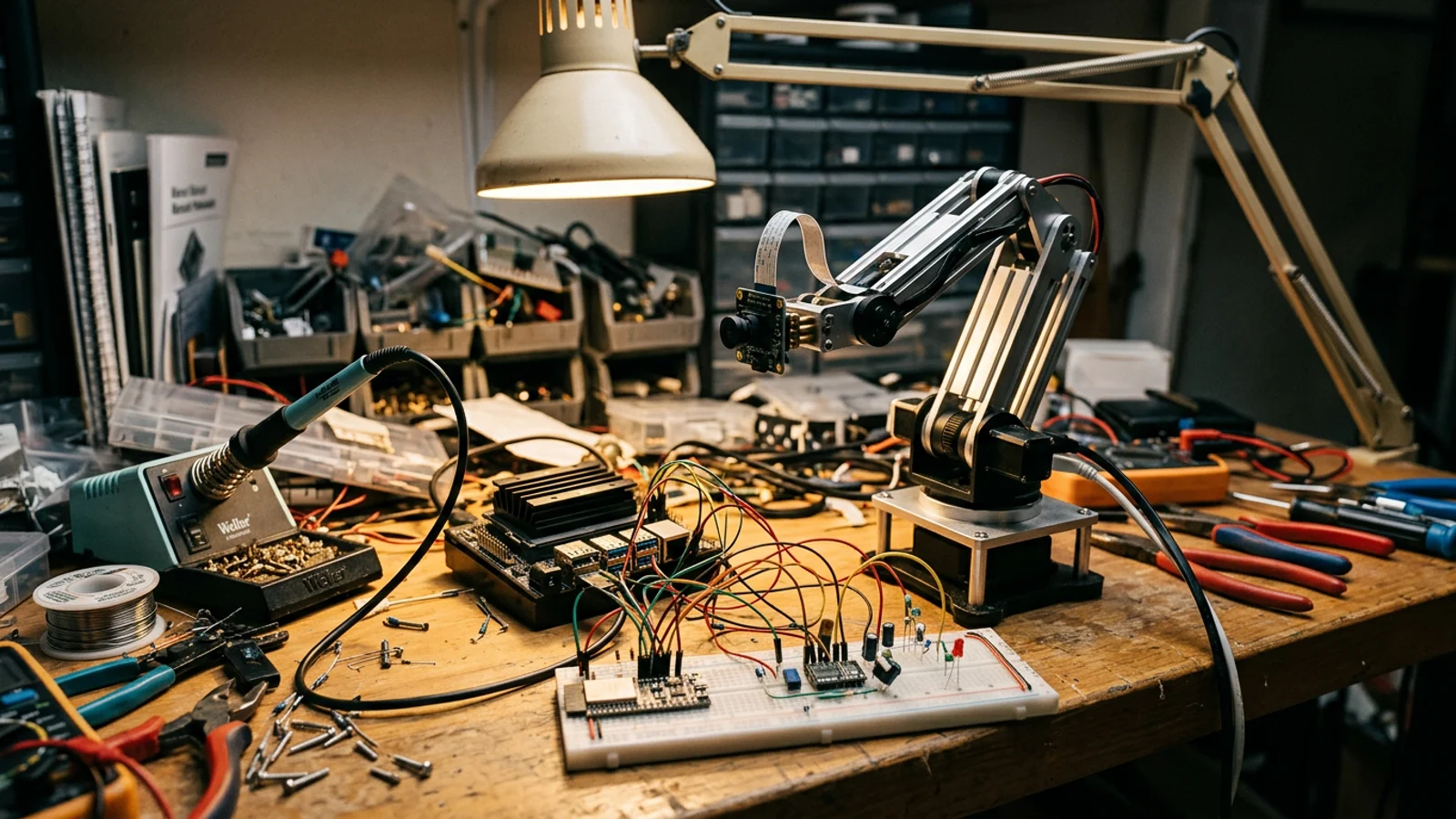
LeRobot's new release lets you talk to a running robot while NVIDIA's VFlash research cuts VLA planning latency 80% on Jetson Thor.
VFlash: One-Pass Planning Claims an 80% Latency Cut on Jetson Thor
NVIDIA Research and university collaborators posted a paper called VFlash to arXiv on November 5, 2026, describing a decoding method that lets a vision-language model draft an entire visual plan — a robot's full trajectory — in one forward pass instead of one coordinate token at a time.
On the team's MolmoSpaces manipulation benchmark, they report end-to-end planning latency on a Jetson AGX Thor module falling from 3,552.7 ms to 703.3 ms, roughly an 80 percent cut, with a similar drop on NVIDIA's DGX Spark desktop box. Waypoint accuracy within 5 centimeters on an AgiBot task rose from 0.398 to 0.739 in their tables, and a downstream action model conditioned on VFlash plans scored 70.2 percent success across four task suites versus 62.6 percent for their own autoregressive baseline.
These are the authors' own measurements on their own stack — a customized TensorRT-Edge-LLM build in FP16 — with no outside rerun and no public release of the full planning model used in most tables. Still, the gap between 3.5 seconds and 0.7 seconds per planning step is the kind of number that decides whether a Jetson-class robot can react to a moving scene or just plan around where things used to be.
LeRobot v0.7.0 Lets You Talk to a Robot Mid-Rollout
Hugging Face's LeRobot team shipped version 0.7.0 of its open robotics library on November 5, 2026, adding four new vision-language-action policies — including Wall-OSS-0.5 and LingBot-VLA 2.0 — and four new world action models, among them NVIDIA's Cosmos 3 and Black Forest Labs' FLUX 3 Action.
The bigger shift is interactive control: adding --interactive=true to lerobot-rollout keeps a robot's policy and weights loaded while you redirect it mid-task, ask what it currently sees through a /vqa command, or hand it a new goal with /autosteer, provided the policy can generate text. A new lerobot-policy-server command also lets heavier models run on a remote GPU while the robot's onboard hardware only needs to stream sensor data and actions.
None of this is independently benchmarked outside Hugging Face's own release notes, and a multi-billion-parameter world action model still usually means leaning on a server somewhere. What it does confirm is that the open robotics stack is converging on the same pattern as on-device chat: a capable brain, a thin client, and a growing menu of smaller policies that might eventually run without the server at all.
A 500M-Parameter Vision Model Skips Text Entirely for Robot Decisions
PanocularAI released PanoVLD-500M on November 4, 2026, a vision-language model built to answer structured questions about a camera frame — multiple choice, yes or no, numeric score — in a single forward pass rather than generating text that then needs parsing.
The company's own benchmark puts PanoVLD at 70.5 mean accuracy across eleven tests, ahead of the seven models it compared against, including a rival nearly twice its size scoring 58.6. On an NVIDIA Jetson AGX Orin, the company measured 79 questions answered per second — a 16-question batch about one frame in roughly 202 milliseconds — versus 335 per second on a data-center A100.
These are self-reported, vendor-chosen comparisons, not an independent leaderboard result. But the design fits the beat: instead of asking a VLM to write 'yes, the gate appears open' and parsing the string, this returns a calibrated probability a control loop can act on directly, fast enough to sit next to the camera rather than behind a cloud call.
Arduino Brings Native I/O Bridging to ROS 2
Arduino announced at ROSCon on November 6, 2026 what it calls the easiest way yet to bring Arduino-controlled I/O into a ROS 2 (Robot Operating System 2) stack, aimed at the common robot architecture where a Linux computer handles navigation and mapping while a microcontroller handles motors, sensors, and other real-time I/O.
Arduino's own post frames this as closing a long standing gap: ROS 2 nodes can now talk to Arduino boards without hand-rolled serial protocols or a custom micro-ROS build for every project.
It is tooling, not a model, but it matters for the same reason local VLA policies matter: once a robot's brain is making decisions on-device, the actuators and sensors still need a clean, low-latency path to act on those decisions, and that path usually runs through exactly this kind of microcontroller bridge.
Today's sweep split between research claims worth watching and real ships: NVIDIA's own numbers on one-pass visual planning, Hugging Face's open robotics stack learning to take mid-task instructions, and two small hardware moves — a compact decision model built for Jetson-class edge boards and fresh I/O tooling linking microcontrollers to ROS 2.
References & Citations
- aiobserver.news — NVIDIA VFlash write-up, November 6, 2026 — https://aiobserver.news/news/robotics/nvidia-vflash-robot-plan-latency-jetson-thor/
- Hugging Face — LeRobot v0.7.0 release blog, November 5, 2026 — https://huggingface.co/blog/lerobot/lerobot-release-v070
- PanocularAI — PanoVLD-500M blog post, November 4, 2026 — https://panocular.ai/blog/panovld
- Arduino blog — ROSCon I/O bridge announcement, November 6, 2026 — https://blog.arduino.cc/2026/11/06/unveiled-at-roscon-the-easiest-way-to-bring-arduino-i-o-into-ros-2/
Subscribe to new posts from theaivibe.org
Related Posts
A 14M-Parameter LLM Tends a Fish Tank on an $8 ESP32 as Drone AI Claims a 3x Speedup
A tiny LLM on an ESP32-S3, a vendor-claimed 3x YOLO speedup on a 12 g drone board, llama.cpp v1.0, and a $62 vision module that beats a CM4 on NPU work.
A 145B Open LLM Claims a Laptop Seat as Snapdragon's NPU Runs Gemma 4 26B
Edge0 open-sources a 145B model it says fits in 29GB on a laptop, Kora reports 25 tokens/sec on a Snapdragon NPU, and DeepX and Intel sign an OpenVINO deal.
An 8M-Parameter LLM Gets Compiled to C for a Cortex-M7 as Tiny AI Listens to Fans
A new MLIR compiler emits dependency-free C for a tiny LLM on a Cortex-M7, and a Cortex-M33 board runs an AI fan-fault detector on its own microphones.