A Wristband Reads Muscles, a Ring Wants Your Ideas: Edge AI Moves Onto the Body
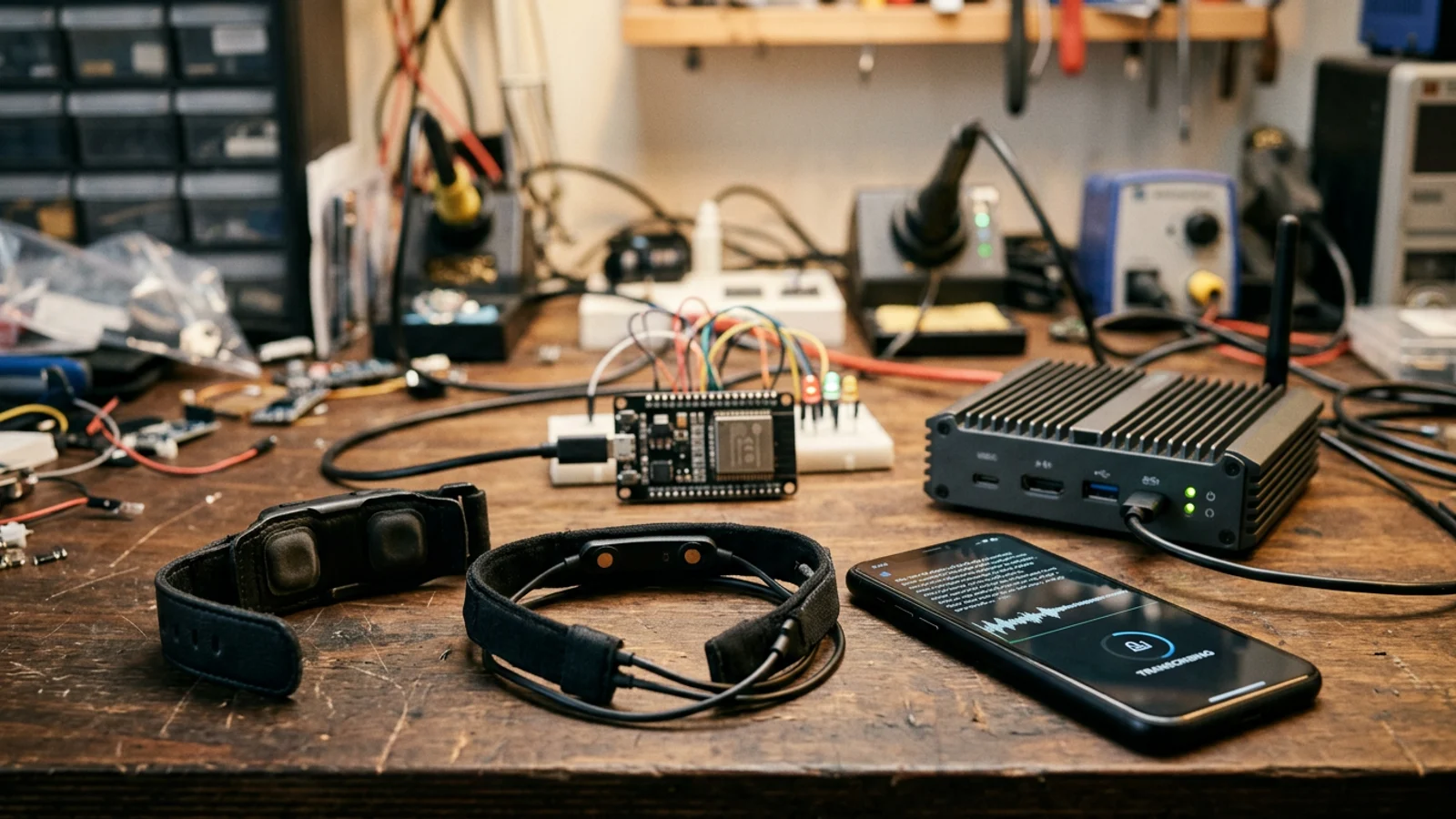
New wearable and phone releases push transcription, gesture control and silent speech fully on-device, while ESP32 and Jetson tooling keeps pace.
A Transcription Model That Never Leaves Your iPhone
A new outfit called Desert Ant Labs launched on September 8, 2026 with 18 small AI models — 12 stable, six in beta — covering speech, vision and text, all packaged as SDKs for Swift, Kotlin and JavaScript. The headline model, a transcription system called Voz, is a 489 MB download that the company says processes 10 minutes of audio in about 2 seconds on an iPhone, with nothing sent to a server, according to the launch write-up on Ground Truth.
The 2-second figure is the company's own benchmark, not independently verified, and availability is narrow for now: iOS and macOS only, with Windows, Linux and GPU support promised for "the coming weeks." The SDKs are on GitHub, which is where the cross-platform claims will actually get tested.
It's another entry in the crowded field of fully local speech tooling, joining a growing list of vendors betting that on-device transcription — no per-token bill, no network dependency — is worth building a whole SDK suite around.
A Neural Wristband Learns Mac Gestures, No Cloud Call
Developer callbacked released Kinesis, an open-source native macOS app that reads muscle signals from Meta's Neural Band wristband and turns finger movements into desktop switches and volume adjustments, according to the Show HN thread posted September 15, 2026 and the project's GitHub repo.
The decoding happens on the Mac itself, not in a Meta cloud service, which is the interesting part: an EMG wearable built for Meta's own ecosystem being repurposed as a general gesture controller through locally-run signal processing, as GIGAZINE notes in its writeup. The catch is that it depends on proprietary Meta hardware you have to already own, and the gesture set so far is limited to a handful of system actions.
Still, it's a small but concrete example of neuromuscular wearables moving from research demo to a weekend open-source project anyone can install.
An EMG Neckband Turns Silent Mouthing Into Text, Locally
Maker Gaurav's Silent Voice project, published on Hackster on September 13, 2026, uses an EMG-sensing neckband built around an Arduino UNO Q to pick up sub-vocalized speech — the muscle activity of mouthing words without sound — and translate it into text for people with vocal impairments, per the project write-up.
The build runs its edge-AI inference on the UNO Q board itself, no phone or cloud round-trip required. Accuracy figures and vocabulary size aren't spelled out in detail, so this reads as an early prototype rather than a finished assistive device — but it's a real demonstration of subvocal-to-text decoding running on a sub-$50 board rather than a lab EMG rig.
Espressif Lets You Run Zephyr on ESP32 Without a Board
Espressif published a developer blog post on September 15, 2026 walking through how to install its own QEMU fork and boot Zephyr RTOS on emulated ESP32, ESP32-S3, ESP32-C3 and ESP32-C6 targets — no physical hardware required, according to the Espressif developer portal.
The emulation covers core CPU and peripheral behavior but not the full Wi-Fi radio stack, so it's a bring-up and CI tool rather than a full substitute for real silicon. For teams prototyping TinyML firmware or testing Zephyr builds across four chip families at once, it removes a hardware bottleneck from the earliest stage of development.
MSI Packs a Jetson Orin Nano Into a Fanless Industrial Box
MSI detailed the MS-C9ZA on September 15, 2026, a compact fanless Edge AI Box PC built around NVIDIA's Jetson Orin Nano 8GB module, with dual Gigabit Ethernet and an M.2 expansion slot, according to LinuxGizmos.
Pricing and ship date weren't included in the report, and the 8GB memory ceiling still caps how large a vision model can run comfortably on-device. But the move toward pre-integrated, ruggedized boxes rather than bare dev kits reflects steady industrial appetite for Jetson-class inference at the edge, away from the datacenter.
Today's sweep leans wearable: a wristband, a neckband and a phone SDK all doing their inference where the sensor is, while the tooling side quietly keeps lowering the cost of getting there. Check the sources below for the primary write-ups.
References & Citations
- groundtruth.day, September 8, 2026 — https://groundtruth.day/news/desert-ant-labs-ships-eighteen-models-that-never-leave-your-phone.html
- callbacked/kinesis — GitHub — https://github.com/callbacked/kinesis
- Hacker News Show HN thread, September 15, 2026 — https://news.ycombinator.com/item?id=49695408
- GIGAZINE, September 15, 2026 — https://gigazine.net/gsc_news/en/20260915-kinesis-meta-neural-band/
- Hackster.io — Silent Voice project, September 13, 2026 — https://www.hackster.io/gaurav16072006/silent-voice-subvocal-speech-ai-neckband-3a7f5b
- Espressif developer portal, September 15, 2026 — https://developer.espressif.com/blog/2026/09/zephyr-espressif-qemu-hello-world/
- LinuxGizmos, September 15, 2026 — https://linuxgizmos.com/fanless-industrial-pc-integrates-jetson-orin-nano-8gb-and-m-2-expansion/
Subscribe to new posts from theaivibe.org
Related Posts
Jetson Thor Sprints Past llama.cpp While a 15M-Parameter LLM Still Fits an $8 Chip
NVIDIA posts a 6.4x MLPerf edge win on Jetson AGX Thor, a dense TinyStories model skips the flash trick, and a paper splits VLA robots between cloud and a tiny local model.
ESP32 Special: An $8 Chip Runs a 29-Million-Parameter LLM, and Vendors Rethink the Board Around It
A one-chip LLM, a Wi-Fi upgrade to Seeed's tiny displays, and Tuya's push to make ESP32 an AI-agent target, not just a Wi-Fi one.
Runtimes on the Move: llama.cpp, ExecuTorch and LiteRT All Update as Edge AI's Software Layer Speeds Up
llama.cpp shipped two builds in two days, ExecuTorch hit 1.0 with new NPU backends, and LiteRT tuned fp16 kernels for mobile CPUs.