Edge Dispatch: A Tiny Robot Learns to See and Talk on a Raspberry Pi While Korea Locks Its AI Stack Inside One Box
Google shows Gemma running a robot's eyes, ears, and voice entirely on a Pi 5, KT ships a sovereign NPU appliance, and FastFlowLM goes official on AMD's ROCm.
Google's LiteRT Turns a Raspberry Pi 5 Into a Talking, Seeing Robot Brain
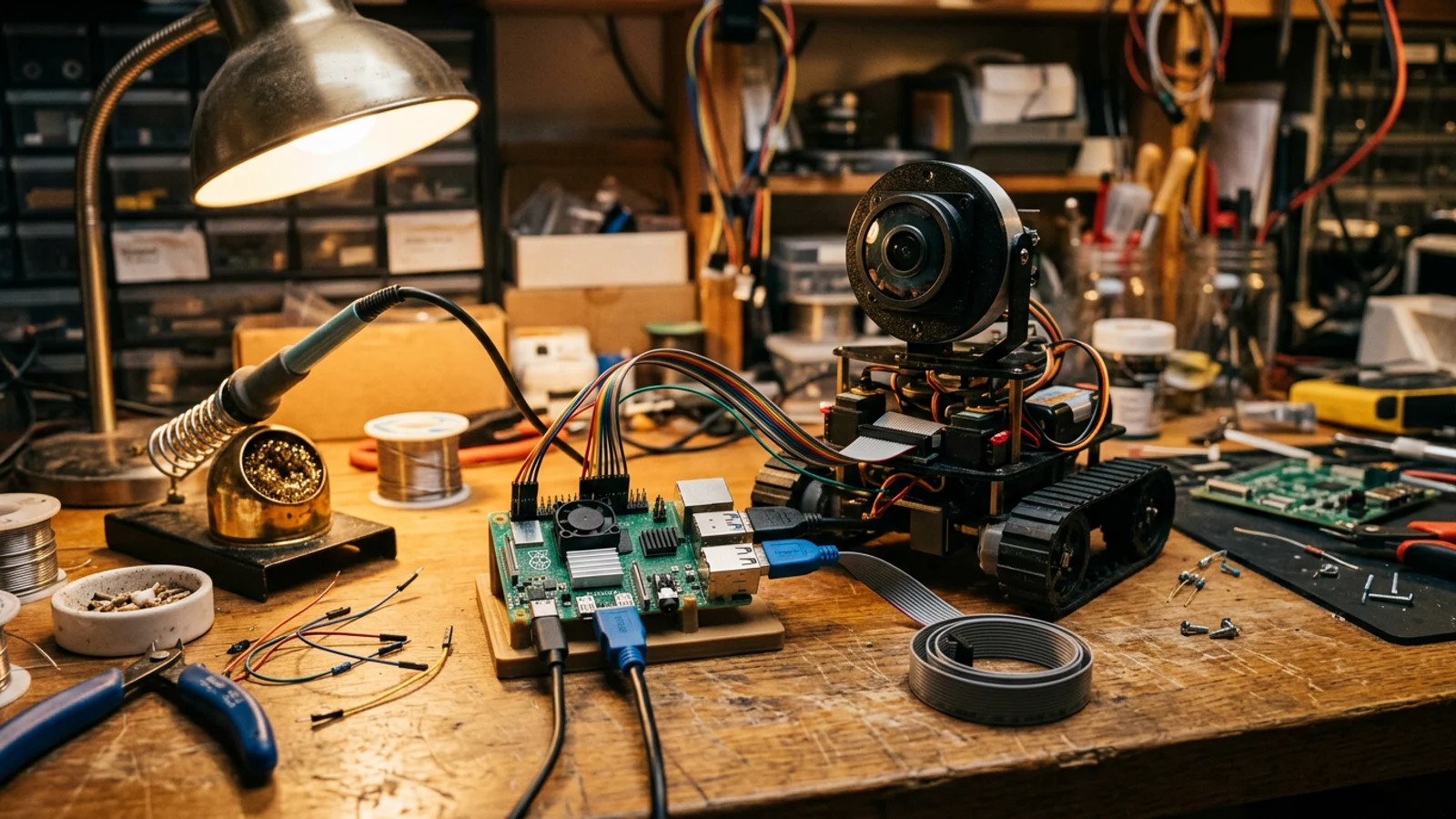
Google's developer blog published a detailed walkthrough of running Gemma 4 E2B on a Raspberry Pi 5 to power Reachy Mini, Hugging Face's small desktop robot, entirely offline. The pipeline splits work across the Pi's CPU and GPU at once: Ultralytics YOLO handles object detection on the GPU, a Moonshine model transcribes speech on the CPU, Gemma 4 E2B reasons over the transcript and visual metadata on the CPU, and a separate text-to-speech model streams the reply back out, all without a network connection. The runtime underneath is LiteRT, Google's on-device inference engine, with LiteRT-LM orchestrating the language model piece, according to developers.googleblog.com.
The numbers are Google's own, measured on Google's own demo hardware: 99 tokens/sec prefill, 9 tokens/sec decode, and a peak memory footprint of about 1,432 MB. That decode speed sounds modest until you factor in Gemma's tokenizer efficiency, which the post says works out to roughly 300 words per minute of generated speech, about twice normal human talking speed. That is a vendor-reported figure from a controlled demo, not an independent benchmark, and it is worth remembering a Pi 5 running four workloads concurrently is not going to feel snappy on harder reasoning tasks.
What makes this notable for the edge beat isn't the model, it's the architecture: real concurrent vision, speech, language, and voice synthesis on a $70-ish board with zero cloud calls. That is the actual bar for calling something on-device robotics, as opposed to a robot shell with a microphone that phones home.
KT Boxes Up a Fully Offline 'Sovereign AI' Server for Korea's Locked-Down Networks
South Korean telecom KT has launched the KT NPU LLM Station, a rack-mount appliance bundling Rebellions' Korean-designed ATOM-MAX NPU chip with KT's own Mi:dm K 2.5 Pro language model and an operations layer, all running generative AI inside a customer's network with no external cloud connection required, per koreatimes.co.kr and rcrwireless.com.
The pitch is aimed squarely at Korean government, finance, and defense systems, where network-separation rules already made calling an external LLM API illegal, so the entire stack, chip, model, and orchestration, is domestic by design. The honest caveat is the flip side of that pitch: customers cannot swap in a non-KT model or rival silicon. This is sovereignty sold as a sealed box, not a flexible edge platform, and the ATOM-MAX chip's real-world throughput has not been independently benchmarked outside KT's own materials.
It matters for the beat because it's a rare example of NPU-plus-LLM inference being sold not on speed or price but on the fact that it never touches a network at all, a use case tiny edge hardware is uniquely positioned to serve.
FastFlowLM 1.0 Becomes an Official AMD ROCm Project, Adds a Robot-Control Model
FastFlowLM, the Ollama-style runtime AMD adopted in July for its Ryzen AI NPUs, shipped version 1.0 as an official project under the ROCm GitHub organization. The runtime is 17 MB, installs in about twenty seconds, and runs inference entirely on the XDNA2 NPU block, leaving the CPU and integrated GPU free, according to hwbusters.com. The project claims better than a tenfold power-efficiency edge over CPU or GPU inference on the same laptops, a figure that is self-reported by the FastFlowLM team rather than independently verified.
Version 1.0's headline addition is SmolVLA, a vision-language-action model, which pulls robotics workloads into a runtime that until now only handled text and vision-language chat. Context windows stretch to 256k tokens on models like Qwen3-4B-Thinking-2507, and the licensing stays permissive: MIT for the orchestration code, with the NPU-accelerated binary kernels free for commercial use even though they're hand-tuned through AMD's IRON and AIE-MLIR toolchains rather than portable source.
The catch is driver support: FastFlowLM needs NPU driver 32.0.203.304 or newer, and plenty of Ryzen AI laptops are still running whatever shipped in the box, so the software being ready does not mean every machine that technically has the chip can use it yet.
Three different bets on the same idea, that inference should stay on the box in front of you, whether that box is a Raspberry Pi robot, a locked-down government server rack, or a Ryzen AI laptop finally putting its idle NPU to work.
References & Citations
- developers.googleblog.com — Mastering Edge AI on Raspberry Pi with LiteRT and Gemma, 2026 — https://developers.googleblog.com/en/mastering-edge-ai-on-raspberry-pi-with-litert-and-gemma/
- koreatimes.co.kr — KT puts Korean AI chips, language model into one enterprise server, August 19, 2026 — https://www.koreatimes.co.kr/business/companies/20260819/kt-puts-korean-ai-chips-language-model-into-one-enterprise-server
- rcrwireless.com — KT launches sovereign AI server with NPU LLM Station, August 20, 2026 — https://rcrwireless.com/20260820/ai/kt-npu-llm-station
- hwbusters.com — FastFlowLM 1.0 Lands Inside AMD's ROCm, August 20, 2026 — https://hwbusters.com/news/fastflowlm-1-0-lands-inside-amds-rocm-a-17mb-runtime-that-finally-puts-ryzen-ai-npus-to-work/
Subscribe to new posts from theaivibe.org
Related Posts
Edge Dispatch: A Robot Arm Joins the NPU Party: FastFlowLM Adds a Vision-Language-Action Model to Ryzen AI
FastFlowLM's first stable release puts a robotics policy on Ryzen AI's NPU, while Korea ships a boxed NPU appliance and a Raspberry Pi learns to narrate what it sees.
Edge Dispatch: Korea's KT Ships a Boxed NPU LLM Station While the ESP32 Crowd Trims Memory Further
A Korean telecom sells an all-in-one on-prem LLM box built on a domestic NPU, while ESP32 tinkerers keep shrinking what a model needs to run.
Edge Dispatch: Ryzen AI's NPU Runtime Goes Official While a Raspberry Pi Learns to See and Speak with a Tiny LLM
AMD folds a hobbyist NPU runtime into ROCm, Google shows Gemma driving a robot from a Raspberry Pi 5, and a 45M-parameter model books tool calls on a phone.