Edge Dispatch: A Robot Arm Joins the NPU Party: FastFlowLM Adds a Vision-Language-Action Model to Ryzen AI
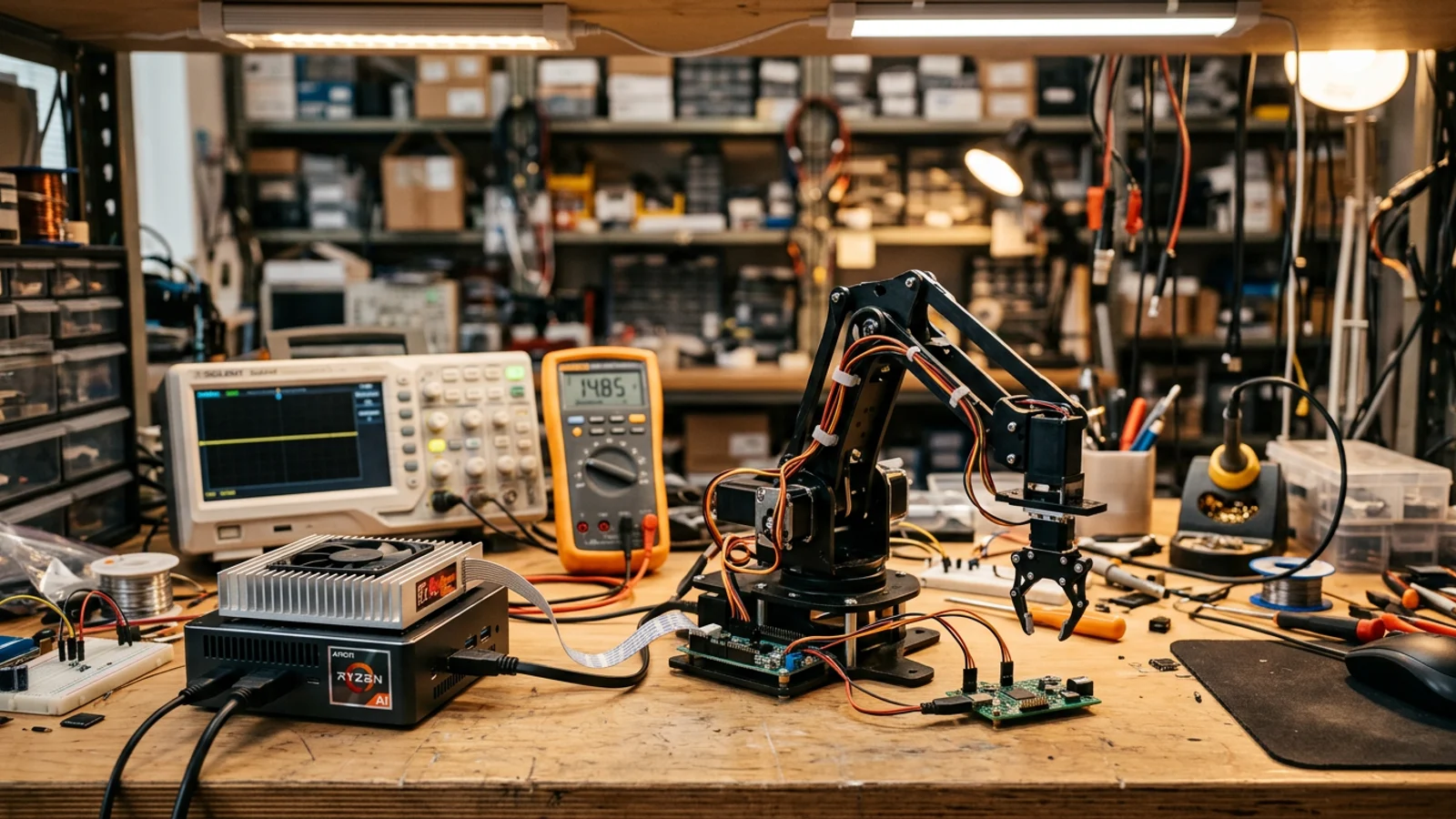
FastFlowLM's first stable release puts a robotics policy on Ryzen AI's NPU, while Korea ships a boxed NPU appliance and a Raspberry Pi learns to narrate what it sees.
FastFlowLM hits 1.0 inside AMD's ROCm — and brings a robot policy with it
FastFlowLM, the Ollama-style runtime AMD folded into its ROCm organization in July, shipped its first general release on August 20, 2026. Version 1.0 is a 17MB binary that talks to Ryzen AI's XDNA2 NPU directly — no CPU, no iGPU involved — and the project claims better than tenfold power efficiency over running the same models on CPU or GPU, a self-reported number worth treating as a starting point rather than a spec sheet. It runs only on Strix, Strix Halo, Kraken, and Gorgon Point silicon, and needs a fairly recent NPU driver to work at all, as detailed by Hardware Busters.
The notable new addition in this release is SmolVLA, a vision-language-action model, which moves FastFlowLM's model lineup beyond chat and vision-language tasks into robotics control. That is a real shift for a runtime whose earlier pitch was mostly "Ollama, but the NPU does the work": now the same 17MB tool that serves an OpenAI-compatible endpoint for a chat model can also host a policy meant to drive a robot's actions, all on the same laptop-class chip.
The honest caveat is that SmolVLA support landing in a runtime is not the same as a validated robot deployment — there is no independent benchmark yet of how this performs end to end on real hardware, and the licensing quirk remains that the NPU-accelerated kernels are hand-tuned through AMD's own toolchains rather than portable code. Still, for the AI PC crowd, putting a VLA model within reach of `flm run` lowers the bar for anyone experimenting with on-device robotics on hardware they might already own.
Korea's KT boxes an NPU, an LLM, and an API into one appliance
KT launched the KT NPU LLM Station on August 19, 2026, an enterprise server pairing Rebellions' ATOM-MAX inference NPU with KT's own Mi:dm K 2.5 Pro language model and an API layer, built so companies can run generative AI entirely inside their own network rather than calling out to a cloud provider, according to The Korea Times.
KT says ATOM-MAX has shown higher performance and power efficiency than comparable GPUs in certified testing — a vendor claim, not an independent benchmark — and that standard APIs let existing AI services plug in without code changes. Planned add-ons include agents for meeting minutes, coding help, and a workflow tool called K-Claw.
This is not edge hardware in the microcontroller sense, but it is the same underlying story as the rest of this beat: inference moving off general-purpose GPUs and onto dedicated NPU silicon, this time at the rack level rather than the pocket level. It is a data point for how far the NPU-instead-of-GPU argument is being pushed, from phones all the way up to enterprise appliances.
Gemma and LiteRT teach a Raspberry Pi robot to narrate what it sees
Google published a walkthrough on running Gemma through LiteRT-LM on a Raspberry Pi 5 to power Reachy Mini, an open robot platform, entirely offline — the robot perceives and reacts to its surroundings with no cloud round trip, as described in the Google Developers Blog.
The numbers are specific and self-reported by Google: Gemma 4 E2B on a Raspberry Pi 5 hits 99 tokens/sec prefill and 9 tokens/sec decode through LiteRT-LM's CPU acceleration via XNNPACK, with peak memory around 1,432MB. In the voice demo, that works out to roughly 300 words per minute of generated speech, helped by a tokenizer that packs about 4.2 characters into each token.
Nine tokens per second of decode is modest by phone or laptop standards, but it is happening on a $80 board with no dedicated AI silicon, driving a physical robot's reactions in real time. Combined with FastFlowLM's SmolVLA addition above, it is another sign that small boards and NPU-equipped laptops are converging on the same target: robots that see, decide, and respond without a network connection.
Needle 2's tool-calling model keeps shrinking the floor
Cactus Compute's Needle 2, a 45M-parameter model built specifically for tool calling and structured extraction, continues to circulate as a reference point for how small a useful model can get: a 14MB binary running a full session in about 28MB of RAM, with weights trained at 2-bit precision from the start rather than quantized after the fact, per MarkTechPost.
Self-reported decode speeds run 500 tokens/sec on a Raspberry Pi 5 and up to 1,500 tokens/sec on devices like Meta Quest 3S — fast because the task is narrow, not because the model is broad. Needle 2 leads on in-domain and out-of-domain Seal-Tools benchmarks but trails larger tool-calling models on BFCL v4 overall, an honest tradeoff for a model this small.
The relevance here is architectural, not just about size: a fixed 28MB RAM ceiling regardless of conversation length, thanks to a sliding attention window and pinned tool-declaration tokens, is the kind of engineering that lets tool-calling run on hardware with no growing memory budget to spare.
Four stories, one direction: NPUs and small boards are being asked to do more — call tools, narrate a room, steer a robot arm — with less silicon and less power than a year ago.
References & Citations
- hwbusters.com — Hardware Busters, August 20, 2026 — https://hwbusters.com/news/fastflowlm-1-0-lands-inside-amds-rocm-a-17mb-runtime-that-finally-puts-ryzen-ai-npus-to-work/
- koreatimes.co.kr — The Korea Times, August 19, 2026 — https://www.koreatimes.co.kr/business/companies/20260819/kt-puts-korean-ai-chips-language-model-into-one-enterprise-server
- developers.googleblog.com — Google Developers Blog — https://developers.googleblog.com/en/mastering-edge-ai-on-raspberry-pi-with-litert-and-gemma/
- marktechpost.com — MarkTechPost, August 13, 2026 — https://www.marktechpost.com/2026/08/13/cactus-compute-needle-2-45m-parameter-tool-calling-model/
Subscribe to new posts from theaivibe.org
Related Posts
Seven $5 Chips Learn to Share an LLM, One Bit at a Time
A BitNet cluster splits an LLM across seven ESP32-S3 boards, a 2-bit tool-calling model lands on GitHub, and a quantization paper gets llama.cpp 15x faster on an M4 Pro.
A 4B AI Model Learns to Run a Robot Arm Entirely on Jetson Thor
NVIDIA's Cosmos 3 Edge drives a robot arm on-device, a $5-class chip gets a voice it hasn't spoken yet, and two new boards widen the SBC lineup.
An NPU-Only Runtime Lands for Ryzen AI as a Vintage Terminal Learns to Think Offline
A 17MB runtime puts LLMs entirely on AMD's XDNA2 NPU, an old terminal gets an offline brain, and Intel's NPU gets unlocked by reverse engineering.