A $7 ESP32 Gives AI Agents a Real iPhone While Ryzen AI's NPU Learns to Swap Brains
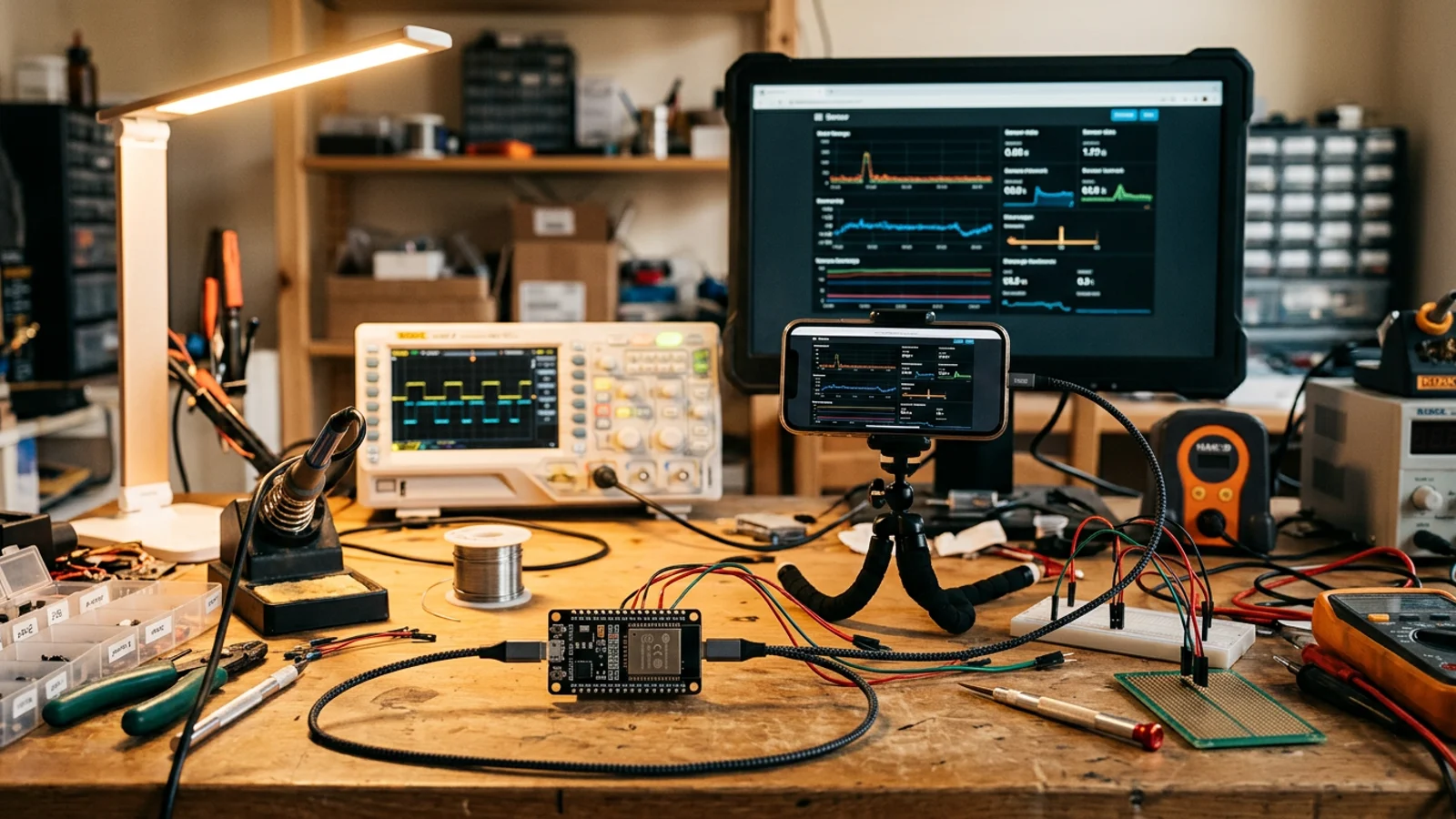
A viral ESP32 bridge lets AI agents control a real iPhone, AMD's NPU now hot-swaps LoRA adapters, and an NPU briefly tries to render Windows.
A $7 ESP32 Becomes an AI Agent's Hands and Eyes on a Real iPhone
A GitHub project called esp32-iphone-agent went viral this week, racking up 4,554 stars by November 6, 2026 after being created on October 11. The idea: a $7 ESP32 board watches an iPhone's screen through AirPlay mirroring and injects taps and swipes through USB HID emulation, so any OpenAI-compatible model can operate a genuine, unmodified phone.
The honest caveat is that the inference itself usually isn't happening on the ESP32. The board is a bridge, not a brain — it can point at a cloud API or a locally served model, but the on-device part here is cheap, purpose-built hardware, not an LLM running locally. What does run on the device is screen capture and precise HID timing, which is its own small engineering feat.
It fits a pattern spreading across maker boards this fall: dirt-cheap microcontrollers turned into universal physical interfaces for agentic AI, giving models hands on real hardware without jailbreaking anything.
AMD's NPU Learns to Swap Fine-Tuned Specialists Without Reloading
AMD pushed Ryzen AI Software 1.9 to GitHub on October 30, 2026, then followed on November 2 with a developer post detailing the headline feature: dynamic LoRA switching on the XDNA2 NPU. The base model now stays resident on the NPU while small LoRA adapters load and swap in by name — set_active_adapter("sql_spider") — with no reload of the underlying weights, as reported by 4GQTV.
AMD's own numbers, run on a quantized Qwen3-4B against 200 examples each, show an SQL adapter lifting execution accuracy from 47.5% to 63.0%, and a medical adapter raising exact-match from 42.0% to 53.0%. Self-reported, small sample, but a real jump for a tiny add-on.
The fine print matters: only three models are supported so far, adapters must be trained against the already-quantized base or the gains vanish, and the runtime bump from OGA 0.14.0 to 0.18.0 breaks models built for 1.8. Older Phoenix and Hawk Point Ryzen chips still fall back to GPU or CPU for LLMs entirely.
An NPU Tries to Draw Your Windows Desktop Instead of the GPU
A developer group called labscommunity released an experimental open-source driver on November 5, 2026 — npu-render, Apache 2.0 licensed — that intercepts Windows 11's desktop compositor and runs it through Intel's OpenVINO on an NPU instead of the GPU, as detailed by pbxscience.com.
On the single tested laptop, an Intel Panther Lake machine with a roughly 45–50 TOPS NPU, the trick works end to end — but desktop updates crawl to 2–3 per second against a 30Hz target. GPU 3D utilization dropped from 3.4% to 0.6% while NPU utilization climbed to about 58%.
It's a research prototype, not something to install. But it's a rare direct measurement of how much headroom a modern laptop NPU has for sustained work, versus the bursty inference it's usually asked to do — relevant as AI PC vendors sell idle NPU capacity as a selling point.
ST Puts an Optional NPU on a Mainstream Motor-Control MCU
STMicroelectronics introduced the STM32H7P4 and STM32H7P5 on November 6, 2026 — 520 MHz Arm Cortex-M7 MCUs built for digital power and motor control, now carrying a Hardware Signal Processor block and an optional Neural-ART NPU, per CNX Software and Hackster.
Exact NPU TOPS weren't disclosed in the initial release, and the Neural-ART block is an optional variant, not standard across the whole H7P family. Still, it signals ST folding its Neural-ART IP, first seen on the flagship STM32N6, down into a mainstream industrial Cortex-M7 line.
For the edge beat, that's the real story: on-chip inference stops being a premium-tier feature and starts showing up on the MCUs that already run pumps, motors and power supplies, without a separate accelerator chip.
A Search Hunts for Optical Flow Models That Fit a Drone's MCU
A paper posted to arXiv on November 5, 2026, MCUFlowNet, applies hardware-aware neural architecture search to dense optical flow networks small enough to run on microcontrollers with embedded neural accelerators — the kind of tight motion-sensing gram-scale drones would need to dodge obstacles without a full SoC on board.
It's a search methodology and benchmark paper, not a shipped flight controller, so real validation on actual micro-drone hardware is still ahead. But it targets a gap this beat keeps running into: most optical-flow models assume a GPU, and almost none are built from the start for an MCU's limited memory and NPU instruction set.
Today's thread: NPUs are getting pushed into jobs nobody designed them for, from swapping LoRA adapters mid-request to drawing a Windows desktop, while cheap ESP32 boards keep finding new ways to put AI agents in control of real hardware.
References & Citations
- onehumanbeing/esp32-iphone-agent — GitHub, Nov 6, 2026 — https://github.com/onehumanbeing/esp32-iphone-agent
- 4GQTV — AMD Ryzen AI 1.9 dynamic LoRA, Nov 2, 2026 — https://4gqtv.com/amds-ryzen-ai-1-9-lets-one-npu-model-swap-between-specialists-but-read-the-fine-print/
- AMD RyzenAI-SW releases — GitHub — https://github.com/amd/RyzenAI-SW/releases
- labscommunity/npu-render — GitHub, Nov 5, 2026 — https://github.com/labscommunity/npu-render
- pbxscience.com — npu-driver write-up, Nov 5, 2026 — https://pbxscience.com/open-source-npu-driver-lets-the-npu-render-the-windows-11-desktop-instead-of-the-gpu-but-only-at-2-3-updates-per-second/
- CNX Software — STM32H7P4/H7P5, Nov 6, 2026 — https://www.cnx-software.com/2026/11/06/520-mhz-stm32h7p4-stm32h7p5-arm-cortex-m7-mcus-feature-hardware-signal-processor-hsp-optional-neural-art-npu/
- Hackster — STM32H7P coverage, Nov 5, 2026 — https://www.hackster.io/news/stmicroelectronics-latest-stm32h7-part-the-stm32h7p-packs-edge-compute-and-dsp-acceleration-63438524828b
- MCUFlowNet — arXiv, Nov 5, 2026 — https://arxiv.org/abs/2611.08147v1
Subscribe to new posts from theaivibe.org
Related Posts
A 14M-Parameter LLM Tends a Fish Tank on an $8 ESP32 as Drone AI Claims a 3x Speedup
A tiny LLM on an ESP32-S3, a vendor-claimed 3x YOLO speedup on a 12 g drone board, llama.cpp v1.0, and a $62 vision module that beats a CM4 on NPU work.
A 145B Open LLM Claims a Laptop Seat as Snapdragon's NPU Runs Gemma 4 26B
Edge0 open-sources a 145B model it says fits in 29GB on a laptop, Kora reports 25 tokens/sec on a Snapdragon NPU, and DeepX and Intel sign an OpenVINO deal.
An 8M-Parameter LLM Gets Compiled to C for a Cortex-M7 as Tiny AI Listens to Fans
A new MLIR compiler emits dependency-free C for a tiny LLM on a Cortex-M7, and a Cortex-M33 board runs an AI fan-fault detector on its own microphones.