A 4B AI Model Learns to Run a Robot Arm Entirely on Jetson Thor
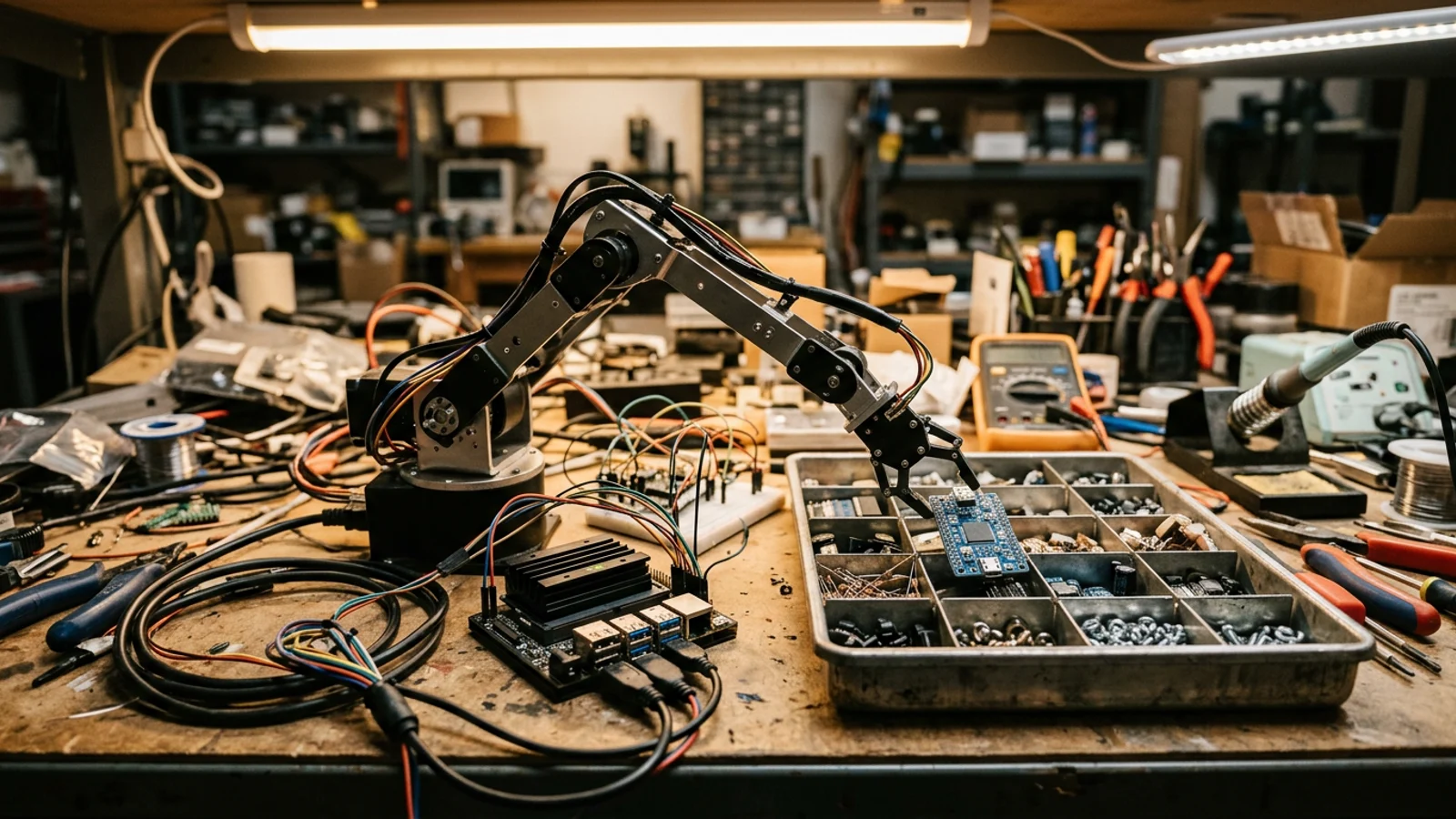
NVIDIA's Cosmos 3 Edge drives a robot arm on-device, a $5-class chip gets a voice it hasn't spoken yet, and two new boards widen the SBC lineup.
Cosmos 3 Edge Puts a 4B VLA Policy on Jetson Thor, No Cluster Required
NVIDIA published a developer-blog walkthrough on October 1, 2026 for post-training Cosmos 3 Edge, a 4B-parameter omni-model (with a 2B Nemotron-based reasoner) built to run natively on the Jetson AGX Thor module. Fine-tuned on the Cosmos3-DROID dataset, the resulting policy generates an action chunk roughly every 1.53 seconds at 640×540 and 15 Hz on a Thor T5000, with the next chunk ready before the current one finishes so the arm keeps moving continuously with no data-center GPU in the loop.
In closed-loop RoboLab testing across 120 language-conditioned manipulation tasks, the post-trained policy hits 22.9% success — NVIDIA's own number, and a reminder that on-device VLA control is still early-stage, not solved. The weights land at about 9 GB in BF16, small enough that both the policy server and the control client fit on the robot's own board.
What matters here is the memory budget, not the score: a world model trained on physical-world video that still fits an edge module's RAM is the kind of constraint small robotics teams actually have to design around.
FLUX 3 Action Turns an Image Lab's Weights Into a Robot Arm Policy
Black Forest Labs, the team behind the FLUX image models, released FLUX 3 Action on September 23, 2026 — an open-weight world action model built on the same video pretraining as its image generators, repurposed to output robot actions instead of pixels. Fine-tuned on the DROID dataset, it places first on the RoboLab benchmark at 42.92% success, ahead of the 16B Cosmos 3 Nano policy's 36.8%, per the company's own published numbers.
The lab also released a SO-101 arm checkpoint, and both the DROID and SO-101 weights are already wired into Hugging Face's LeRobot library, so a desk-size arm can be fine-tuned with a LoRA rather than a full training run. As developer Laurence Moroney noted, the caveat is that this is a self-reported benchmark from a company new to robotics, with independent replication still to come.
Why it matters for small hardware: a model trained mostly on internet video, not costly teleoperated demonstrations, now has a direct path onto a $100-class arm.
Ito's Streaming TTS Fits a $5 Chip — But No Chip Has Run It Yet
Lokutor released Ito, a streaming neural text-to-speech model sized for the ESP32-S3, in a write-up and GitHub repo posted around October 2, 2026. It is 4.4 million parameters, 4.9 MB in int8, speaks two voices at 24 kHz, and needs no cloud connection and no neural accelerator — just the chip's 240 MHz dual-core CPU.
The honest catch, stated plainly by the builder: Ito has only been verified bit-exact inside Espressif's QEMU emulator. No physical board has run it yet, so the time-to-first-audio and real-time-factor numbers are estimates from counted operations, not measurements off real silicon. Lokutor is also careful to note Ito isn't the smallest neural TTS for a microcontroller — earlier work like sanoTTS got there first — just, by its own claim, the most natural-sounding complete model built for an MCU with no NPU.
It's a useful marker of how small voice synthesis has shrunk, with the usual gap between a cycle-accurate simulator and a $5 chip still to be closed.
An Arduino UNO Q Gives a Toy Robot Dog On-Device Vision
Hackster reported on October 1, 2026 that a maker upgraded a DOGZILLA S2 robot-dog kit with an Arduino UNO Q board, giving it onboard computer vision and browser-based control under the name Robodog V2.0. The UNO Q pairs a Linux-capable application processor with an Arduino-side real-time MCU on a single board, a combination increasingly common in small robotics builds that split perception and motor control across cores of the same module.
Hackster's writeup is light on which specific vision model runs where, so the "AI brain" label is the maker's own framing rather than a benchmarked claim. Still, it's one more entry in a pattern worth tracking: hobby robot kits getting a vision-capable board swap instead of a full teleoperation rig.
AAEON Adds Fanless Solid-State Cooling to Its Panther Lake Mini PC
CNX Software reported on October 2, 2026 that AAEON added an "Air" variant to its UP Xtreme PTL Edge mini PC line, pairing Intel's Panther Lake processor with Frore Systems' AirJet solid-state active cooling — a chip-based airflow module replacing a spinning fan. Panther Lake carries an NPU aimed at the AI PC category, and the point of solid-state cooling is to hold that silicon at sustained clocks inside a sealed, fanless enclosure.
No pricing or ship date surfaced in the coverage, so treat this as a confirmed SKU addition to AAEON's lineup rather than a shipping product with a date attached.
Banana Pi's BPI-CM7 Module Lands With Armbian Support
LinuxGizmos covered the Banana Pi BPI-CM7 compute module on October 3, 2026: a quad-core Allwinner H618 SoC with onboard LPDDR4 memory, eMMC storage, Wi-Fi 5 and Bluetooth 5.0, built with confirmed Armbian support rather than a vendor-only image.
The H618 has no NPU of its own, but compute modules like this are the base layer plenty of small on-device projects — camera boxes, local voice loops, sensor hubs — get built on before anyone bolts on an accelerator card.
Nothing above claims a finished product running at scale — a QEMU-only TTS, a 22.9% success rate, a benchmark from a company new to robots. That is the honest state of edge AI in early October 2026: real progress, measured in small, qualified numbers.
References & Citations
- NVIDIA Technical Blog, Oct 1 2026 — https://developer.nvidia.com/blog/post-train-nvidia-cosmos-3-edge-for-on-device-robot-control/
- Black Forest Labs via Hugging Face, Sept 23 2026 — https://huggingface.co/blog/black-forest-labs/flux-3-action
- Laurence Moroney, Sept 30 2026 — https://laurencemoroney.com/2026/09/30/flux-3-action-robot-arm.html
- Lokutor blog, Ito write-up — https://lokutor.com/blog/ito-streaming-neural-speech-on-a-5-dollar-chip/
- lokutor-ai/ito GitHub repo — https://github.com/lokutor-ai/ito
- Hacker News thread on Ito — https://news.ycombinator.com/item?id=49934308
- Hackster.io, Oct 1 2026 — https://www.hackster.io/news/arduino-uno-q-gives-dogzilla-s2-an-ai-brain-91ba7a210255
- CNX Software, Oct 2 2026 — https://www.cnx-software.com/2026/10/02/up-xtreme-ptl-edge-air-panther-lake-mini-pc-gets-airjet-solid-state-active-cooling-solution/
- LinuxGizmos, Oct 3 2026 — https://linuxgizmos.com/banana-pi-bpi-cm7-with-allwinner-h618-wi-fi-5-and-armbian-support/
Subscribe to new posts from theaivibe.org
Related Posts
An NPU-Only Runtime Lands for Ryzen AI as a Vintage Terminal Learns to Think Offline
A 17MB runtime puts LLMs entirely on AMD's XDNA2 NPU, an old terminal gets an offline brain, and Intel's NPU gets unlocked by reverse engineering.
A 312K-Parameter LLM Learns to Flip Switches as Pi Prices Climb Again
A tiny GPIO-control model and a Japanese TTS join the ESP32 pile-up while Raspberry Pi raises prices and a Jetson robot chases bubbles.
ESP32 Special: Small LLMs Learn to Chat, Listen and Keep the Fish Alive
A full day inside the ESP32 world: chatty microcontroller LLMs, a $5-chip speech model, and two new boards from Espressif's own community.