A 30B AI Agent Learns to Live on One GPU While a 254M Model Learns to Listen Offline
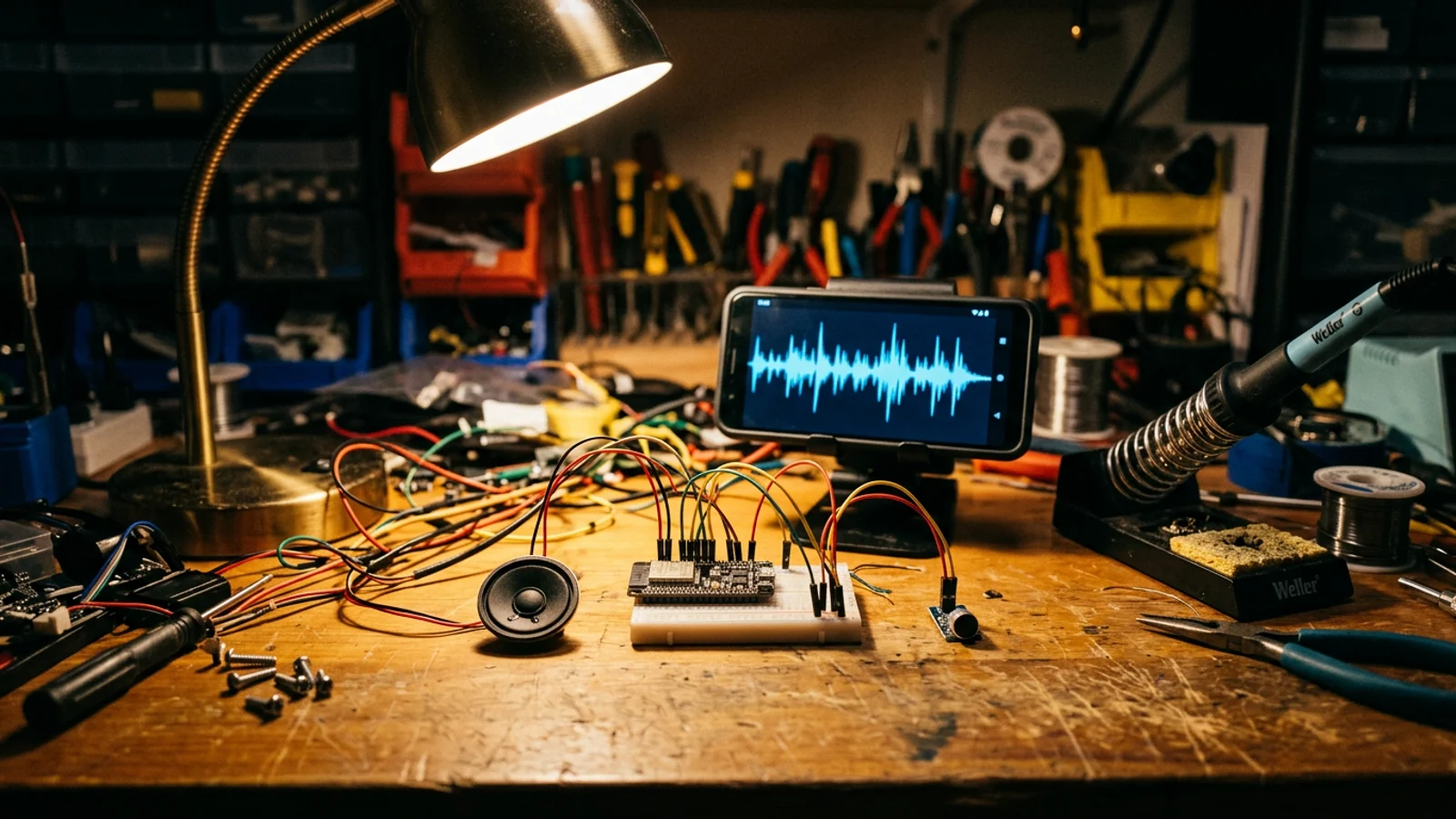
Meta's 30B on-device agent, a 254M offline speech model, and a $10 ESP32 that hears without the cloud lead today's edge sweep.
A 254M-Parameter ASR Model Goes Fully Offline on Phones and Glasses
Tether AI Research released QVAC TranscribePsy on October 14, 2026, a 254-million-parameter multilingual speech recognition model meant to run entirely on phones, smart glasses, and humanoid robot controllers without a cloud round-trip.
Tether's own figures, not yet independently verified, put TranscribePsy at an 8.02% word error rate on the Open ASR Leaderboard and 6.58% on Multilingual LibriSpeech, ahead of models three to four times its size. The company says its Core ML build transcribes ten minutes of audio in 1.65 seconds on an iPhone 17 Pro Max.
The model ships as GGUF for mobile runtimes and Core ML for Apple Silicon under Apache 2.0, per openmodelweights.com's summary. For wearables makers, a sub-300M model that beats Whisper Medium on a vendor's own test is exactly the size a glasses SoC's power budget can actually afford.
Meta's Muse Glimmer Puts a 30B Agent on a Single Consumer GPU
Meta published Muse Glimmer, a 30-billion-parameter, Apache 2.0 model built for multi-step tool use and failure recovery, quantized to roughly 4-bit precision so it fits in a single GPU's memory instead of a data center rack.
Meta's own agentic benchmarks place Glimmer ahead of Gemma4-31B and Qwen3.6-27B on tool-use and planning tasks — self-reported numbers from the paper's authors, not an independent leaderboard. "On device" here means a desktop or workstation GPU, not a phone or microcontroller; a 4-bit 30B model still needs roughly 16 to 20GB of VRAM to load.
Even with that caveat, it's a genuine local-first release: no API key and no cloud dependency for the agent loop itself, which matters for the AI PC and local-agent corner of this beat rather than the microcontroller end.
Cactus Compute's Tiny Models Reach Tool Calls — and a $10 ESP32
Cactus Compute's needle repository, billed as an "automation foundation model for tiny devices," climbed GitHub's trending list on October 19-20, 2026. The family ships 2-bit quantized checkpoints between 8 and 29 MB, aimed at tool calls, ASR, and structured extraction on hardware too small for a normal LLM.
A real demo of that philosophy surfaced the same week: a build documented by Stork.AI and covered by Geeky Gadgets squeezed Cactus's Whistle speech-to-text model, originally 16.9 MB, onto a $10 ESP32-S3 with only 16 MB of flash. The team pruned it to four layers, leaving just 98 KB of flash to spare, with both radios disabled during inference.
The honest caveat: recognition still takes about 10 seconds per command after optimization, down from 24 — fine for "turn the light purple," not a real-time assistant. But it's genuine on-chip inference with zero network traffic, on a chip that costs less than lunch.
FUTO Ships Three Streaming ASR Models Sized for CPUs, Not Clouds
FUTO, maker of the privacy-focused FUTO Keyboard and FUTO Voice apps, published a technical rundown of its ASR4all speech models: three sizes — 28M, 56M, and 97M parameters — built to decode in streaming mode on ordinary CPU instructions without heavy memory bandwidth.
FUTO says the models can output text while audio is still arriving, or switch to a higher-latency chunked mode for better offline accuracy. The write-up leans on its own users' reports rather than a third-party benchmark table, so the "pareto frontier" framing is the company's own claim, not an independent one.
Still, the design target is explicit and useful for this beat: phones and low-power edge boards, not GPUs — another small entry in the race toward sub-100M-parameter offline voice typing.
Arduino ESP32 Core v4.0 Rewrites Bluetooth From Scratch
Espressif's developer blog detailed the Arduino ESP32 core v4.0 Bluetooth overhaul on October 20, 2026. The release unifies the BLE library's API across both the NimBLE and Bluedroid stacks and modernizes the underlying codebase for safer memory handling.
No new silicon here, just firmware plumbing — but it's plumbing a lot of ESP32 voice-assistant and sensor projects on this beat depend on for BLE audio streaming and provisioning. A unified API means fewer stack-specific workarounds for makers wiring up wake-word and companion-app boards.
Linux 7.3 Lands With Fresh Arm, RISC-V and MIPS Work
Linus Torvalds announced Linux 7.3 on the kernel mailing list the previous Sunday, October 18, 2026, with CNX Software's summary highlighting architecture updates across Arm, RISC-V, and MIPS.
It's a routine point release rather than an edge-AI headline, but every embedded Linux board running local inference — from Raspberry Pi to RISC-V SBCs — eventually inherits these architecture fixes. Worth logging for anyone tracking which kernel their next NPU-equipped board will ship on.
Today's sweep leans toward software: a 254M offline ASR model, a 30B agent model built for a single GPU, and a $10 microcontroller that hears without touching the network, bracketed by routine but necessary firmware and kernel updates. None of it replaces cloud AI outright, but each shaves watts, latency, or dollars off doing inference where the microphone or camera actually sits.
References & Citations
- Tether.io — QVAC TranscribePsy announcement, October 14, 2026 — https://tether.io/news/tether-brings-on-device-speech-recognition-to-smart-glasses-and-humanoid-robots-as-smart-technology-moves-deeper-into-private-life/
- openmodelweights.com — TranscribePsy summary, October 20, 2026 — https://openmodelweights.com/news/qvac-transcribepsy-254m-local-multilingual-asr-20261020/
- Meta AI Research — Muse Glimmer 30B publication — https://ai.meta.com/research/publications/muse-glimmer-30b-an-on-device-agentic-model/
- Cactus Compute — needle repo, GitHub — https://github.com/cactus-compute/needle
- Stork.AI — ESP32 Whistle speech-to-text build — https://www.stork.ai/blog/a-10-chip-just-learned-to-hear
- Geeky Gadgets — offline ESP32 speech recognition, October 20, 2026 — https://www.geeky-gadgets.com/esp32-offline-speech-recognition/
- FUTO — ASR4all blog post — https://futo.tech/blog/asr4all
- Espressif Developer Portal — Arduino ESP32 v4.0 Bluetooth rewrite, October 20, 2026 — https://developer.espressif.com/blog/2026/10/arduino-bluetooth-refactor/
- CNX Software — Linux 7.3 release summary, October 20, 2026 — https://www.cnx-software.com/2026/10/20/linux-7-3-release-main-changes-arm-risc-v-and-mips-architectures/
Subscribe to new posts from theaivibe.org
Related Posts
A $25 ESP32 Trains Its Own Tiny LLM While an 8B MoE Model Squeezes Under 1GB of RAM
From a from-scratch LLM on a $25 microcontroller to an 8B MoE model living in under a gigabyte, the edge keeps shrinking its memory budget.
A Viral Android AI Agent Taps Its Own Phone While a Neuromorphic Chip Teaches a Raspberry Pi to Learn Live
An open-source Android AI agent tops 2,100 GitHub stars in two days as a neuromorphic kit teaches a Raspberry Pi 5 to learn sounds on the fly.
A Game Runs Entirely on a $6 Chip While AMD Tries to Skip ROCm for Local AI
A tiny world model plays games on a Pico 2 W, AMD ships an early NPU/GPU SDK, and a measurement study checks edge-NPU VLM hype.