Small AI Models Steer Robots While ESP32 Boards Do the Grunt Work
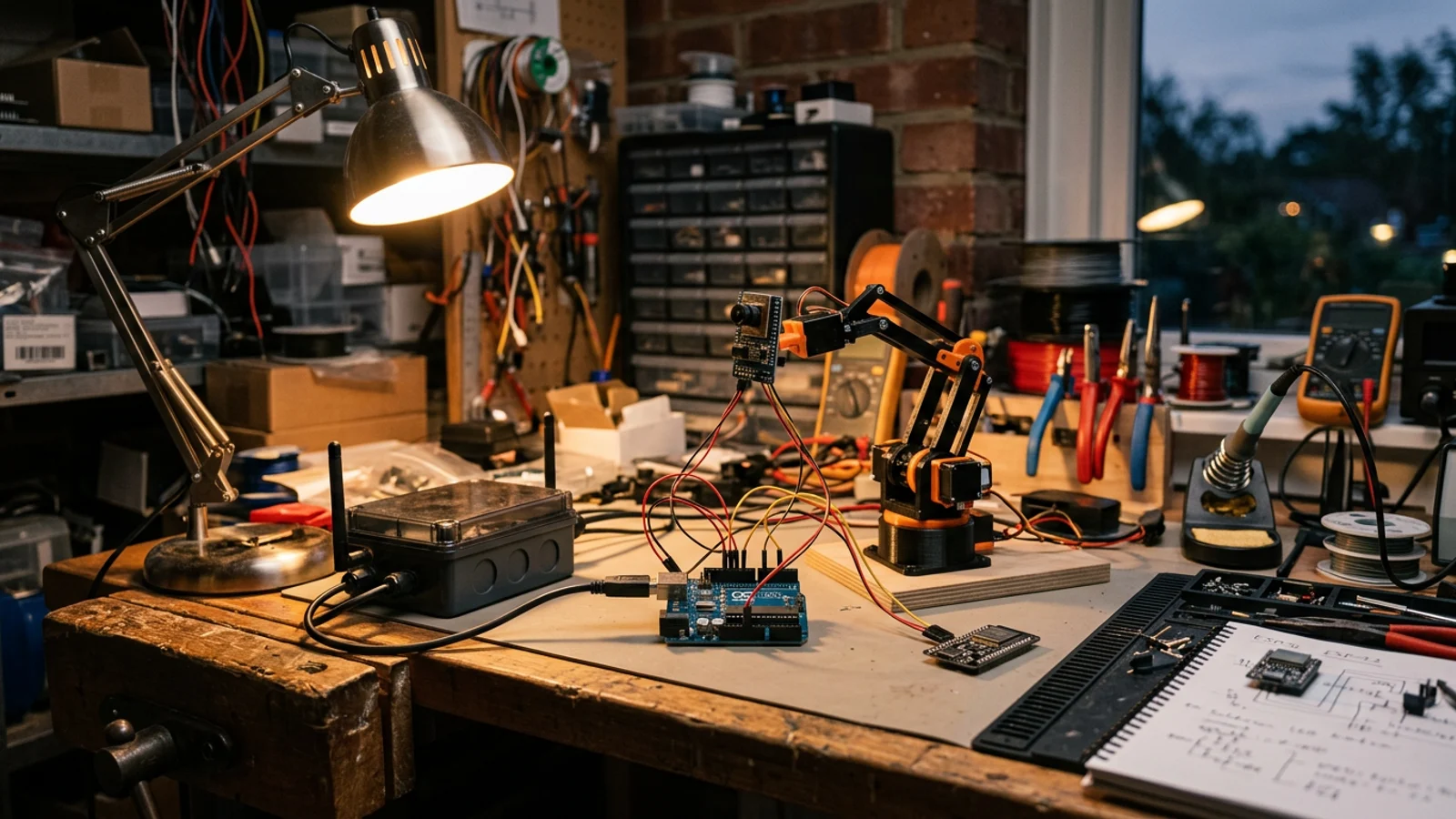
A dual-core Arduino runs robot policies on-device, a paper argues for skill-sized models over one big brain, and two ESP32 boards ship.
A Dual-Core Arduino Board Runs Multi-Agent Robot Policies On-Device
Maker Mohsen Jalaeian Farimani built an embedded ROS 2 node that runs learned multi-agent control policies directly on an Arduino UNO Q, with no robot-side cloud call needed, as detailed in a write-up on Hackster.io.
The UNO Q pairs a Linux-capable application processor with a real-time microcontroller on one board. The Linux side runs ROS 2 messaging and policy inference — turning camera and sensor input into action commands for two or more coordinating agents — while the microcontroller side handles the deterministic, safety-bounded timing loop that actually drives motors.
This is a hobbyist demonstrator, not a production robot: the write-up describes coordination behaviors like collision avoidance and formation keeping, not a quantified success rate. But the split architecture — one chip for perception and policy, one chip for guaranteed timing — is becoming a common pattern for cheap on-device robotics on this board family.
A New Paper Argues Robots Need Skill-Specialized Small Models, Not One Big LLM
Researchers published Skill-SLM on arXiv on October 7, 2026, proposing that onboard robot decision-making should route tasks to small, skill-specific language models rather than lean on one large general model squeezed onto the robot.
The paper's framing is that today's small language models, while attractive onboard because they skip network latency, still struggle to generalize across the variety of skills a robot needs — picking, navigating, describing surroundings — and that specializing by skill improves reliability on each one.
It is a preprint with the authors' own results, not an independent benchmark, and the abstract previews no specific hardware or latency numbers. Still, it adds to a growing on-device robotics literature arguing that smaller, task-bounded models beat bigger general ones when every millisecond and milliwatt is spent on the robot itself.
Google Open-Sources ML Drift, a GPU Inference Engine for Edge Devices
Google's AI Edge team released ML Drift, a GPU-accelerated inference engine aimed at phones, laptops and other edge hardware, surfacing on r/LocalLLaMA on October 9, 2026.
The project is pitched as a next-generation GPU backend for on-device inference, built to run models directly on a device's GPU instead of its CPU or a remote server — following the lineage of Google's existing TFLite and MediaPipe GPU delegates.
No independent benchmarks have surfaced yet, and this is a fresh open-source drop rather than a shipped product, so rough edges should be expected. But a maintained, open GPU runtime from Google matters for the edge stack broadly: llama.cpp and MLC already compete in this space, and more open GPU backends mean more phones and small PCs that can run real models with no network connection.
M5Stack's ToughC5 Packs Wi-Fi 6, Zigbee and Thread Into a Weatherproof ESP32-C5 Box
M5Stack introduced the ToughC5 on October 10, 2026, a rugged outdoor IoT controller built around Espressif's ESP32-C5, as reported by CNX Software.
The board carries dual-band Wi-Fi 6, Bluetooth LE 5, and Zigbee/Thread radios on one chip, plus a 2.0-inch capacitive touchscreen, inside a weatherproof enclosure built for permanent outdoor installs.
There is no model running on it — this is a connectivity and sensing board, not an inference board — but the ESP32-C5's radio stack matters for the edge-AI pipeline anyway: it is the kind of chip that would carry sensor data to, or host wake-word detection ahead of, an on-device model running elsewhere in a build.
A $2 ESP32-C3 Blocks Half a Million Ad Domains With No External Memory
Developer Zed (M-Abozaid) published esp32-c3-adblock, an open-source, Pi-hole-style DNS ad blocker that runs on a roughly $2 ESP32-C3 board, as covered by CNX Software on October 9, 2026.
The project filters more than 500,000 ad and tracker domains using the ESP32-C3's own flash and RAM — no PSRAM module required — by compressing the blocklist into a compact on-chip lookup structure instead of loading it raw.
There's no AI inference in it, but it is the same kind of resourceful, memory-constrained firmware engineering the community later applies to squeezing small models onto this exact chip family.
No giant launches today — a dual-core Arduino running robot policies, a paper making the case for skill-sized models over one big brain, Google's new GPU runtime, and two ESP32 boards doing very different jobs on the same silicon family.
References & Citations
- Mohsen Jalaeian Farimani — Hackster.io, 2026-10 — https://www.hackster.io/mohsen-jalaeian-farimani/multiagent-policy-inference-ros-node-for-cooperative-robotic-0ef1e8
- Skill-SLM paper — arXiv, 2026-10-07 — https://arxiv.org/abs/2610.10812v1
- google-ai-edge/ml-drift — GitHub — https://github.com/google-ai-edge/ml-drift
- r/LocalLLaMA thread on ML Drift, 2026-10-09 — https://www.reddit.com/r/LocalLLaMA/comments/1x1owzm/github_googleaiedgemldrift_gpuaccelerated_aiml/
- CNX Software — M5Stack ToughC5, 2026-10-10 — https://www.cnx-software.com/2026/10/10/m5stack-toughc5-weatherproof-esp32-c5-iot-controller-offers-dual-band-wi-fi-6-ble-5-and-zigbee-thread/
- CNX Software — esp32-c3-adblock, 2026-10-09 — https://www.cnx-software.com/2026/10/09/open-source-esp32-c3-dns-ad-blocker-supports-up-to-over-500000-domains-without-psram/
Subscribe to new posts from theaivibe.org
Related Posts
Windows Learns GGUF as AI Agents Design Their Own Inference Chip
Microsoft wires llama.cpp into Windows ML's NPU stack while an agent-built FPGA accelerator and fresh AI PC benchmarks show where edge inference actually stands.
A 14M-Parameter LLM Keeps a Virtual Fish Tank Alive on an $8 Chip
A distilled LLM runs a fish tank on an $8 ESP32-S3, four Raspberry Pi 5s share a 30B model, and a 2B decision model lands for edge agents.
ESP32 Special: Cloud Voices and an E-Ink Reader, No New On-Device LLM Yet
Two ESP32 voice projects lean on cloud AI while a maker's e-ink reader builds the hardware the next on-device model will need.