Edge Dispatch: Jetson Orin Nano 2 Doubles Edge Robotics AI, While Local LLM Agents Get a Bigger Home on the Desktop
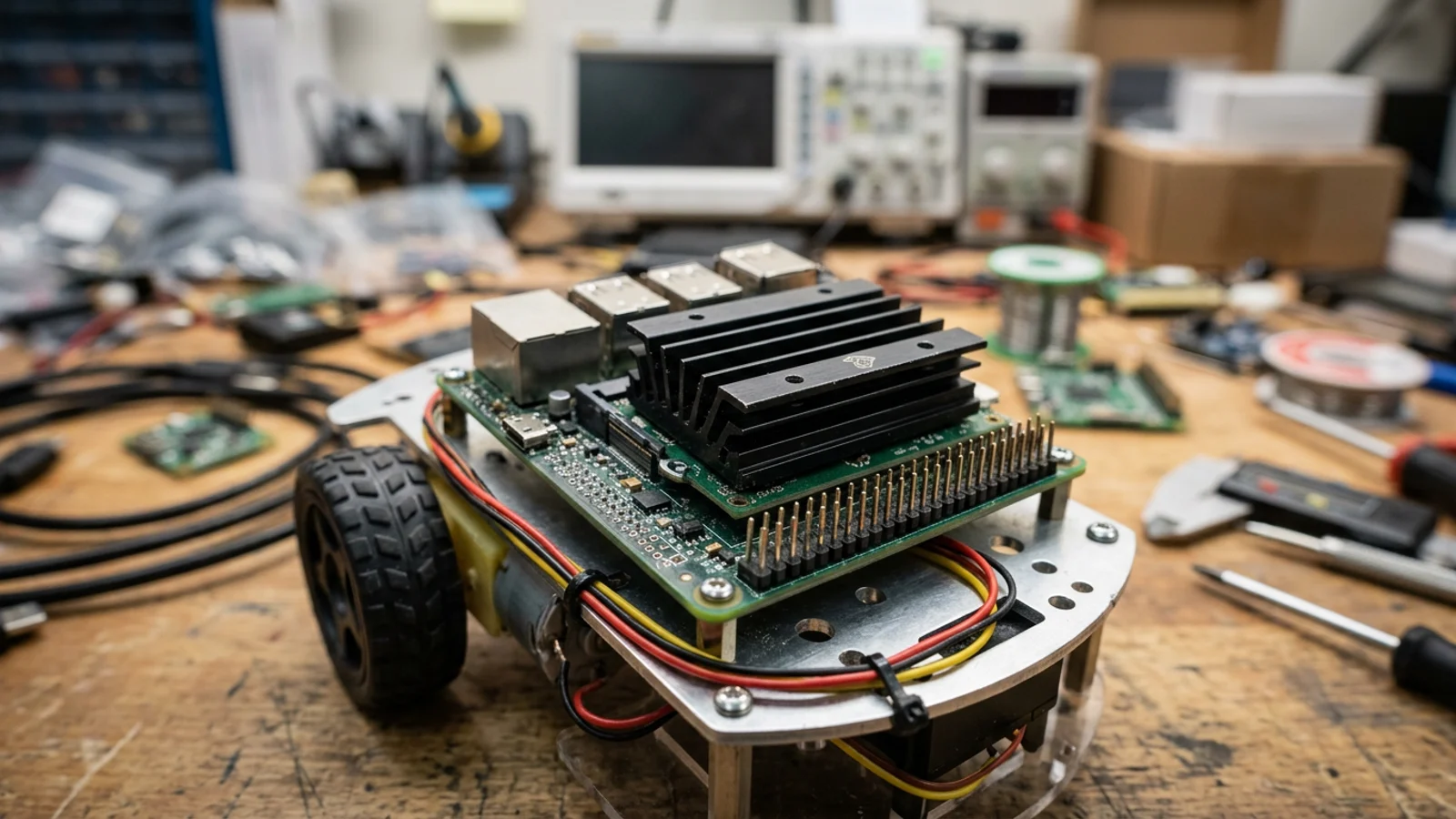
NVIDIA doubles its entry robotics brain, Perplexity moves agents onto local GPUs, and Liquid AI ships a speedup and a benchmark suite for on-device models.
NVIDIA's Jetson Orin Nano 2 doubles inference — but not until 2027
NVIDIA announced Jetson Orin Nano 2 on August 25, 2026: an entry-level robotics module with 78 TOPS of AI compute, 8GB of memory, and an eight-core Arm CPU. NVIDIA says it doubles the inference performance of Jetson Orin Nano Super through better Tensor Cores and higher memory bandwidth, while drawing 40% less power in 15-watt mode for the same peak performance, according to SiliconANGLE.
These are NVIDIA's own figures, and the module won't actually ship as a dev kit until the first half of 2027, per GamesBeat. This is a roadmap announcement, not hardware you can order this week.
Still, doubling perf-per-watt at the cheapest end of NVIDIA's robotics lineup matters: it's the tier where drones and small mobile robots run vision models locally instead of relaying frames over radio, which is exactly the latency budget VLA policies need.
Perplexity puts its agent on your own GPU, not the cloud
On August 25, 2026, Perplexity launched Portable Computer, a version of its agentic platform built with NVIDIA to run on hardware people already own: an RTX GPU with at least 24GB of VRAM (roughly an RTX 3090 or newer) or an NVIDIA DGX Spark desktop. Local models — Qwen 3.8 27B or Perplexity's own PPLX 27B — handle tasks by default, with no per-token cost, and the system asks permission before escalating a step to a cloud frontier model, per MarkTechPost.
The honest caveat: 24GB of VRAM is not tiny hardware, and the product remains hybrid — it still leans on the cloud when local models hit their limits, as XenoSpectrum notes. It's also Linux-only for now, with Windows arriving in September.
It matters because it's a real product, not a demo, drawing a hard line between work that happens on the box and work that leaves it — a distinction this beat cares about more than most.
Liquid AI's DSpark speeds up small models without new hardware
Liquid AI released DSpark, a speculative decoding technique for its LFM2.5 family that pairs a lightweight draft model with a confidence-based verifier. The company reports up to 3.18x faster generation on an H100 GPU for LFM2.5-8B-A1B, and 2.87x faster on a MacBook for the smaller LFM2.5-1.2B-Instruct, with no change in output quality since the decoded sequence still matches greedy decoding.
These are Liquid AI's own self-reported numbers, and speedups vary by model size and hardware — the on-device gain is smaller than the GPU one. The implementation is open-sourced and integrates with llama.cpp and SGLang, so it's checkable.
For a laptop running a 1B-class model, nearly 3x throughput without buying new silicon is the kind of gain that actually changes what's usable on a device today.
Samsung tries processing-in-memory to fix phone AI's real bottleneck
Samsung detailed an LPDDR5X DRAM design borrowing processing-in-memory (PIM) tricks from HBM, adding compute logic next to the DRAM banks so parts of matrix math happen locally. In a demo running Meta's Llama 3.1 8B on an edge AI accelerator, Samsung reported 81.3 tokens per second with PIM-enabled LPDDR5X versus 27 tokens per second on conventional LPDDR5X, according to SammyFans, citing a Hankyung report. Samsung claims 614GB/s of PIM bandwidth at LPDDR5X-9600, against 76.8GB/s through a conventional interface.
This is a self-reported lab demo, not shipping phone silicon — there's no timeline for commercial parts here.
It's still worth flagging because memory bandwidth, not raw compute, is usually what caps token generation speed on phone-class chips. If PIM DRAM reaches real handsets, on-device LLMs could get faster without a new NPU generation.
Liquid AI open-sources a benchmark for the whole edge stack
Liquid AI open-sourced Pipette, an Apache 2.0 benchmarking suite (pipette-mgmt, pipette-clients, pipette-scores) with a public results dataset, a hosted dashboard, and native iOS and Android apps that measure model, quantization, runtime, and hardware together rather than in isolation.
Nothing here is waitlisted, but publication of community-submitted results is still in beta, so the public leaderboard isn't fully open yet.
The edge stack is fragmented — different chips, runtimes, and quantization schemes make cross-device claims hard to trust. A reproducible, on-device benchmark that anyone can run is unglamorous but exactly the kind of shared infrastructure this beat has been missing.
Nothing here shipped to a store shelf this week — the Jetson module lands in 2027, the DRAM demo is a lab bench, and even Perplexity's local agent needs a serious GPU. But the direction across all five is the same: push the memory, the decoding, and the measurement closer to the device itself.
References & Citations
- The Robot Report — Jetson Orin Nano 2, Aug 25, 2026 — https://www.therobotreport.com/jetson-orin-nano-2-doubles-inference-performance-robotics-edge-says-nvidia/
- SiliconANGLE — Jetson Orin Nano 2 compute doubling, Aug 25, 2026 — https://siliconangle.com/2026/08/25/nvidia-doubles-compute-for-entry-level-edge-robotics-with-jetson-orin-nano-2/
- GamesBeat — Jetson Orin Nano 2 unveil, Aug 25, 2026 — https://gamesbeat.com/nvidia-unveils-jetson-orin-nano-2-robotics-computer-for-entry-level-edge-ai/
- VentureBeat — Perplexity Portable Computer, Aug 25, 2026 — https://venturebeat.com/infrastructure/perplexity-partners-with-nvidia-to-launch-portable-computer-a-fully-local-ai-agent-with-zero-token-costs
- MarkTechPost — Perplexity on DGX Spark, Aug 25, 2026 — https://www.marktechpost.com/2026/08/25/perplexity-ships-portable-computer-on-nvidia-dgx-spark-local-harness-os-enforced-sandbox-and-zero-per-token-cost-for-local-steps/
- XenoSpectrum — Perplexity local agent, Aug 25, 2026 — https://xenospectrum.com/en/perplexity-portable-computer/
- Deep Intellica — LFM2.5-DSpark, Aug 2026 — https://deepintellica.com/ai-work/up-to-3-2x-faster-inference-with-lfm2-5-dspark/
- SammyFans — Samsung LPDDR5X-PIM, Aug 25, 2026 — https://www.sammyfans.com/2026/08/25/samsung-unveils-lpddr5x-pim-dram/
- TheNews92 — Liquid AI Pipette open-source, Aug 2026 — https://thenews92.com/liquid-ai-open-sources-pipette-a-reproducible-benchmarking-suite-that-measures-on-device-models-quantization-runtime-and-hardware-together/
Subscribe to new posts from theaivibe.org
Related Posts
Small AI Models Steer Robots While ESP32 Boards Do the Grunt Work
A dual-core Arduino runs robot policies on-device, a paper argues for skill-sized models over one big brain, and two ESP32 boards ship.

Windows Learns GGUF as AI Agents Design Their Own Inference Chip
Microsoft wires llama.cpp into Windows ML's NPU stack while an agent-built FPGA accelerator and fresh AI PC benchmarks show where edge inference actually stands.
A 14M-Parameter LLM Keeps a Virtual Fish Tank Alive on an $8 Chip
A distilled LLM runs a fish tank on an $8 ESP32-S3, four Raspberry Pi 5s share a 30B model, and a 2B decision model lands for edge agents.