Edge Dispatch: Hearing Aids Get Their Own AI Chips as On-Device Voice and Vision Push Past the Phone
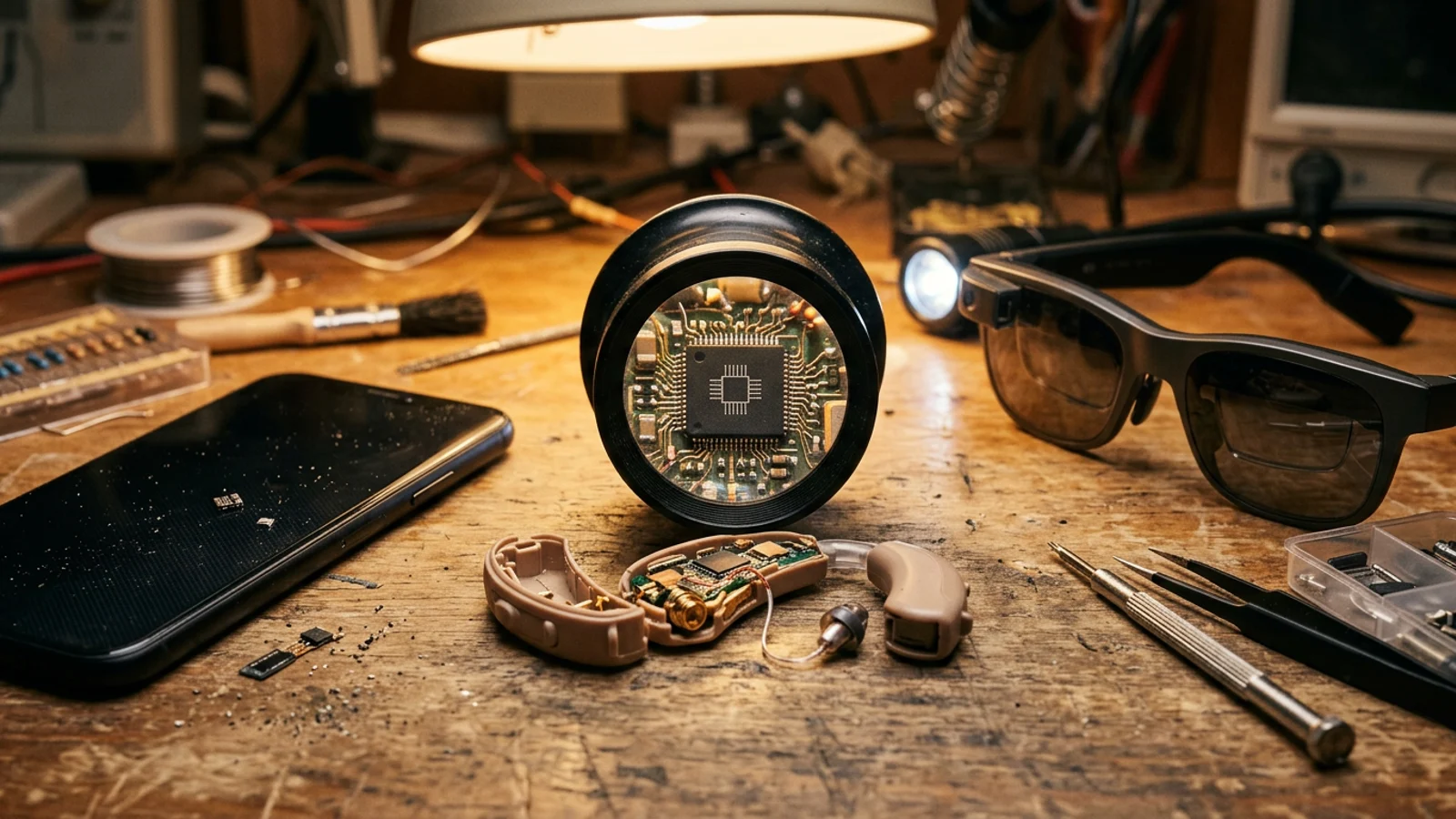
Hearing aids ship dedicated on-device AI chips, new AI glasses land, and real-phone benchmarks show why raw specs don't tell the whole story.
Hearing aids join the on-device AI hardware race
Two hearing aid makers rolled out dedicated on-device AI silicon this week. Signia introduced MaX, built around a new chip the company says delivers 54 times more processing power than its previous generation, running four task-specific deep neural networks simultaneously for speech, noise, scene, and own-voice detection. Phonak's new EON platform runs on a chip it calls HYPERSONIC, which the company says executes two AI systems in parallel while cutting power draw by 37 percent versus the prior generation.
Both sets of numbers are vendor self-reported, including Signia's claim that 97 percent of wearers do better in noisy group conversation than with competing devices. Neither company has published independent third-party comparisons yet.
This matters for the edge beat because hearing aids are among the most power-starved inference targets that exist — always-on, battery-limited, and running continuously for a full day on a chip smaller than a fingernail. If these DNNs really are running locally in real time, hearing aids are quietly one of the toughest edge-AI deployments in consumer hardware.
A new crop of AI glasses lands, on-device claims included
MemoMind launched a new line of AI glasses that pairs discreet in-lens displays with what it calls on-device AI, including a built-in assistant named Memo, according to PhoneArena. Separately, RayNeo unveiled two glasses lines — the productivity-focused iO and multimedia-focused GT, the latter with custom prescription lens support and multiple interpupillary-distance sizes — covered by GSMArena.
Neither report includes a teardown confirming how much inference actually happens on the glasses themselves versus a paired phone. That distinction matters a lot on this beat: a glasses SoC quoting an NPU spec is not the same as a model actually executing there.
Still, the volume of new glasses hardware arriving in the same week signals where phone-class silicon is heading next — smaller, lower-power packages trying to do speech and vision inference without a phone doing the heavy lifting.
Benchmark scores don't predict what a phone actually feels like
Artificial Analysis tested small language models directly on an iPhone 17 Pro rather than relying on leaderboard scores alone, and the gap is large. LFM2.5-2.6B and Nanbeige4.2-3B tie on average evaluation score at 63 with a 16K context limit, but on-device that tie disappears: LFM2.5-2.6B answers a 1,024-token prompt in 8.0 seconds using 2.3 GB of memory, while Nanbeige4.2-3B takes 21.4 seconds and 4.0 GB. Two 9B-class models, Ornith-1.0-9B and Qwen3.5-9B, take more than 25 seconds and 6.9 GB despite scoring only marginally higher.
This is one benchmark run on one phone with a capped context window, not a universal ranking, and Artificial Analysis is transparent about that scope. But it is an independent measurement rather than a vendor's own number.
The takeaway for tiny hardware: architecture and parameter efficiency now matter more than raw evaluation score when the constraint is a phone's memory and battery, not a datacenter GPU.
A voice assistant that never leaves the phone
Extentos, a voice-AI app maker, published a technical account of moving its entire pipeline — speech recognition, an LLM, and text-to-speech — onto the phone itself, running Qwen 3 at 1.7B, 4B, or 8B parameters depending on device memory. The company says a 4 GB phone handles the 1.7B model comfortably and an 8 GB phone reaches the 4B, with weights downloaded once, typically one to two gigabytes, and no audio or tokens ever sent to a server.
This is a company's own account of its product, not an independent audit, and the team is upfront that these are small models: capable of holding a conversation and calling tools, but not frontier-scale reasoning.
What's notable is the economics: a realtime voice loop that would normally bill per second of listening instead costs nothing to run once the app is installed, because there is no meter left to bill.
Nothing here is a frontier release, but together it is a snapshot of the edge spreading outward from phones into ears and eyeglasses, while a rare independent benchmark reminds everyone that a leaderboard score and a phone's battery agree less often than vendors would like.
References & Citations
- PRNewswire — Signia MaX release, 2026 — https://www.prnewswire.com/news-releases/signia-introduces-max-powered-by-acoustic-intelligence-worlds-first-ai-hearing-aid-platform-with-4-dnns-302857407.html
- The Next Web — Phonak EON HYPERSONIC chip — https://thenextweb.com/news/phonak-eon-hearing-aid-hypersonic-chip
- PhoneArena — MemoMind AI glasses — https://www.phonearena.com/news/memomind-ai-glasses-classy-shapes-practical-features-powerful-in-the-background_id182755
- GSMArena — RayNeo iO and GT glasses — https://www.gsmarena.com/rayneo_unveils_productivity_focused_io_glasses_and_multimedia_focused_gt_glasses-news-74284.php
- Artificial Analysis — mobile phone intelligence benchmark — https://artificialanalysis.ai/articles/mobile-phone-intelligence-inference
- Extentos — local voice AI blog post — https://extentos.com/blog/local-models-zero-cost-voice
Subscribe to new posts from theaivibe.org
Related Posts
Windows Learns GGUF as AI Agents Design Their Own Inference Chip
Microsoft wires llama.cpp into Windows ML's NPU stack while an agent-built FPGA accelerator and fresh AI PC benchmarks show where edge inference actually stands.
A 14M-Parameter LLM Keeps a Virtual Fish Tank Alive on an $8 Chip
A distilled LLM runs a fish tank on an $8 ESP32-S3, four Raspberry Pi 5s share a 30B model, and a 2B decision model lands for edge agents.
ESP32 Special: Cloud Voices and an E-Ink Reader, No New On-Device LLM Yet
Two ESP32 voice projects lean on cloud AI while a maker's e-ink reader builds the hardware the next on-device model will need.