AI PCs Go Big: A 300B-Parameter Desktop, an 80-TOPS Mini PC, and Edge NPUs Redraw the Local-Inference Map
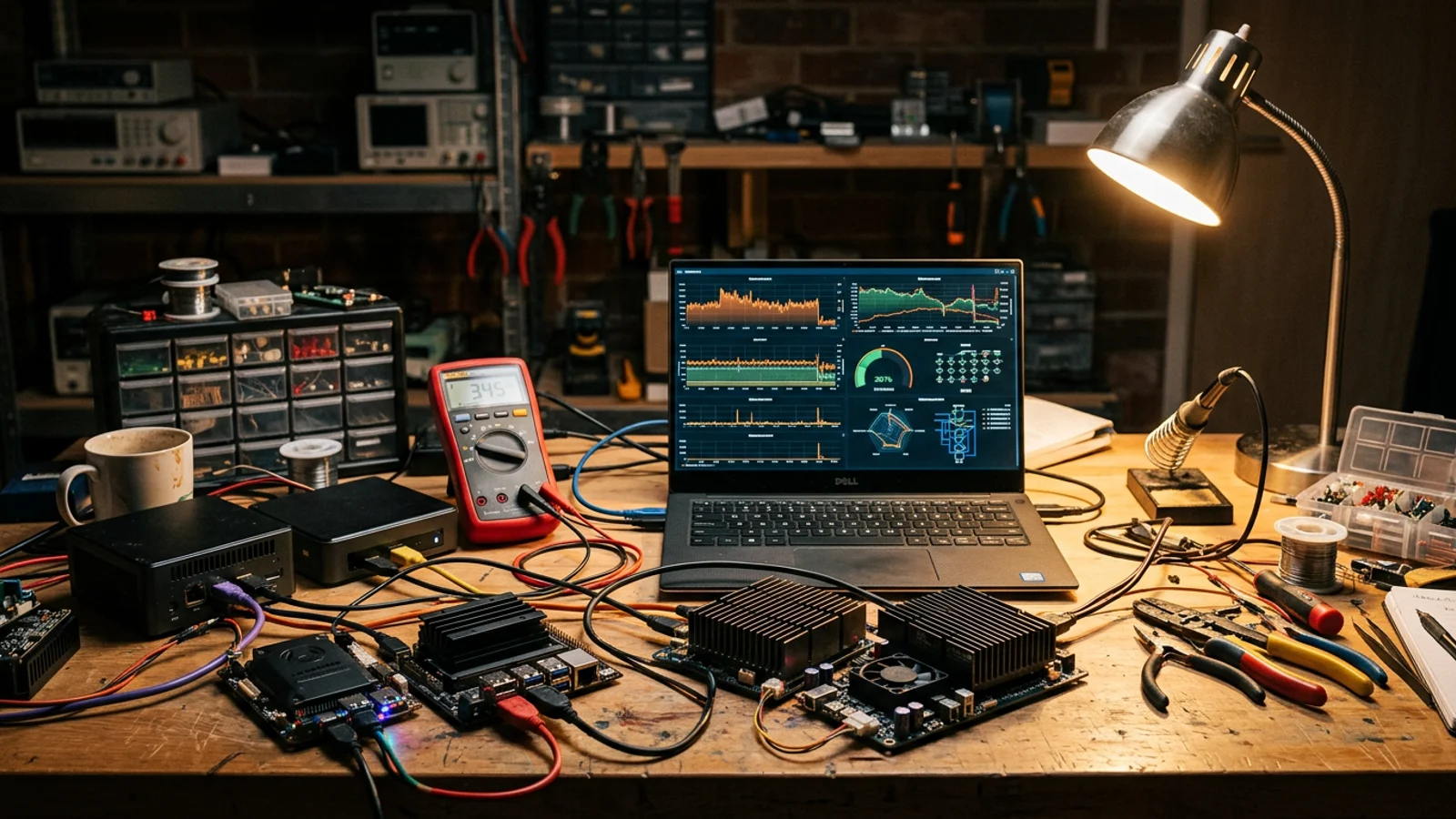
GMKtec, ASUS and Radxa all shipped NPU hardware this week while OpenVINO and a Qualcomm robotics runtime pushed what those chips can actually run.
A Desktop Box Claims It Can Run a 300B-Parameter Model, Fully Offline
GMKtec unveiled the EVO-X5 Pro at IFA 2026 on September 18, 2026, built around AMD's Ryzen AI Max+ PRO 495: 16 Zen 5 cores, an XDNA 2 NPU rated at 55 TOPS, and up to 192GB of LPDDR5X-8533 unified memory delivering 273 GB/s of bandwidth. GMKtec's headline claim is that the box runs a 300-billion-parameter LLM entirely offline. It ships on September 28, 2026.
The caveat: this is a vendor claim with no independent tokens-per-second figure attached. A 300B model, even quantized, will lean almost entirely on CPU and unified memory bandwidth rather than the 55-TOPS NPU, and 273 GB/s is modest next to a discrete GPU — expect single-digit tokens per second, not chat-speed output.
Still, it's a data point in the same race as Jetson Thor and Ryzen AI Max+: cramming frontier-scale weights into a machine that never talks to the cloud.
ASUS Squeezes an 80-TOPS NPU Into a Sub-0.7-Liter Mini PC
ASUS announced the Ascent QN10 on September 18, 2026, calling it the first agentic AI mini PC with an 80-TOPS NPU. It runs Qualcomm's Snapdragon X2 Elite with an 18-core Oryon CPU, and ASUS says it exceeds Microsoft's Copilot+ PC requirements while fitting in under 0.7 liters.
The 80 TOPS figure is Qualcomm's own Hexagon NPU spec, not an independently measured throughput number, and 'agentic' here mostly means it targets Copilot-style local assistants rather than proving a specific model runs at a specific speed.
What matters for the beat is form factor: this is the same Snapdragon X2 silicon showing up in laptops now landing in a fanless desktop small enough to sit behind a monitor.
A Coin-Sized Module Packs a 48-TOPS NPU for Robots
Radxa's rCore-Q8550, detailed by LinuxGizmos on September 18, 2026, is a coin-sized System-on-Module built around Qualcomm's Dragonwing QCS8550 platform. Radxa specs it at 48 TOPS of NPU compute with PCIe Gen 4 support, pitched at robotics and machine-vision integrators who need real inference power without a full carrier board.
No price is listed yet in the write-up, so the concrete facts here are silicon and interface, not cost — worth checking before treating this as buyable.
The shrinking-module trend matters because it moves serious NPU compute closer to the actuator, not just the camera, in small robots and drones.
OpenVINO 2026.4 Puts Speech and Image Generation on the NPU, Not Just the GPU
Intel's OpenVINO team published the 2026.4 release notes in mid-September 2026, adding NPU support for Kokoro-82M text-to-speech and for FLUX.2-Klein-4B, a compact image generator from Black Forest Labs, plus an ASRPipeline for Node.js speech recognition. The pitch is running these directly on an Intel AI PC's NPU instead of pulling power from the CPU or discrete GPU.
These are Intel's own release notes, so the efficiency gains are self-reported and hardware-specific — they apply to Intel Core Ultra NPUs, not ARM or Qualcomm silicon.
Still, putting a 4B image model on an NPU rather than a GPU is a real shift for cheap AI PCs that never had discrete graphics to begin with.
A Robot Arm Drops From 1.6 Seconds to 230 Milliseconds on a Qualcomm NPU
Nota AI presented a custom NPU runtime at KRAIN 2026 on September 11, 2026, benchmarking five vision-language-action backbones on the same Qualcomm NPU board and settling on GR00T N1.7 for a live SO-101 robot arm. Per-inference latency fell from 1.6 seconds to 230 milliseconds; end-to-end pipeline time dropped from 3,681ms to 1,173.9ms, a 68% cut.
Nota AI reports these numbers itself, and the final bottleneck it identifies isn't the model at all — it's the camera thread, a reminder that VLA latency on real hardware is a systems problem, not just a quantization one.
It's a concrete counterpoint to GPU-centric VLA guidance: robot brains are starting to live entirely on the NPU.
A 2-Bit, Sub-30MB Model Aims at Tool Calls Instead of Chat
Cactus Compute released Needle, described as an automation foundation model for tiny devices: 2-bit quantized, 8 to 29MB depending on configuration, and built specifically for tool calls and structured data extraction rather than open-ended conversation. The repo has passed 11,000 GitHub stars as of September 18, 2026.
Star counts measure attention, not accuracy — there's no independent benchmark yet showing how reliably a 2-bit model calls tools versus hallucinating arguments.
The idea is worth watching: most tiny on-device LLMs chase storytelling or chat demos, while Needle bets that structured automation is the more useful job for a model this small.
Today's silicon news split cleanly between two questions: how big a model an edge box can hold, and how fast a small one can actually respond — GMKtec chasing the first, Nota AI chasing the second.
References & Citations
- ASUS — official product announcement, September 18, 2026 — https://www.asus.com/us/business/resources/news/asus-announces-ascent-qn10/
- HotHardware — ASUS Ascent QN10 coverage — https://hothardware.com/news/asus-ascent-qn10-mini-pc-snapdragon-x2-elite-80-tops-ai
- LinuxGizmos — Radxa rCore-Q8550, September 18, 2026 — https://linuxgizmos.com/coin-sized-radxa-rcore-q8550-module-features-48-tops-npu-and-pcie-gen-4/
- OpenVINO toolkit team — Medium, 2026.4 release notes — https://medium.com/openvino-toolkit/openvino-2026-4-broader-model-support-faster-inference-and-node-js-speech-recognition-393ea73ebcff
- Nota AI — VLA edge NPU optimization write-up — https://blog.nota.ai/insights/vla-edge-npu-optimization
- Cactus Compute — needle repository — https://github.com/cactus-compute/needle
- UpdateNews.info / Finanznachrichten — GMKtec EVO-X5 Pro press release, September 18, 2026 — https://www.updatenews.info/gmktec-unveils-evo-x5-pro-at-ifa-2026-with-amd-ryzenai-max-processors-introducing-the-worlds-first-desktop-ai-supercomputer-capable-of-running-a-300b-parameter-llm-fully-offline/
Subscribe to new posts from theaivibe.org
Related Posts
Jetson Thor Sprints Past llama.cpp While a 15M-Parameter LLM Still Fits an $8 Chip
NVIDIA posts a 6.4x MLPerf edge win on Jetson AGX Thor, a dense TinyStories model skips the flash trick, and a paper splits VLA robots between cloud and a tiny local model.
ESP32 Special: An $8 Chip Runs a 29-Million-Parameter LLM, and Vendors Rethink the Board Around It
A one-chip LLM, a Wi-Fi upgrade to Seeed's tiny displays, and Tuya's push to make ESP32 an AI-agent target, not just a Wi-Fi one.
A Wristband Reads Muscles, a Ring Wants Your Ideas: Edge AI Moves Onto the Body
New wearable and phone releases push transcription, gesture control and silent speech fully on-device, while ESP32 and Jetson tooling keeps pace.