A 4B AI Model Drives a Robot Arm on Jetson Thor, No Datacenter in the Loop
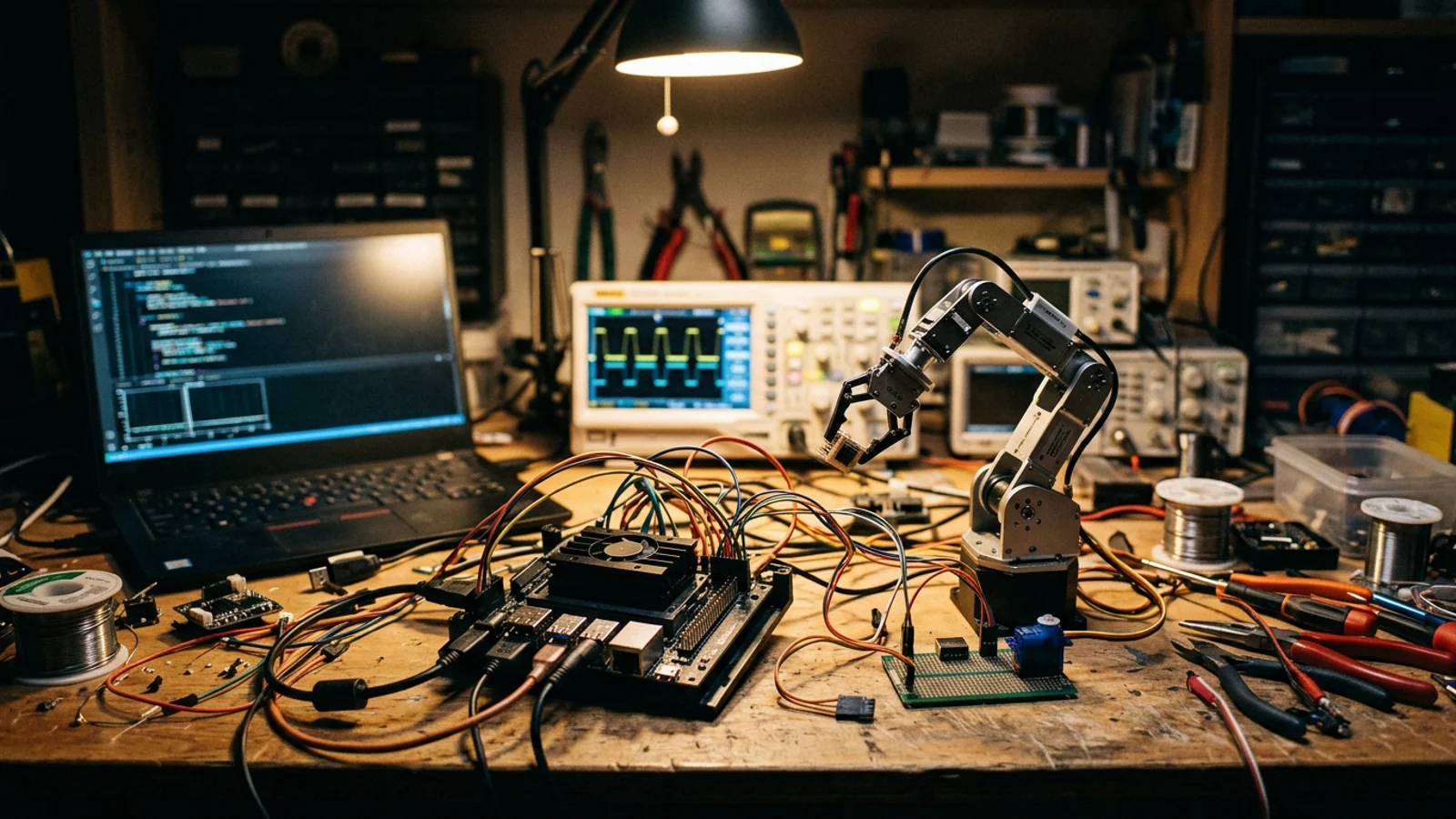
NVIDIA post-trains Cosmos 3 Edge for on-device manipulation, a PKU lab ships a llama.cpp engine for VLA policies, and Jetson's next Orin Nano gets a ship date.
Cosmos 3 Edge Drives a Robot Arm Straight From Jetson Thor
NVIDIA published a developer blog on September 17, 2026 showing how to post-train Cosmos 3 Edge, a 4B-parameter world-foundation model, for real-time robot control that runs entirely on a Jetson AGX Thor T5000 developer kit. After post-training on the Cosmos3-DROID dataset, the policy generates each action chunk in about 1.53 seconds at 640×540 resolution and 15 Hz, while a single chunk covers roughly 2.13 seconds of arm motion — enough overlap to keep the arm moving continuously with no data-center GPU in the loop.
NVIDIA's own closed-loop RoboLab evaluation puts success at 22.9% across 120 language-conditioned manipulation tasks — a vendor-reported number that shows the recipe works, not that it's reliable yet. The weights run at roughly 9GB in BF16, small enough to sit in Thor's onboard memory alongside the WebSocket policy server that speaks the OpenPI protocol.
This is a research recipe, not a shipping product, and a sub-23% success rate leaves plenty of room to fail. But a 4B multimodal model handling perception, reasoning and action generation on one onboard chip, with reproducible scripts in NVIDIA's open cosmos-framework repo, is a concrete step for robots that can't phone home for every move.
A Lab Ports VLA Policies Onto llama.cpp for Jetson Orin
A team at Peking University's SEC Lab open-sourced Jetson-PI-Edge, a llama.cpp-based inference engine built specifically to run vision-language-action policies on Jetson hardware. An August 2026 update added pre-converted GGUF checkpoints for PI0, PI0.5 and NVIDIA's GR00T N1.7 on Hugging Face, so the full Qwen3-VL backbone, action head and flow-matching steps run through either a foreground HTTP server or an in-process pybind11 module.
The companion arXiv paper, "Jetson-PI: Towards Onboard Real-Time Robot Control via Foresight-Aligned Asynchronous Inference," reports an 8.66x control-frequency gain over naive PyTorch and 5.41x over a prior vla.cpp baseline on Jetson Orin, plus a 14.8-point success-rate edge over a method called VLASH on the LIBERO benchmark — self-reported academic numbers, not yet independently reproduced.
The core idea is a lightweight "future correction module" that predicts what the scene will look like once a committed action finishes, so the action expert doesn't have to wait on a fresh camera frame every cycle. It's the kind of asynchronous scheduling trick that lets an Orin-class module, not a rack of GPUs, keep a robot arm moving in real time.
Jetson Orin Nano 2 Gets a Ship Window: First Half of 2027
NVIDIA is following its Jetson Thor line with a smaller sibling. RobotToday describes the Jetson Orin Nano 2 as an entry-level robotics computer aimed at drones, delivery robots and vision-heavy edge AI projects. Home-robotics company Matic confirmed in a September 16, 2026 announcement that the Jetson Orin Nano 2 module and developer kit are expected to ship in the first half of 2027, and said it plans to integrate the part into its home robots six to nine months after availability.
Neither NVIDIA nor Matic has published full specifications yet, so this is a roadmap commitment rather than a benchmark. Matic frames the move as doubling on-device, privacy-focused intelligence for a robot that already avoids sending video to the cloud.
For builders, the news matters less for the silicon itself than for the calendar: a 2027 ship window for the next Orin Nano gives developers currently prototyping on the original module a rough sense of how long that board stays the entry point before a refresh lands.
A Desktop Robot's Voice and Vision Never Leave Its Jetson
Developer Andrew White published reachy-mini-jetson-assistant, an open-source voice-and-vision assistant for the Reachy Mini Lite desktop robot that runs entirely on an attached NVIDIA Jetson board. Per the project's GitHub readme, speech recognition, vision processing and response generation all execute locally with GPU acceleration — no cloud calls, no API keys, and no internet connection required at runtime.
It's a hobbyist integration rather than a benchmarked product, and the repo doesn't publish latency or accuracy numbers, so this is a working proof of concept, not a measured result. Still, it's a concrete example of a split that keeps showing up on this beat: a small desktop robot handling motors and sensors while a nearby Jetson module does the actual language and vision inference, fully offline.
Four different scales of the same idea today — a 4B world model, a llama.cpp fork, a not-yet-shipped chip, and a hobbyist's desktop robot — all pointed at getting perception and action off the network and onto the device itself.
References & Citations
- NVIDIA Technical Blog, September 17, 2026 — https://developer.nvidia.com/blog/post-train-nvidia-cosmos-3-edge-for-on-device-robot-control/
- PKU-SEC-Lab, arXiv paper (Jetson-PI) — https://arxiv.org/html/2607.12659v4
- PKU-SEC-Lab/Jetson-PI-Edge, GitHub — https://github.laiyagushi.com/PKU-SEC-Lab/Jetson-PI-Edge
- RobotToday, September 2026 — https://robottoday.com/industry-briefing/nvidia-launches-jetson-orin-nano-2-for-robotics-and-edge-ai-applications/13551
- Matic via MarketMinute, September 16, 2026 — https://kointv.marketminute.com/article/bizwire-2026-9-16-matic-becomes-among-the-first-home-robotics-companies-to-adopt-and-scale-nvidia-jetson-orin-nano-2-doubling-on-device-privacy-focused-intelligence
- Andrew White, reachy-mini-jetson-assistant, GitHub — https://github.com/andrewwhitecdw/reachy-mini-jetson-assistant
Subscribe to new posts from theaivibe.org
Related Posts
AI PCs Go Big: A 300B-Parameter Desktop, an 80-TOPS Mini PC, and Edge NPUs Redraw the Local-Inference Map
GMKtec, ASUS and Radxa all shipped NPU hardware this week while OpenVINO and a Qualcomm robotics runtime pushed what those chips can actually run.
Jetson Thor Sprints Past llama.cpp While a 15M-Parameter LLM Still Fits an $8 Chip
NVIDIA posts a 6.4x MLPerf edge win on Jetson AGX Thor, a dense TinyStories model skips the flash trick, and a paper splits VLA robots between cloud and a tiny local model.
ESP32 Special: An $8 Chip Runs a 29-Million-Parameter LLM, and Vendors Rethink the Board Around It
A one-chip LLM, a Wi-Fi upgrade to Seeed's tiny displays, and Tuya's push to make ESP32 an AI-agent target, not just a Wi-Fi one.