Multi-Agent Systems: When AI Agents Learn to Collaborate
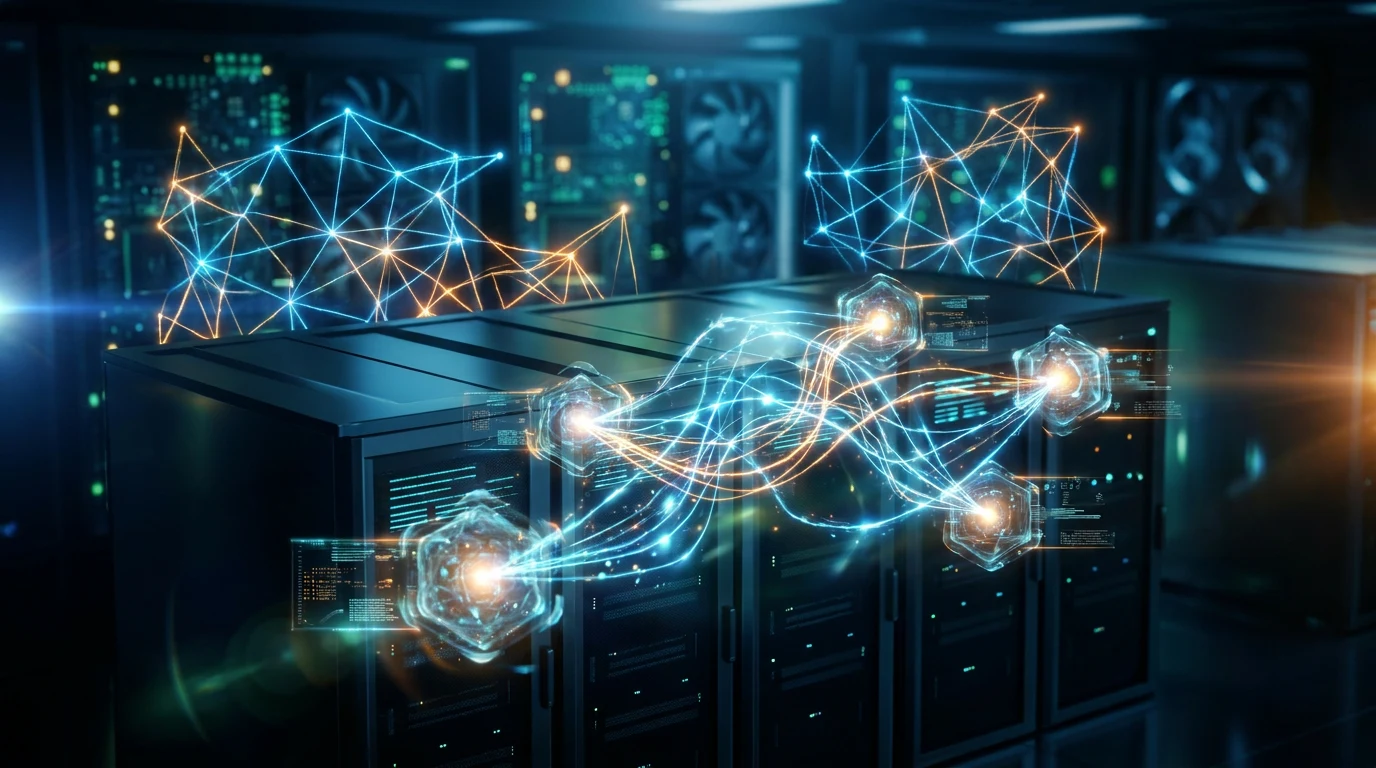
Single agents are powerful. Teams of specialized agents working together are transformative. Here's how multi-agent architectures are reshaping complex problem-solving.
Beyond Single-Agent Limitations
A single AI agent is like a single developer — capable, but limited by bandwidth and expertise. The breakthrough of 2025 isn't just better individual agents; it's multi-agent systems where specialized agents collaborate to solve problems none could tackle alone.
How Multi-Agent Systems Work
The architecture typically involves:
- Orchestrator Agent: Decomposes the task, assigns sub-tasks, manages coordination
- Specialist Agents: Each handles a specific domain — frontend, backend, testing, security review
- Critic Agent: Reviews outputs from other agents, catches errors, enforces quality
- Communication Protocol: Structured message passing between agents with shared context
Example: Building a Feature
Orchestrator: "Implement user notifications feature"
  → Frontend Agent: Creates notification UI components
  → Backend Agent: Builds notification API and WebSocket handler
  → Database Agent: Designs schema and writes migrations
  → Test Agent: Writes integration tests for each component
  → Security Agent: Reviews for XSS, injection, auth bypass
  → Orchestrator: Integrates outputs, resolves conflicts
Real-World Implementations
AutoGen (Microsoft)
Microsoft's AutoGen framework enables conversational multi-agent workflows. Agents discuss, debate, and refine solutions through structured dialogue. The key insight: agents improve their outputs when they have to defend their decisions to other agents.
CrewAI
CrewAI takes a role-based approach. You define agents with specific roles, goals, and backstories. A "Senior Backend Engineer" agent behaves differently from a "Junior QA Tester" agent — and the interaction between them produces more nuanced results.
LangGraph (LangChain)
LangGraph models multi-agent workflows as directed graphs. Each node is an agent or tool, edges define the flow. This gives fine-grained control over execution order and conditional branching.
The Emergent Behaviors
The most fascinating aspect of multi-agent systems is emergent behavior — capabilities that arise from interaction but weren't explicitly programmed:
- Self-correction through debate: When two agents disagree about an approach, the resolution often produces a better solution than either would have found alone
- Specialization pressure: Agents naturally develop more refined behaviors when they know other agents are checking their work
- Knowledge synthesis: A frontend agent and a backend agent together understand the full-stack implications in ways neither does alone
Challenges and Failure Modes
Multi-agent systems introduce new categories of failures:
- Coordination overhead: More agents means more communication, which can become a bottleneck
- Cascading hallucinations: If Agent A hallucinates, Agent B may build on that hallucination, amplifying the error
- Infinite loops: Agents can get stuck in cycles of correction and counter-correction
- Context fragmentation: Each agent has a partial view; no single agent holds the complete picture
When to Use Multi-Agent vs. Single-Agent
| Scenario | Best Approach |
|---|---|
| Simple bug fix | Single agent |
| Full feature implementation | Multi-agent |
| Code review | Two agents (author + reviewer) |
| Large refactoring | Multi-agent with orchestrator |
| Quick script/utility | Single agent |
The Future: Agent Organizations
The logical endpoint of multi-agent systems is agent organizations — persistent teams of agents that develop institutional knowledge over time, specialize in different aspects of a project, and coordinate like a software team. We're not there yet. But the foundations are being laid in 2025.
Subscribe to new posts from theaivibe.org
Related Posts

Anthropic's AI Protein Design Run, Number by Number: 354 Binders, 27%, and What It Doesn't Prove
Anthropic gave Claude an entire protein binder design campaign — target research, epitope choice, tool orchestration, ranking — and synthesised every design it returned. 354 of 1,320 bound. Here is every figure from the paper, including the three targets where it failed.

The Hidden Cost of Embedding Model Drift in Production RAG
Your vector index and your query encoder drifted apart months ago. Retrieval quality is quietly collapsing, and nothing in your observability stack noticed.

The Future of Local AI: Every AI Lab Should Redesign Its LLM Architecture to Run on Your Laptop
Kimi K3 proved open-weight LLMs can reach the frontier — and proved they're far too big to run where users actually are. The next race isn't a bigger model; it's the architecture review that puts frontier AI on an ordinary laptop.